
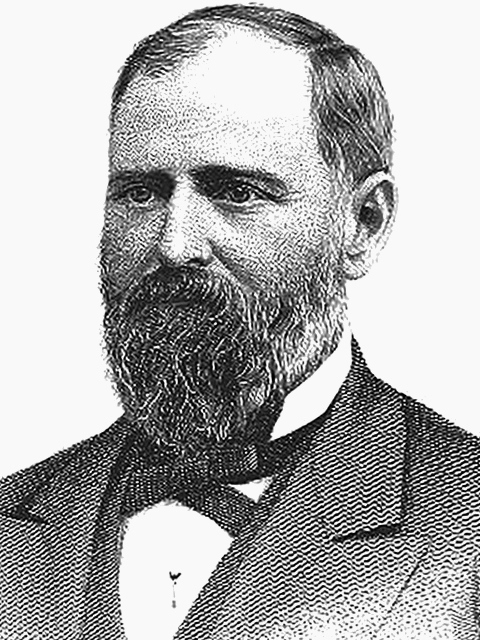
Historical · U.S. House · Ohio · District 18
Joseph Taylor
Former U.S. Representative · Ohio District 18 · 1881–1893 · Republican
Joseph Taylor represented Ohio's District 18 in the United States House of Representatives (1881–1893) for the Republican party. The page below collects sourced biographical facts, term history, committee roles, and provenance for Taylor.
Bioguide ID: T000093
Key facts
- Full name
- Joseph Taylor
- State
- Ohio
- District
- District 18
- Party
- Republican
- House service
- 1881–1893
- First House term
- 1881
- Status
- Left office
- Current term ends
- —
- Born
- 1830
- Bioguide ID
- T000093
- Committee assignments
- —
- Dataset version
- 1.20260606
Biographical narrative
965 words · sourced from the Wikipedia REST extract
Joseph Taylor was an American politician, lawyer, and newspaper publisher who served as a U.S. Representative for Ohio's 18th congressional district. A member of the Republican Party, Taylor's congressional career spanned over a decade, during which he was elected to five terms in the House of Representatives, including filling a vacancy and later securing multiple re-elections. His life and career were marked by significant contributions to both his local community and the nation, particularly during the tumultuous years of the Civil War and the post-war period.
Early life and career
Joseph D. Taylor was born on November 7, 1830, in Goshen Township, Belmont County, Ohio. He received his early education in the public schools of Belmont County, which laid the foundation for his future endeavors. Taylor pursued higher education at Madison College in Antrim, where he earned a teaching degree. His career in education began when he took a position at Fairview High School, where he taught from 1854 to 1856. His dedication and capabilities led to his appointment as principal of the school in 1857, showcasing his leadership and commitment to education.
Seeking to expand his professional horizons, Taylor transitioned from education to law. He enrolled at Cincinnati Law School, where he studied diligently and obtained his Bachelor of Laws (LL.B.) degree in 1860. His legal career began shortly thereafter, as he was admitted to the bar in 1859, allowing him to open his own law practice in 1860. In addition to his legal work, Taylor ventured into journalism by founding the Guernsey Times newspaper in 1861. He owned and operated the publication until 1871, during which he gained prominence as a writer and commentator on various issues, including social justice and civil rights. His articles often denounced slavery and advocated for negotiations to end the practice, reflecting his strong moral convictions.
As the nation approached the Civil War, Taylor's commitment to the Union led him to enlist in the military. He joined the 88th Ohio Infantry as a captain, where he served with distinction. His military service included a role as judge advocate from 1863 until the conclusion of the war in 1865. Following his service, he returned to his legal practice and also served as the prosecuting attorney for Guernsey County from 1863 to 1866, further solidifying his reputation in the legal community.
House tenure
Taylor's political career began to take shape as he became increasingly involved in public service. He was a delegate to the National Union Convention in 1866 and participated in local governance as a member of the Cambridge School Board from 1870 to 1877. His engagement with the Republican Party included serving as a delegate to the Republican National Conventions in 1876 and 1880, where he contributed to the party's platform and direction during a critical period in American politics.
In 1881, Taylor was elected as a Republican to the United States House of Representatives, filling the vacancy left by the death of Jonathan T. Updegraff. His initial term in the Forty-seventh Congress marked the beginning of a significant congressional career. He was subsequently re-elected to the Forty-eighth Congress, serving until 1885. Although he faced a setback in his re-election bid during that year, Taylor's political aspirations did not wane. He returned to the political arena and successfully campaigned for the Fiftieth, Fifty-first, and Fifty-second Congresses, serving from March 4, 1887, until March 3, 1893. Throughout his tenure, Taylor was involved in various legislative matters that addressed the needs and concerns of his constituents in Ohio.
Taylor's time in Congress was characterized by his commitment to representing the interests of his district and contributing to national discussions on pressing issues. His experience as a lawyer and newspaper publisher likely informed his legislative priorities and approach to governance. Although specific legislative achievements during his terms are not detailed, his sustained presence in the House indicates a dedication to public service and a desire to influence policy on behalf of his constituents.
Legislative focus and committees
During his time in the House of Representatives, Joseph Taylor's legislative focus encompassed a range of issues pertinent to his constituents and the broader national context. While specific bills and legislative initiatives are not documented in the available information, Taylor's background as a lawyer and newspaper publisher suggests that he was likely engaged in discussions surrounding legal reform, civil rights, and economic development. His early advocacy against slavery and for civil rights may have continued to inform his legislative priorities as he addressed the needs of a post-Civil War America.
As a member of the Republican Party during a time of significant political transformation, Taylor would have participated in debates and decisions that shaped the direction of the nation. The late 19th century was marked by industrialization, economic expansion, and social change, all of which would have influenced the legislative agenda. Taylor's role in Congress would have involved collaboration with fellow lawmakers, participation in committee work, and engagement with constituents to understand their needs and concerns.
In addition to his legislative duties, Taylor's involvement in local governance and community development continued after his congressional career. Following his retirement from politics, he remained an influential figure in the growth and development of Guernsey County and the city of Cambridge. His contributions to the community extended beyond his time in office, as he continued to advocate for local issues and support initiatives that benefited the residents of his district.
Joseph Taylor passed away on September 19, 1899, in Cambridge, Ohio, at the age of 68. His legacy as a public servant, lawyer, and newspaper publisher is remembered in the context of his contributions to both local and national affairs. He was interred in the South Cemetery in Cambridge, leaving behind a history marked by dedication to public service, legal advocacy, and community engagement.
Notable legislation
Sponsored and co-sponsored legislation for Joseph Taylor is pending operator curation. The biographical narrative above carries the same provenance trail until per-bill rows are written.
Sources
- [1]https://en.wikipedia.org/wiki/Joseph_D._TaylorWikipedia · retrieved 2026-06-06
Notable quotes
Sourced quotes for Joseph Taylor are pending operator curation. Narrative-scope provenance remains attached below.
Sources
- [1]https://en.wikipedia.org/wiki/Joseph_D._TaylorWikipedia · retrieved 2026-06-06
Key positions
Curated policy positions for Joseph Taylor are pending operator review. The biographical narrative above carries the same provenance trail until per-topic positions are written.
Sources
- [1]https://en.wikipedia.org/wiki/Joseph_D._TaylorWikipedia · retrieved 2026-06-06
Terms served
- 1881–1883U.S. House · Term 1 · Republican
- 1883–1885U.S. House · Term 2 · Republican
- 1887–1889U.S. House · Term 3 · Republican
- 1889–1891U.S. House · Term 4 · Republican
- 1891–1893U.S. House · Term 5 · Republican
Sources & provenance
Every attributable claim above carries a per-section [N] marker that resolves to the corresponding URL below. Each entry records the upstream provider, the canonical URL, and the timestamp at which the source was retrieved by the ingest pipeline.
Key facts
- https://bioguide.congress.gov/search/bio/T000093bioguide · retrieved 2026-06-06
- https://www.govtrack.us/congress/members/410676govtrack · retrieved 2026-06-06
Biographical narrative
- https://en.wikipedia.org/wiki/Joseph_D._Taylorwikipedia · retrieved 2026-06-06
Find your representative
Every U.S. state elects representatives by district. Browse Ohio’s delegation, the full former-representative roster, or explore the role and term length.
Related on The Candidate
- Preceded by William UpsonEarlier holder of the Ohio District 18 House seat · Republican.Open
- Succeeded by George IkirtLater holder of the Ohio District 18 House seat · Democratic.Open
- Aaron PerryFormer U.S. Representative · Ohio District 1 · RepublicanOpen
- Alexander DuncanFormer U.S. Representative · Ohio District 1 · DemocraticOpen
- Bellamy StorerFormer U.S. Representative · Ohio District 1 · WhigOpen
- Bellamy StorerFormer U.S. Representative · Ohio District 1 · RepublicanOpen