
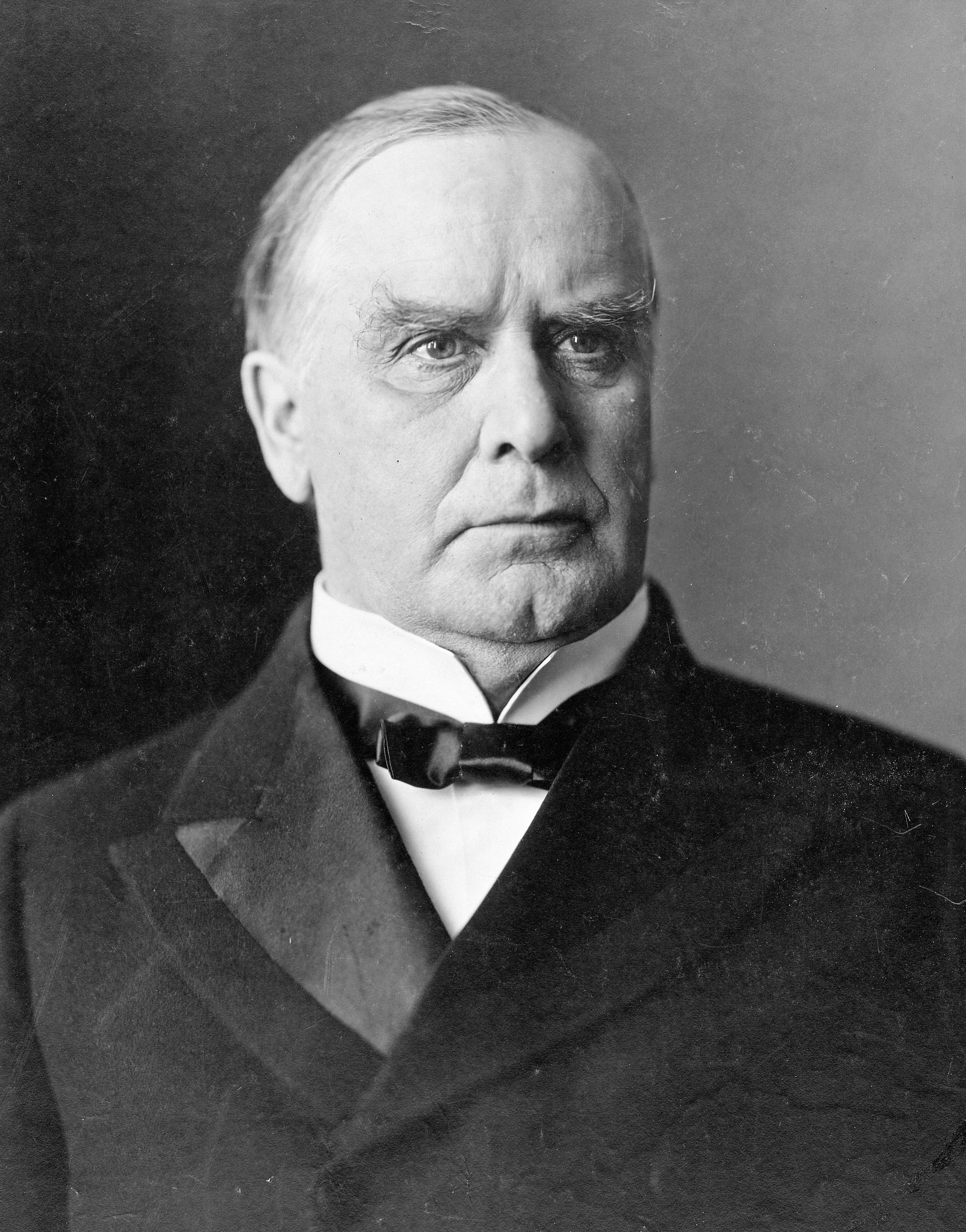
Historical · U.S. House · Ohio · District 18
William McKinley Jr.
Former U.S. Representative · Ohio District 18 · 1877–1891 · Republican
William McKinley Jr. represented Ohio's District 18 in the United States House of Representatives (1877–1891) for the Republican party. The page below collects sourced biographical facts, term history, committee roles, and provenance for Jr..
Bioguide ID: M000522
Key facts
- Full name
- William McKinley Jr.
- State
- Ohio
- District
- District 18
- Party
- Republican
- House service
- 1877–1891
- First House term
- 1877
- Status
- Left office
- Current term ends
- —
- Born
- 1843
- Bioguide ID
- M000522
- Committee assignments
- —
- Dataset version
- 1.20260606
Biographical narrative
929 words · sourced from the Wikipedia REST extract
William McKinley Jr. was a prominent American politician who served as a U.S. Representative from Ohio's 18th congressional district. A member of the Republican Party, he held office from 1877 until 1891, completing a total of seven terms in the House of Representatives. McKinley is perhaps best known for his later role as the 25th President of the United States, a position he held from 1897 until his assassination in 1901. His legislative career laid the groundwork for his presidency, during which he became a key figure in American economic policy and foreign affairs.
Early life and career
William McKinley Jr. was born on January 29, 1843, in Niles, Ohio. He was the seventh of nine children born to William McKinley Sr. and Nancy Allison McKinley. The McKinley family had roots tracing back to English and Scots-Irish ancestry, with their immigrant ancestor, David McKinley, originating from County Antrim in present-day Northern Ireland. The family moved to Ohio during McKinley Sr.'s childhood, settling in New Lisbon, where he later met and married Nancy Allison, a member of one of Pennsylvania's earliest settler families.
The McKinley household was influenced by the family's involvement in iron making, with McKinley Sr. operating foundries across various locations in Ohio, including New Lisbon, Niles, Poland, and Canton. The family's values were shaped by a strong Whiggish and abolitionist sentiment, rooted in their Methodist beliefs. This religious background played a significant role in shaping McKinley's character, as he became actively involved in the local Methodist church at the age of sixteen and maintained a lifelong commitment to his faith.
In 1852, the family relocated from Niles to Poland, Ohio, to provide their children with access to better educational opportunities. McKinley graduated from Poland Seminary in 1859 and subsequently enrolled at Allegheny College in Meadville, Pennsylvania. He was an honorary member of the Sigma Alpha Epsilon fraternity during his time there. However, after one year at Allegheny, McKinley returned home due to health issues and depression. He also studied at Mount Union College, where he later served on the board of trustees. Despite recovering his health, financial difficulties prevented him from returning to Allegheny, leading him to work as a postal clerk and later as a teacher at a local school.
With the outbreak of the American Civil War in 1861, McKinley enlisted in the Union Army, joining the 23rd Ohio Volunteer Infantry. He served with distinction throughout the war, rising through the ranks from private to brevet major. His military service during this tumultuous period not only shaped his character but also influenced his later political career, as he became known for his strong support of the Union cause.
House tenure
William McKinley began his congressional career in 1877 when he was elected to represent Ohio's 18th congressional district. His tenure in the House of Representatives spanned a total of seven terms, during which he established himself as a leading figure in the Republican Party. McKinley's early legislative focus centered on economic issues, particularly the protective tariff, which he believed was essential for fostering American industry and ensuring economic prosperity.
As a member of Congress, McKinley became known as the Republican expert on tariff policy. He argued that protective tariffs would shield American manufacturers from foreign competition, thereby promoting job growth and economic stability. His advocacy for protectionism culminated in the introduction of the McKinley Tariff in 1890, which aimed to raise tariffs on imported goods. However, this legislation proved to be highly controversial and contributed to his defeat in the 1890 elections, as the Democratic Party capitalized on public discontent with the tariff and redistricting efforts aimed at diminishing his influence.
Despite this setback, McKinley remained active in Ohio politics and was elected governor of Ohio in 1891, a position he held until 1893. His governorship allowed him to further develop his political skills and establish connections within the Republican Party, setting the stage for his future presidential aspirations.
Legislative focus and committees
During his time in the House of Representatives, McKinley served on various committees, where he played a significant role in shaping economic policy. His primary focus was on tariff legislation, which he viewed as a means to protect American industries and workers. McKinley's commitment to protectionism was rooted in his belief that a strong domestic economy would lead to overall national prosperity.
In addition to his work on tariffs, McKinley was involved in other legislative matters that reflected the interests of his constituents and the broader Republican agenda. He supported measures that aimed to promote economic growth, including initiatives related to infrastructure development and trade. His legislative efforts were characterized by a pragmatic approach, seeking to balance the interests of various stakeholders, including labor and business.
McKinley's tenure in the House was marked by significant political developments, including shifts in party dynamics and evolving public opinion on economic issues. His ability to navigate these changes and maintain his position as a leading Republican figure contributed to his eventual nomination for the presidency in 1896. His experiences in the House provided him with valuable insights into the legislative process and the complexities of governance, which he would later apply during his presidency.
In summary, William McKinley Jr.'s early life and congressional career laid the foundation for his later achievements as President of the United States. His commitment to protectionism and economic growth, coupled with his military service and political acumen, positioned him as a significant figure in American politics during a transformative era. His legacy continues to be studied and analyzed as part of the broader narrative of American history.
Notable legislation
Sponsored and co-sponsored legislation for William McKinley Jr. is pending operator curation. The biographical narrative above carries the same provenance trail until per-bill rows are written.
Sources
- [1]https://en.wikipedia.org/wiki/William_McKinleyWikipedia · retrieved 2026-06-06
Notable quotes
Sourced quotes for William McKinley Jr. are pending operator curation. Narrative-scope provenance remains attached below.
Sources
- [1]https://en.wikipedia.org/wiki/William_McKinleyWikipedia · retrieved 2026-06-06
Key positions
Curated policy positions for William McKinley Jr. are pending operator review. The biographical narrative above carries the same provenance trail until per-topic positions are written.
Sources
- [1]https://en.wikipedia.org/wiki/William_McKinleyWikipedia · retrieved 2026-06-06
Terms served
- 1877–1879U.S. House · Term 1 · Republican
- 1879–1881U.S. House · Term 2 · Republican
- 1881–1883U.S. House · Term 3 · Republican
- 1883–1885U.S. House · Term 4 · Republican
- 1885–1887U.S. House · Term 5 · Republican
- 1887–1889U.S. House · Term 6 · Republican
- 1889–1891U.S. House · Term 7 · Republican
Sources & provenance
Every attributable claim above carries a per-section [N] marker that resolves to the corresponding URL below. Each entry records the upstream provider, the canonical URL, and the timestamp at which the source was retrieved by the ingest pipeline.
Key facts
- https://bioguide.congress.gov/search/bio/M000522bioguide · retrieved 2026-06-06
- https://www.govtrack.us/congress/members/407515govtrack · retrieved 2026-06-06
Biographical narrative
- https://en.wikipedia.org/wiki/William_McKinleywikipedia · retrieved 2026-06-06
Find your representative
Every U.S. state elects representatives by district. Browse Ohio’s delegation, the full former-representative roster, or explore the role and term length.
Related on The Candidate
- Preceded by William UpsonEarlier holder of the Ohio District 18 House seat · Republican.Open
- Succeeded by George IkirtLater holder of the Ohio District 18 House seat · Democratic.Open
- Aaron PerryFormer U.S. Representative · Ohio District 1 · RepublicanOpen
- Alexander DuncanFormer U.S. Representative · Ohio District 1 · DemocraticOpen
- Bellamy StorerFormer U.S. Representative · Ohio District 1 · WhigOpen
- Bellamy StorerFormer U.S. Representative · Ohio District 1 · RepublicanOpen