
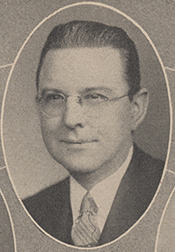
Historical · U.S. House · Ohio · District 3
Edward Gardner
Former U.S. Representative · Ohio District 3 · 1945–1947 · Democratic
Edward Gardner represented Ohio's District 3 in the United States House of Representatives (1945–1947) for the Democratic party. The page below collects sourced biographical facts, term history, committee roles, and provenance for Gardner.
Bioguide ID: G000051
Key facts
- Full name
- Edward Gardner
- State
- Ohio
- District
- District 3
- Party
- Democratic
- House service
- 1945–1947
- First House term
- 1945
- Status
- Left office
- Current term ends
- —
- Born
- 1898
- Bioguide ID
- G000051
- Committee assignments
- —
- Dataset version
- 1.20260605
Biographical narrative
861 words · sourced from the Wikipedia REST extract
Edward Joseph Gardner was an American businessman and politician who served as a U.S. Representative for Ohio's third congressional district from 1945 to 1947. A member of the Democratic Party, Gardner's political career was marked by his commitment to issues affecting returning servicemen and economic security in the post-World War II era. His tenure in the House of Representatives was characterized by his support for wartime policies and labor rights, although he ultimately faced challenges in his reelection bid amid a shifting political landscape.
Early life and career
Edward Joseph Gardner was born on August 7, 1898, in Hamilton, Ohio. He was the son of Edward Gardner, an immigrant from Ireland, and Mary Gardner, who was born in Ohio. Growing up in Hamilton, Gardner attended local parochial schools, which laid the foundation for his later educational pursuits. He graduated from the College of Commerce and Finance at St. Xavier University in 1920, where he developed a strong background in business and finance. Following his undergraduate studies, Gardner furthered his education with graduate work at the Wharton School of Business at the University of Pennsylvania and the University of Cincinnati.
Gardner's early career was shaped by his service in the military during World War I. He enlisted in the United States Army in 1918, serving as a private. This experience likely influenced his later political focus on veterans' issues. After the war, he transitioned into the business sector, initially working as a district controller for a food distributing company in Philadelphia for four years. In 1924, he returned to Hamilton, where he established himself as a public accountant, a profession he would maintain until his death in 1950.
Gardner's entry into politics began in 1926 when he was elected to the Hamilton city council. His leadership abilities were recognized during his tenure, as he served as both president and vice mayor for two years. His political career continued to evolve, and in 1937, he was elected to the Ohio House of Representatives. He successfully secured reelection in 1941, serving two-year terms in the state legislature, where he gained valuable experience in governance and public service.
House tenure
In 1944, Gardner was elected as a Democrat to the Seventy-ninth Congress, representing Ohio's third congressional district. His campaign emphasized his dedication to addressing the needs of returning servicemen, a pressing concern in the aftermath of World War II. Gardner articulated a vision focused on job creation and economic security, advocating for policies that would ensure employment opportunities and wage stability for veterans reentering the workforce.
During his time in Congress, Gardner was involved in various legislative efforts that reflected the priorities of his constituents and the broader national context. He supported a temporary extension of wartime price controls, which were designed to stabilize the economy during the transition from wartime to peacetime conditions. Additionally, he endorsed the continuation of the draft, recognizing the ongoing need for military preparedness in the post-war period. Gardner also championed the rights of workers, advocating for labor rights, including the right to strike, which was a significant issue during a time of economic adjustment and labor unrest.
Despite his efforts and commitment to his constituents, Gardner faced challenges in his reelection campaign in 1946. The political climate was shifting, and President Harry S. Truman's unpopularity had a considerable impact on Democratic candidates across the country. Gardner's bid for a second term was ultimately unsuccessful, and he left office on January 3, 1947.
Legislative focus and committees
During his single term in the House of Representatives, Gardner's legislative focus was primarily centered on issues pertinent to returning veterans and the economic challenges of the post-war era. His advocacy for employment and economic security resonated with many constituents who were navigating the complexities of reintegration into civilian life after military service. Gardner's support for maintaining wartime price controls highlighted his concern for inflation and the cost of living, which were critical issues as the nation transitioned from a wartime economy.
In addition to his focus on economic issues, Gardner's support for labor rights reflected a broader movement within the Democratic Party during this period. His endorsement of the right to strike indicated a commitment to protecting workers' rights and ensuring fair labor practices, which were essential components of the post-war labor landscape.
Although specific details regarding the committees on which Gardner served during his congressional tenure are not provided, it is common for representatives to align their committee work with their legislative priorities. Given his background in finance and public accounting, it is plausible that he may have participated in committees related to economic policy, labor, or veterans' affairs, aligning with his advocacy for job creation and support for servicemen.
After leaving Congress, Gardner returned to Hamilton, where he continued his work as a public accountant. His professional career in accounting and his prior political experience contributed to his understanding of the economic challenges facing his community. Gardner passed away on December 7, 1950, in Hamilton, Ohio. He was interred at St. Mary's Cemetery, leaving behind a legacy as a public servant committed to the welfare of his constituents and the principles of economic security and labor rights.
Notable legislation
Sponsored and co-sponsored legislation for Edward Gardner is pending operator curation. The biographical narrative above carries the same provenance trail until per-bill rows are written.
Sources
- [1]https://en.wikipedia.org/wiki/Edward_Joseph_GardnerWikipedia · retrieved 2026-06-05
Notable quotes
Sourced quotes for Edward Gardner are pending operator curation. Narrative-scope provenance remains attached below.
Sources
- [1]https://en.wikipedia.org/wiki/Edward_Joseph_GardnerWikipedia · retrieved 2026-06-05
Key positions
Curated policy positions for Edward Gardner are pending operator review. The biographical narrative above carries the same provenance trail until per-topic positions are written.
Sources
- [1]https://en.wikipedia.org/wiki/Edward_Joseph_GardnerWikipedia · retrieved 2026-06-05
Terms served
- 1945–1947U.S. House · Term 1 · Democratic
Sources & provenance
Every attributable claim above carries a per-section [N] marker that resolves to the corresponding URL below. Each entry records the upstream provider, the canonical URL, and the timestamp at which the source was retrieved by the ingest pipeline.
Key facts
- https://bioguide.congress.gov/search/bio/G000051bioguide · retrieved 2026-06-05
- https://www.govtrack.us/congress/members/404425govtrack · retrieved 2026-06-05
Biographical narrative
- https://en.wikipedia.org/wiki/Edward_Joseph_Gardnerwikipedia · retrieved 2026-06-05
Find your representative
Every U.S. state elects representatives by district. Browse Ohio’s delegation, the full former-representative roster, or explore the role and term length.
Related on The Candidate
- Preceded by Harry JeffreyEarlier holder of the Ohio District 3 House seat · Republican.Open
- Succeeded by Raymond BurkeLater holder of the Ohio District 3 House seat · Republican.Open
- Aaron PerryFormer U.S. Representative · Ohio District 1 · RepublicanOpen
- Alexander DuncanFormer U.S. Representative · Ohio District 1 · DemocraticOpen
- Bellamy StorerFormer U.S. Representative · Ohio District 1 · WhigOpen
- Bellamy StorerFormer U.S. Representative · Ohio District 1 · RepublicanOpen