
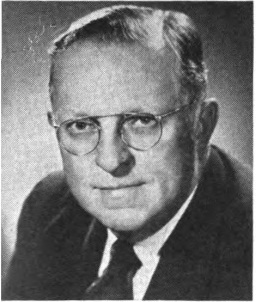
Historical · U.S. House · Ohio · District 3
Paul Schenck
Former U.S. Representative · Ohio District 3 · 1951–1965 · Republican
Paul Schenck represented Ohio's District 3 in the United States House of Representatives (1951–1965) for the Republican party. The page below collects sourced biographical facts, term history, committee roles, and provenance for Schenck.
Bioguide ID: S000117
Key facts
- Full name
- Paul Schenck
- State
- Ohio
- District
- District 3
- Party
- Republican
- House service
- 1951–1965
- First House term
- 1951
- Status
- Left office
- Current term ends
- —
- Born
- 1899
- Bioguide ID
- S000117
- Committee assignments
- —
- Dataset version
- 1.20260605
Biographical narrative
931 words · sourced from the Wikipedia REST extract
Paul Schenck was an American educator and politician who served as a U.S. Representative for Ohio's third congressional district from 1951 until 1965. A member of the Republican Party, Schenck was elected to seven consecutive terms in the House of Representatives, where he engaged in various legislative efforts and contributed to the political landscape of his time. His career spanned a significant period in American history, marked by social change and legislative reform.
Early life and career
Paul Fornshell Schenck was born on April 19, 1899, in Miamisburg, Ohio. His family relocated to Dayton, Ohio, in 1908, where he would later complete his secondary education at Steele High School, graduating in 1917. Following high school, Schenck pursued further education, receiving two years of college training. During this period, he also worked as a student teacher at Steele High School from 1917 to 1919, marking the beginning of his long association with education.
After his initial foray into teaching, Schenck transitioned to the automotive service industry, where he worked from 1919 to 1923. This experience in the automotive sector would later inform his legislative interests, particularly regarding issues related to vehicle emissions and public health. In 1923, he returned to education as an automotive training teacher and served as the faculty manager of athletics at Roosevelt High School in Dayton until 1929. His early career in education and athletics laid a foundation for his later public service.
Schenck's involvement in public service began in earnest when he was appointed as the director of recreation for the city of Dayton from 1929 to 1935. This role allowed him to engage with the community and develop programs that would benefit local residents. In September 1935, during the challenging economic conditions of the Great Depression, he established his own business in real estate, mortgage loans, and insurance. This entrepreneurial venture not only contributed to his professional development but also expanded his influence within the community.
In addition to his business pursuits, Schenck entered the political arena by being elected to the Dayton Board of Education, where he served from 1941 to 1950. His leadership capabilities were recognized when he was appointed president of the board for seven years. During this time, he was also active in other civic organizations, serving as vice chairman of the Dayton Safety Council in 1946 and 1947 and as president of the Dayton Real Estate Board from 1947 to 1949. These roles further solidified his reputation as a dedicated public servant and community leader.
House tenure
Schenck's political career took a significant turn when he was nominated by the Republican Party to run for Congress from Ohio's third congressional district in 1950. Although he initially faced defeat against the incumbent Edward G. Breen, the political landscape shifted when Breen resigned in 1951 due to health issues. This vacancy provided an opportunity for Schenck, who was subsequently elected in a special election to fill the seat in the 82nd Congress.
Following his initial election, Schenck was reelected to the 83rd Congress and subsequently to five additional terms, serving from November 6, 1951, until January 3, 1965. His tenure in the House of Representatives was marked by active participation in various legislative matters, particularly those concerning public health and civil rights. However, his political career faced a setback in 1964 when he was defeated in his bid for reelection to the 89th Congress.
During his time in Congress, Schenck was a member of the Committee on Interstate and Foreign Commerce, which played a crucial role in shaping policies related to transportation, communication, and commerce. His involvement in this committee allowed him to address pressing issues of the time, particularly those related to the automotive industry and its impact on public health.
Legislative focus and committees
Throughout his congressional career, Schenck demonstrated a commitment to addressing the growing concerns about environmental issues, particularly in relation to automobile emissions. In 1957, he introduced a bill aimed at prohibiting the sale of vehicles that discharged hydrocarbons at levels deemed dangerous by the Surgeon General. Although this legislation did not pass in its original form, it reflected the increasing national awareness of the need for environmental regulation and public health protection.
Schenck's efforts in this area culminated in 1959 when President Dwight D. Eisenhower signed a modified version of his proposed legislation, known as the Schenck Act. This law mandated that the Surgeon General study the relationship between auto pollution and public health, highlighting Schenck's foresight regarding the implications of automotive emissions on community health and safety.
In addition to his environmental initiatives, Schenck was also an advocate for civil rights. He voted in favor of significant civil rights legislation, including the Civil Rights Acts of 1957, 1960, and 1964. These votes demonstrated his alignment with the broader movement for civil rights during a transformative period in American history, as the nation grappled with issues of racial equality and justice.
Beyond his legislative activities, Schenck was involved in various community organizations and civic groups. He was a Freemason and a member of the Shriners, specifically the Antioch Temple, reflecting his engagement in social and philanthropic activities outside of his political responsibilities.
Paul F. Schenck passed away on November 30, 1968, in Dayton, Ohio. He is interred in Woodland Cemetery, where his contributions to education, public service, and legislative reform are remembered. His career as a U.S. Representative was characterized by a dedication to addressing the needs of his constituents and engaging with the pressing issues of his time, leaving a legacy that continues to resonate in discussions of public policy and civic engagement.
Notable legislation
Sponsored and co-sponsored legislation for Paul Schenck is pending operator curation. The biographical narrative above carries the same provenance trail until per-bill rows are written.
Sources
- [1]https://en.wikipedia.org/wiki/Paul_F._SchenckWikipedia · retrieved 2026-06-05
Notable quotes
Sourced quotes for Paul Schenck are pending operator curation. Narrative-scope provenance remains attached below.
Sources
- [1]https://en.wikipedia.org/wiki/Paul_F._SchenckWikipedia · retrieved 2026-06-05
Key positions
Curated policy positions for Paul Schenck are pending operator review. The biographical narrative above carries the same provenance trail until per-topic positions are written.
Sources
- [1]https://en.wikipedia.org/wiki/Paul_F._SchenckWikipedia · retrieved 2026-06-05
Terms served
- 1951–1953U.S. House · Term 1 · Republican
- 1953–1955U.S. House · Term 2 · Republican
- 1955–1957U.S. House · Term 3 · Republican
- 1957–1959U.S. House · Term 4 · Republican
- 1959–1961U.S. House · Term 5 · Republican
- 1961–1963U.S. House · Term 6 · Republican
- 1963–1965U.S. House · Term 7 · Republican
Sources & provenance
Every attributable claim above carries a per-section [N] marker that resolves to the corresponding URL below. Each entry records the upstream provider, the canonical URL, and the timestamp at which the source was retrieved by the ingest pipeline.
Key facts
- https://bioguide.congress.gov/search/bio/S000117bioguide · retrieved 2026-06-05
- https://www.govtrack.us/congress/members/409625govtrack · retrieved 2026-06-05
Biographical narrative
- https://en.wikipedia.org/wiki/Paul_F._Schenckwikipedia · retrieved 2026-06-05
Find your representative
Every U.S. state elects representatives by district. Browse Ohio’s delegation, the full former-representative roster, or explore the role and term length.
Related on The Candidate
- Preceded by Raymond BurkeEarlier holder of the Ohio District 3 House seat · Republican.Open
- Succeeded by Rodney LoveLater holder of the Ohio District 3 House seat · Democratic.Open
- Aaron PerryFormer U.S. Representative · Ohio District 1 · RepublicanOpen
- Alexander DuncanFormer U.S. Representative · Ohio District 1 · DemocraticOpen
- Bellamy StorerFormer U.S. Representative · Ohio District 1 · WhigOpen
- Bellamy StorerFormer U.S. Representative · Ohio District 1 · RepublicanOpen