
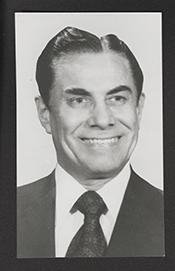
Historical · U.S. House · Ohio · District 4
Tennyson Guyer
Former U.S. Representative · Ohio District 4 · 1973–1983 · Republican
Tennyson Guyer represented Ohio's District 4 in the United States House of Representatives (1973–1983) for the Republican party. The page below collects sourced biographical facts, term history, committee roles, and provenance for Guyer.
Bioguide ID: G000537
Key facts
- Full name
- Tennyson Guyer
- State
- Ohio
- District
- District 4
- Party
- Republican
- House service
- 1973–1983
- First House term
- 1973
- Status
- Left office
- Current term ends
- —
- Born
- 1913
- Bioguide ID
- G000537
- Committee assignments
- —
- Dataset version
- 1.20260605
Biographical narrative
939 words · sourced from the Wikipedia REST extract
Tennyson Guyer was a Republican politician who served as a U.S. Representative for Ohio's 4th congressional district from 1973 until his death in 1981. His tenure in the House of Representatives was marked by a commitment to public service and active engagement in various legislative initiatives, particularly in the area of drug policy. Before entering Congress, Guyer had a diverse career that included roles in local government and the private sector, reflecting a long-standing dedication to his community and the state of Ohio.
Early life and career
Tennyson Guyer was born on November 29, 1912 or 1913, in Findlay, Ohio. He grew up in a challenging environment, as his father passed away from a heart attack when Guyer was just 12 years old. Following this tragedy, he moved in with his uncle, which provided him with a stable home during his formative years. Guyer received his education in the public schools of Findlay, where he demonstrated a flair for performance early on, notably as an aerialist with the Hagenbeck-Wallace Circus.
In 1934, Guyer earned a Bachelor of Science degree from Findlay College. Following his graduation, he pursued a career in ministry and became an ordained minister. His commitment to public service was evident early in his career when he served as the mayor of Celina, Ohio, from 1940 to 1944. This role marked the beginning of his political journey, which would continue for several decades.
In addition to his mayoral duties, Guyer was active in the Ohio Republican Party. He served on the state central committee from 1954 to 1966, contributing to the party's local and state-level strategies. His professional life also included a significant tenure as the public affairs director for Cooper Tire & Rubber Company in Findlay, a position he held from 1950 until 1972. This role allowed him to engage with various community and business leaders, further enhancing his reputation as a dedicated public servant.
Guyer’s political career continued to evolve when he was elected to the Ohio State Senate, where he served from 1959 to 1972. His involvement in state politics was complemented by his participation as a delegate to the Ohio State Republican conventions from 1950 to 1957, and he also attended the Republican National Convention in 1956. These experiences laid the groundwork for his eventual election to the U.S. Congress.
House tenure
Tennyson Guyer was elected to the United States House of Representatives as a Republican in 1972, beginning his first term on January 3, 1973. Over the course of his congressional career, he was re-elected four times, serving a total of five terms in office. His tenure in the House was characterized by active participation in legislative processes and a focus on issues pertinent to his constituents in Ohio's 4th congressional district.
During his time in Congress, Guyer was known for his commitment to addressing various national issues. One of his notable roles was as the chairman of the Cocaine Task Force in 1979, where he worked to combat the growing problem of drug abuse in the United States. His leadership in this area highlighted his dedication to public health and safety, as well as his responsiveness to the concerns of his constituents regarding drug-related issues.
Guyer’s congressional activities were not limited to domestic policy; he also traveled extensively across the country and internationally to deliver speeches and represent the interests of his district. His engagement in public speaking allowed him to advocate for various causes and connect with a broader audience, further amplifying his influence as a legislator.
Throughout his time in office, Guyer maintained a focus on the needs of his constituents, often addressing local concerns and working to secure funding for projects that would benefit Ohio. His ability to navigate the complexities of federal legislation and advocate for his district contributed to his reputation as a dedicated public servant.
Legislative focus and committees
During his tenure in the House of Representatives, Tennyson Guyer served on several committees that aligned with his legislative interests and the needs of his constituents. While specific committee assignments are not detailed in the available information, it is common for members of Congress to serve on committees that oversee areas such as public health, education, and local infrastructure, among others. Guyer’s background in public affairs and local government likely informed his contributions to these discussions.
His leadership of the Cocaine Task Force in 1979 was a significant aspect of his legislative focus, reflecting a broader national concern about drug abuse during that era. This role demonstrated his commitment to addressing pressing social issues and working collaboratively with other lawmakers to develop effective policies aimed at curbing drug use and its associated problems.
Guyer’s legislative efforts were also characterized by a strong emphasis on community engagement. He was known for his willingness to listen to the concerns of his constituents and to advocate for their needs at the federal level. This approach was indicative of his belief in the importance of representation and accountability in government.
In summary, Tennyson Guyer’s career as a U.S. Representative was marked by a dedication to public service, a focus on drug policy, and a commitment to addressing the needs of his constituents in Ohio. His diverse background in local government, business, and ministry provided him with a unique perspective that informed his legislative priorities and actions. Guyer passed away on April 12, 1981, while still in office, leaving behind a legacy of public service that reflected his lifelong dedication to his community and country. He was interred in Maple Grove Cemetery in Findlay, Ohio, where he is remembered for his contributions to both local and national politics.
Notable legislation
Sponsored and co-sponsored legislation for Tennyson Guyer is pending operator curation. The biographical narrative above carries the same provenance trail until per-bill rows are written.
Sources
- [1]https://en.wikipedia.org/wiki/Tennyson_GuyerWikipedia · retrieved 2026-06-05
Notable quotes
Sourced quotes for Tennyson Guyer are pending operator curation. Narrative-scope provenance remains attached below.
Sources
- [1]https://en.wikipedia.org/wiki/Tennyson_GuyerWikipedia · retrieved 2026-06-05
Key positions
Curated policy positions for Tennyson Guyer are pending operator review. The biographical narrative above carries the same provenance trail until per-topic positions are written.
Sources
- [1]https://en.wikipedia.org/wiki/Tennyson_GuyerWikipedia · retrieved 2026-06-05
Terms served
- 1973–1975U.S. House · Term 1 · Republican
- 1975–1977U.S. House · Term 2 · Republican
- 1977–1979U.S. House · Term 3 · Republican
- 1979–1981U.S. House · Term 4 · Republican
- 1981–1983U.S. House · Term 5 · Republican
Sources & provenance
Every attributable claim above carries a per-section [N] marker that resolves to the corresponding URL below. Each entry records the upstream provider, the canonical URL, and the timestamp at which the source was retrieved by the ingest pipeline.
Key facts
- https://bioguide.congress.gov/search/bio/G000537bioguide · retrieved 2026-06-05
- https://www.govtrack.us/congress/members/404880govtrack · retrieved 2026-06-05
Biographical narrative
- https://en.wikipedia.org/wiki/Tennyson_Guyerwikipedia · retrieved 2026-06-05
Find your representative
Every U.S. state elects representatives by district. Browse Ohio’s delegation, the full former-representative roster, or explore the role and term length.
Related on The Candidate
- Preceded by William McCullochEarlier holder of the Ohio District 4 House seat · Republican.Open
- Aaron PerryFormer U.S. Representative · Ohio District 1 · RepublicanOpen
- Alexander DuncanFormer U.S. Representative · Ohio District 1 · DemocraticOpen
- Bellamy StorerFormer U.S. Representative · Ohio District 1 · WhigOpen
- Bellamy StorerFormer U.S. Representative · Ohio District 1 · RepublicanOpen
- Republican PartyFederal candidates and office holders on the Republican line.Open