
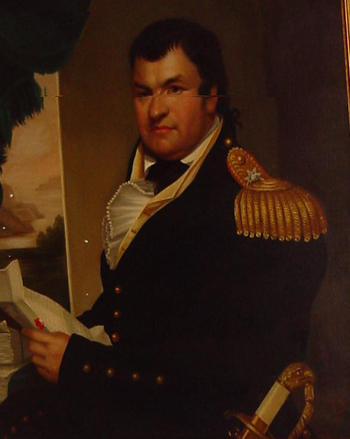
Historical · U.S. House · Ohio · District 6
Duncan McArthur
Former U.S. Representative · Ohio District 6 · 1813–1825
Duncan McArthur represented Ohio's District 6 in the United States House of Representatives (1813–1825). The page below collects sourced biographical facts, term history, committee roles, and provenance for McArthur.
Bioguide ID: M000299
Key facts
- Full name
- Duncan McArthur
- State
- Ohio
- District
- District 6
- Party
- —
- House service
- 1813–1825
- First House term
- 1813
- Status
- Left office
- Current term ends
- —
- Born
- 1772
- Bioguide ID
- M000299
- Committee assignments
- —
- Dataset version
- 1.20260606
Biographical narrative
807 words · sourced from the Wikipedia REST extract
Duncan McArthur was a notable figure in early American history, serving as a U.S. Representative from Ohio's 6th congressional district. His political career was marked by his involvement in the military during the War of 1812, as well as his subsequent roles in state governance. McArthur's life spanned from 1772 until 1839, during which he played a significant role in the development of Ohio and its governance, including a term as the state's governor.
Early life and career
Duncan McArthur was born on June 14, 1772, to Scottish immigrant parents in Dutchess County, New York, although some sources suggest alternative birthdates. His early years were spent in western Pennsylvania before he moved to Kentucky, where he worked as an Indian ranger. His military career began in 1790 when he volunteered at Fort Pitt for expeditions against Native American tribes during the Northwest Indian War. He served as a scout under prominent military leaders such as Generals Josiah Harmar and Anthony Wayne.
In 1793, McArthur joined Nathaniel Massie, a prominent land surveyor, on an expedition in the Northwest Territory. This collaboration was significant as it laid the groundwork for McArthur's future endeavors in land speculation. By 1796, he was instrumental in the establishment of Chillicothe, Ohio, which would later become the state capital in 1803. McArthur relocated across the Ohio River to Chillicothe in 1797, where he engaged in land speculation, accumulating wealth and influence in the region.
During the War of 1812, McArthur was elected to the United States House of Representatives representing Ohio's 3rd congressional district. However, he did not formally assume office as he chose to continue his military service. He was appointed colonel of Ohio volunteers and served as second-in-command to General William Hull at Fort Detroit. Following Hull's surrender, McArthur expressed his anger at being included in the capitulation, a sentiment shared by other officers of the time. After his parole by British forces, he returned to Ohio and continued his military career.
House tenure
McArthur's congressional career included two terms in the U.S. House of Representatives, with his first term commencing in 1813. His tenure in Congress was characterized by his military background and his commitment to the interests of Ohio. Following the War of 1812, he continued to serve in various capacities within Ohio's state government, including the Ohio House of Representatives and the Ohio State Senate.
In 1823, McArthur was elected to the U.S. House of Representatives again, serving until 1825. His time in Congress coincided with a period of significant growth and development in Ohio, as the state was establishing its political identity and governance structures. After completing his second term in the House, McArthur transitioned to the role of governor of Ohio, a position he held after winning election in 1830. He served a single term as governor and did not seek re-election.
Legislative focus and committees
During his time in the House of Representatives, Duncan McArthur's legislative focus was influenced by his military background and his commitment to the development of Ohio. While specific details regarding the bills he sponsored or the committees he served on are not documented, it is known that he was active in addressing issues pertinent to the state's growth and the welfare of its citizens. His experience as a military officer likely informed his perspectives on national defense and relations with Native American tribes, particularly in the context of treaties and land negotiations.
In addition to his legislative work, McArthur's military service continued to shape his political career. After the War of 1812, he was involved in negotiating treaties with Native American tribes, including the Treaty of Fort Meigs in 1817. This treaty was significant in establishing peace and land agreements between the U.S. government and various tribes, reflecting McArthur's ongoing commitment to resolving conflicts and fostering stability in the region.
McArthur's legacy extends beyond his political career. He was instrumental in the founding of the city of Greenfield, Ohio, in 1799, and the village of McArthur, Ohio, is named in his honor. His contributions to Ohio's development and governance are recognized in various ways, including the naming of a highway in his honor by the Ohio General Assembly.
Duncan McArthur passed away on April 29, 1839, and was buried in Grandview Cemetery in Chillicothe, Ohio. His will, which included provisions for his grandchildren, became the subject of a significant legal case, McArthur v. Scott, which reached the U.S. Supreme Court. This case highlighted issues related to estate planning and the rights of future generations, further cementing McArthur's place in American legal history.
Overall, Duncan McArthur's life and career reflect the complexities of early American governance and the interplay between military service and political leadership. His contributions to Ohio's development, both as a military officer and a politician, have left a lasting impact on the state and its history.
Notable legislation
Sponsored and co-sponsored legislation for Duncan McArthur is pending operator curation. The biographical narrative above carries the same provenance trail until per-bill rows are written.
Sources
- [1]https://en.wikipedia.org/wiki/Duncan_McArthurWikipedia · retrieved 2026-06-06
Notable quotes
Sourced quotes for Duncan McArthur are pending operator curation. Narrative-scope provenance remains attached below.
Sources
- [1]https://en.wikipedia.org/wiki/Duncan_McArthurWikipedia · retrieved 2026-06-06
Key positions
Curated policy positions for Duncan McArthur are pending operator review. The biographical narrative above carries the same provenance trail until per-topic positions are written.
Sources
- [1]https://en.wikipedia.org/wiki/Duncan_McArthurWikipedia · retrieved 2026-06-06
Terms served
- 1813–1815U.S. House · Term 1
- 1823–1825U.S. House · Term 2
Sources & provenance
Every attributable claim above carries a per-section [N] marker that resolves to the corresponding URL below. Each entry records the upstream provider, the canonical URL, and the timestamp at which the source was retrieved by the ingest pipeline.
Key facts
- https://bioguide.congress.gov/search/bio/M000299bioguide · retrieved 2026-06-06
- https://www.govtrack.us/congress/members/407314govtrack · retrieved 2026-06-06
Biographical narrative
- https://en.wikipedia.org/wiki/Duncan_McArthurwikipedia · retrieved 2026-06-06
Find your representative
Every U.S. state elects representatives by district. Browse Ohio’s delegation, the full former-representative roster, or explore the role and term length.
Related on The Candidate
- Succeeded by Francis MuhlenbergLater holder of the Ohio District 6 House seat · Adams.Open
- Aaron PerryFormer U.S. Representative · Ohio District 1 · RepublicanOpen
- Alexander DuncanFormer U.S. Representative · Ohio District 1 · DemocraticOpen
- Bellamy StorerFormer U.S. Representative · Ohio District 1 · WhigOpen
- Bellamy StorerFormer U.S. Representative · Ohio District 1 · RepublicanOpen
- Representatives from OhioEvery former U.S. Representative who has represented Ohio.Open