
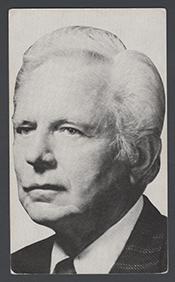
Historical · U.S. House · Ohio · District 6
William Harsha
Former U.S. Representative · Ohio District 6 · 1961–1981 · Republican
William Harsha represented Ohio's District 6 in the United States House of Representatives (1961–1981) for the Republican party. The page below collects sourced biographical facts, term history, committee roles, and provenance for Harsha.
Bioguide ID: H000281
Key facts
- Full name
- William Harsha
- State
- Ohio
- District
- District 6
- Party
- Republican
- House service
- 1961–1981
- First House term
- 1961
- Status
- Left office
- Current term ends
- —
- Born
- 1921
- Bioguide ID
- H000281
- Committee assignments
- —
- Dataset version
- 1.20260605
Biographical narrative
1,033 words · sourced from the Wikipedia REST extract
William H. Harsha was an American lawyer and politician who served as a Republican member of the United States House of Representatives, representing Ohio's 6th congressional district from January 3, 1961, until January 3, 1981. His two-decade tenure in Congress was marked by his commitment to his constituents and his involvement in various legislative initiatives. A veteran of World War II, Harsha's early life and career laid the foundation for his public service and legal career, which spanned several decades.
Early life and career
William Howard Harsha Jr. was born on January 1, 1921, in Portsmouth, Ohio. He completed his secondary education at Portsmouth High School, graduating in 1939. Following high school, he pursued higher education at Kenyon College in Gambier, Ohio, where he earned a Bachelor of Arts degree in 1943. During his time at Kenyon, he became a member of the Sigma Pi fraternity, which is known for fostering a sense of community and leadership among its members.
In 1942, amid the global conflict of World War II, Harsha enlisted in the United States Marine Corps. He served in the military until 1944, contributing to the war effort during a critical period in history. After his service, he returned to academia and attended Western Reserve University in Cleveland, Ohio, where he obtained his Bachelor of Laws (LL.B.) degree in 1947. This legal education equipped him with the knowledge and skills necessary for a career in law and public service.
Following his admission to the bar on March 6, 1947, Harsha began his legal career as the assistant solicitor for the city of Portsmouth. He held this position until 1951, when he was elected as the Scioto County Prosecuting Attorney. During his four-year term in this role, he gained valuable experience in the legal system and developed a reputation for his dedication to justice and community service. His work as a prosecutor provided him with insights into the legal challenges facing his constituents, which would later inform his legislative priorities.
Harsha's transition from local legal practice to national politics began in 1961 when he was elected to the United States Congress. His election marked the beginning of a significant chapter in his career, as he would go on to serve ten consecutive terms in the House of Representatives.
House tenure
William H. Harsha's congressional career commenced with his election to the House of Representatives in 1961. Over the course of his two decades in office, he represented Ohio's 6th congressional district, which encompasses a diverse range of communities and interests. His long tenure in Congress is notable for its duration, spanning twenty years, during which he participated in numerous legislative debates and initiatives.
Throughout his time in the House, Harsha was known for his commitment to his constituents and his active engagement in legislative matters. He was involved in various committees and subcommittees, where he contributed to discussions on a wide array of issues that affected the lives of the people in his district and beyond. His legislative work often focused on matters pertinent to Ohio and the broader national landscape, reflecting his dedication to public service.
Harsha's political career was characterized by his ability to connect with voters and address their concerns. He was known for his accessibility and willingness to engage with the public, which helped him maintain support throughout his time in office. His re-election campaigns were managed by Bob McEwen, who later succeeded him in Congress, indicating the strong political network and relationships Harsha cultivated during his tenure.
After serving ten terms, Harsha concluded his congressional career on January 3, 1981. His departure from the House marked the end of an era for his constituents, who had come to rely on his representation in Washington, D.C. Following his retirement, Harsha transitioned to a consulting role in Washington, D.C., where he continued to lend his expertise to various political and legal matters until 1986.
Legislative focus and committees
During his time in the House of Representatives, William H. Harsha focused on a variety of legislative issues that were significant to his constituents and the nation. His work encompassed a range of topics, including economic development, infrastructure, and public services. As a member of the Republican Party, he aligned with the party's broader goals while also advocating for the specific needs of Ohio's 6th congressional district.
Harsha's legislative focus was informed by his background as a lawyer and his experiences in local government. He understood the complexities of the legal and political systems, which allowed him to navigate the intricacies of legislation effectively. His participation in various committees provided him with a platform to influence policy and advocate for initiatives that would benefit his district.
One notable aspect of Harsha's legislative career was his commitment to infrastructure development. He recognized the importance of transportation and public works in fostering economic growth and improving the quality of life for his constituents. His efforts in this area contributed to the development of essential infrastructure projects that supported both local and regional economies.
In addition to infrastructure, Harsha was involved in discussions related to economic policy and development. He sought to promote initiatives that would create jobs and stimulate economic growth in Ohio. His understanding of the challenges faced by businesses and workers in his district informed his approach to economic legislation.
After retiring from Congress, Harsha returned to Portsmouth, Ohio, where he resumed his legal practice. His post-congressional career allowed him to continue contributing to his community and utilizing his legal expertise in a different capacity.
William H. Harsha passed away on October 11, 2010, in Portsmouth, Ohio, at the age of 89. His legacy is commemorated in part by the naming of an artificial lake on the East Fork of the Little Miami River in Clermont County, as well as the William H. Harsha Bridge, which spans the Ohio River between Ohio and Kentucky. These landmarks serve as a reminder of his contributions to the state and his commitment to public service. Harsha's family includes his wife, Rosemary L. Spellerberg, whom he married in 1946, and their son, William H. Harsha III, who serves as a judge on the Ohio Court of Appeals for the Fourth Appellate District.
Notable legislation
Sponsored and co-sponsored legislation for William Harsha is pending operator curation. The biographical narrative above carries the same provenance trail until per-bill rows are written.
Sources
- [1]https://en.wikipedia.org/wiki/Bill_HarshaWikipedia · retrieved 2026-06-05
Notable quotes
Sourced quotes for William Harsha are pending operator curation. Narrative-scope provenance remains attached below.
Sources
- [1]https://en.wikipedia.org/wiki/Bill_HarshaWikipedia · retrieved 2026-06-05
Key positions
Curated policy positions for William Harsha are pending operator review. The biographical narrative above carries the same provenance trail until per-topic positions are written.
Sources
- [1]https://en.wikipedia.org/wiki/Bill_HarshaWikipedia · retrieved 2026-06-05
Terms served
- 1961–1963U.S. House · Term 1 · Republican
- 1963–1965U.S. House · Term 2 · Republican
- 1965–1967U.S. House · Term 3 · Republican
- 1967–1969U.S. House · Term 4 · Republican
- 1969–1971U.S. House · Term 5 · Republican
- 1971–1973U.S. House · Term 6 · Republican
- 1973–1975U.S. House · Term 7 · Republican
- 1975–1977U.S. House · Term 8 · Republican
- 1977–1979U.S. House · Term 9 · Republican
- 1979–1981U.S. House · Term 10 · Republican
Sources & provenance
Every attributable claim above carries a per-section [N] marker that resolves to the corresponding URL below. Each entry records the upstream provider, the canonical URL, and the timestamp at which the source was retrieved by the ingest pipeline.
Key facts
- https://bioguide.congress.gov/search/bio/H000281bioguide · retrieved 2026-06-05
- https://www.govtrack.us/congress/members/405155govtrack · retrieved 2026-06-05
Biographical narrative
- https://en.wikipedia.org/wiki/Bill_Harshawikipedia · retrieved 2026-06-05
Find your representative
Every U.S. state elects representatives by district. Browse Ohio’s delegation, the full former-representative roster, or explore the role and term length.
Related on The Candidate
- Preceded by James PolkEarlier holder of the Ohio District 6 House seat · Democratic.Open
- Succeeded by Bob McEwenLater holder of the Ohio District 6 House seat · Republican.Open
- Aaron PerryFormer U.S. Representative · Ohio District 1 · RepublicanOpen
- Alexander DuncanFormer U.S. Representative · Ohio District 1 · DemocraticOpen
- Bellamy StorerFormer U.S. Representative · Ohio District 1 · WhigOpen
- Bellamy StorerFormer U.S. Representative · Ohio District 1 · RepublicanOpen