
Historical · U.S. House · Ohio · District 8
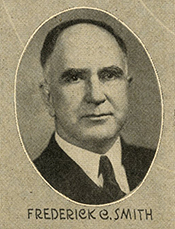
Frederick Smith
Former U.S. Representative · Ohio District 8 · 1939–1951 · Republican
Frederick Smith represented Ohio's District 8 in the United States House of Representatives (1939–1951) for the Republican party. The page below collects sourced biographical facts, term history, committee roles, and provenance for Smith.
Bioguide ID: S000536
Key facts
- Full name
- Frederick Smith
- State
- Ohio
- District
- District 8
- Party
- Republican
- House service
- 1939–1951
- First House term
- 1939
- Status
- Left office
- Current term ends
- —
- Born
- 1884
- Bioguide ID
- S000536
- Committee assignments
- —
- Dataset version
- 1.20260605
Biographical narrative
946 words · sourced from the Wikipedia REST extract
Frederick Cleveland Smith was an American physician and politician who served as a Republican member of the U.S. House of Representatives for Ohio's 8th congressional district from 1939 until 1951. Over the course of his political career, he was elected to six consecutive terms in Congress, where he was known for his conservative positions and strong support for U.S. involvement in World War II.
Early life and career
Frederick C. Smith was born on July 29, 1884, in Shanesville, Ohio. His early education and training in the field of medicine began in Kirksville, Missouri, where he pursued a degree in osteopathic medicine. Following his studies in the United States, Smith expanded his medical education overseas, studying in notable cities such as Frankfurt, Germany, and Vienna, Austria. This international experience contributed to his understanding of medicine and likely influenced his later professional endeavors.
In 1917, Smith received his medical license to practice medicine and surgery in the State of Ohio. He established his medical practice in Marion, Ohio, where he became an integral part of the local community. His commitment to healthcare led him to found the Frederick C. Smith Clinic in Marion, a facility that brought together various specialists to provide comprehensive medical care. The clinic was located on East Church Street and was designed to leverage the expertise of different doctors to benefit patients. This initiative reflected Smith's dedication to improving healthcare access and quality in his community.
In addition to his medical career, Smith also engaged in local politics. He served as the mayor of Marion, Ohio, from January 1936 until January 1, 1939. His tenure as mayor was marked by his involvement in local governance and community affairs, which likely laid the groundwork for his subsequent entry into national politics. Smith resigned from the mayoral position to focus on his congressional campaign, marking a significant transition in his professional life.
House tenure
Frederick Smith was elected to the U.S. House of Representatives in 1938 as a member of the Republican Party, representing Ohio's 8th congressional district. He began his first term in Congress in 1939 and was subsequently re-elected for five additional terms, serving a total of six terms in office. Throughout his congressional career, Smith was known for his strong support of U.S. involvement in World War II and his opposition to isolationist policies.
During his time in Congress, Smith was an advocate for significant military and economic aid to allies during the war. He supported a $7 billion aid package to Britain and was a proponent of the Lend-Lease program, which provided critical support to nations fighting against Axis powers. Additionally, he backed the 1941 amendment to the Neutrality Act, which lifted restrictions that had previously prohibited U.S. vessels from entering combat zones and barred American citizens from sailing on ships belonging to belligerent nations. His actions reflected a commitment to bolstering the Allied war effort during a pivotal period in history.
Smith's political stance was characterized by a strong pro-British sentiment, particularly during the early years of World War II when Great Britain faced significant challenges. He frequently spoke in favor of aiding Britain and denounced isolationism, positioning himself as a vocal supporter of U.S. engagement in global affairs. His views on foreign policy were indicative of a broader trend among certain congressional members who believed that American involvement was essential for the defense of democracy and freedom.
In the early 1950s, Smith was recognized as one of the most conservative members of Congress, often receiving low ratings from liberal organizations such as Americans for Democratic Action. His political ideology aligned with conservative principles, and he was noted for his staunch opposition to leftist policies. Smith's views and legislative actions positioned him among the more conservative legislators of his time, contributing to his reputation within the Republican Party.
Despite his long tenure in Congress, Smith chose not to seek renomination in 1950, marking the end of his congressional career. Following his departure from the House of Representatives, he returned to his medical practice, continuing to serve the community in Marion, Ohio.
Legislative focus and committees
Throughout his six terms in the U.S. House of Representatives, Frederick Smith's legislative focus was primarily centered on issues related to foreign policy, military aid, and conservative domestic policies. His support for U.S. involvement in World War II was a defining aspect of his congressional career, and he played a role in shaping legislation that facilitated military and economic assistance to allies.
Smith's alignment with conservative values influenced his positions on various domestic issues as well. He was known for his opposition to policies that he perceived as too liberal or progressive, which often placed him at odds with more moderate or left-leaning members of Congress. His voting record reflected a commitment to traditional Republican principles, emphasizing limited government intervention and fiscal conservatism.
In addition to his legislative work, Smith's medical background provided him with a unique perspective on healthcare-related issues, although specific details about his involvement in health policy during his congressional tenure are not extensively documented. His experience as a physician may have informed his views on healthcare and public health matters, contributing to the broader discussions occurring in Congress during his time in office.
After leaving Congress, Smith continued to engage with the medical community and maintained his practice in Marion, Ohio. His contributions to both medicine and politics left a lasting impact on the local community, and his legacy is remembered through the clinic that bears his name. Frederick Smith passed away on July 16, 1956, in Marion, Ohio, and was interred in the Marion Cemetery, marking the end of a life dedicated to public service and healthcare.
Notable legislation
Sponsored and co-sponsored legislation for Frederick Smith is pending operator curation. The biographical narrative above carries the same provenance trail until per-bill rows are written.
Sources
- [1]https://en.wikipedia.org/wiki/Frederick_Cleveland_SmithWikipedia · retrieved 2026-06-05
Notable quotes
Sourced quotes for Frederick Smith are pending operator curation. Narrative-scope provenance remains attached below.
Sources
- [1]https://en.wikipedia.org/wiki/Frederick_Cleveland_SmithWikipedia · retrieved 2026-06-05
Key positions
Curated policy positions for Frederick Smith are pending operator review. The biographical narrative above carries the same provenance trail until per-topic positions are written.
Sources
- [1]https://en.wikipedia.org/wiki/Frederick_Cleveland_SmithWikipedia · retrieved 2026-06-05
Terms served
- 1939–1941U.S. House · Term 1 · Republican
- 1941–1943U.S. House · Term 2 · Republican
- 1943–1945U.S. House · Term 3 · Republican
- 1945–1947U.S. House · Term 4 · Republican
- 1947–1949U.S. House · Term 5 · Republican
- 1949–1951U.S. House · Term 6 · Republican
Sources & provenance
Every attributable claim above carries a per-section [N] marker that resolves to the corresponding URL below. Each entry records the upstream provider, the canonical URL, and the timestamp at which the source was retrieved by the ingest pipeline.
Key facts
- https://bioguide.congress.gov/search/bio/S000536bioguide · retrieved 2026-06-05
- https://www.govtrack.us/congress/members/410019govtrack · retrieved 2026-06-05
Biographical narrative
- https://en.wikipedia.org/wiki/Frederick_Cleveland_Smithwikipedia · retrieved 2026-06-05
Find your representative
Every U.S. state elects representatives by district. Browse Ohio’s delegation, the full former-representative roster, or explore the role and term length.
Related on The Candidate
- Preceded by Thomas FletcherEarlier holder of the Ohio District 8 House seat · Democratic.Open
- Succeeded by Jackson BettsLater holder of the Ohio District 8 House seat · Republican.Open
- Aaron PerryFormer U.S. Representative · Ohio District 1 · RepublicanOpen
- Alexander DuncanFormer U.S. Representative · Ohio District 1 · DemocraticOpen
- Bellamy StorerFormer U.S. Representative · Ohio District 1 · WhigOpen
- Bellamy StorerFormer U.S. Representative · Ohio District 1 · RepublicanOpen