
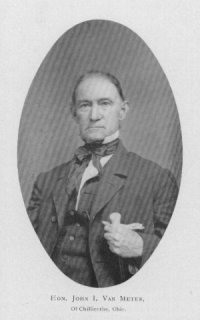
Historical · U.S. House · Ohio · District 8
John Vanmeter
Former U.S. Representative · Ohio District 8 · 1843–1845 · Whig
John Vanmeter represented Ohio's District 8 in the United States House of Representatives (1843–1845) for the Whig party. The page below collects sourced biographical facts, term history, committee roles, and provenance for Vanmeter.
Bioguide ID: V000048
Key facts
- Full name
- John Vanmeter
- State
- Ohio
- District
- District 8
- Party
- Whig
- House service
- 1843–1845
- First House term
- 1843
- Status
- Left office
- Current term ends
- —
- Born
- —
- Bioguide ID
- V000048
- Committee assignments
- —
- Dataset version
- 1.20260606
Biographical narrative
942 words · sourced from the Wikipedia REST extract
John Inskeep Vanmeter was a prominent political figure in the early 19th century, serving as a U.S. Representative from Ohio. A member of the Whig Party, he represented Ohio's 8th congressional district during the Twenty-eighth Congress from 1843 to 1845. His career spanned various roles in both Virginia and Ohio, where he engaged in law, agriculture, and politics. Vanmeter's life reflects the complexities of American political life during a time of significant change and development in the United States.
Early life and career
John Inskeep Vanmeter was born in February 1798 near Moorefield, Virginia, an area that is now part of West Virginia. His early education took place at the College of William and Mary in Williamsburg, Virginia, a prestigious institution known for its rigorous academic standards. After completing his studies there, he graduated from Princeton College in 1821, further solidifying his educational foundation.
Following his graduation, Vanmeter pursued a career in law, attending the Litchfield Law School, which was one of the earliest law schools in the United States. He was admitted to the bar in Virginia in 1822, marking the beginning of his legal career. He commenced his practice in Moorefield, where he built a reputation as a competent attorney. His involvement in the legal field was complemented by his entry into politics, as he served as a member of the Virginia House of Delegates in 1824. This early political experience provided him with insights into legislative processes and governance.
In 1826, seeking new opportunities, Vanmeter relocated to Pike County, Ohio. There, he shifted his focus from law to agriculture, engaging in farming and contributing to the local economy. His move to Ohio marked a significant transition in his life, as he adapted to the challenges and opportunities presented by the frontier environment. Vanmeter's involvement in agriculture not only reflected the economic realities of the time but also connected him to the broader community in which he lived.
Vanmeter's political career continued to evolve as he became active in Ohio's state politics. In 1836, he was elected to the Ohio House of Representatives, where he served in the state legislature. His political engagement deepened further when he was elected to the Ohio Senate in 1838. These roles provided him with valuable experience in state governance and legislative affairs, which would later inform his work at the federal level.
House tenure
John Vanmeter's tenure in the U.S. House of Representatives began when he was elected as a Whig to the Twenty-eighth Congress, serving from March 4, 1843, to March 3, 1845. His election to Congress came at a time when the Whig Party was gaining prominence as a significant political force in the United States, particularly in opposition to the Democratic Party. Vanmeter's role as a congressman allowed him to participate in national discussions and decisions that shaped the direction of the country during a pivotal period.
During his time in the House, Vanmeter was involved in various legislative matters, although specific details regarding the bills he supported or opposed are not documented. His contributions to the legislative process would have included engaging in debates, committee work, and representing the interests of his constituents from Ohio's 8th district. The Whig Party's platform during this era focused on issues such as economic development, infrastructure, and a cautious approach to territorial expansion, which would have influenced Vanmeter's legislative priorities.
Despite his active participation in Congress, Vanmeter faced challenges in securing re-election. He ran for a second term in the Twenty-ninth Congress but was unsuccessful in his bid for re-election in 1844. This defeat marked the end of his congressional career, but it did not signify the end of his involvement in public life.
Legislative focus and committees
While specific details about Vanmeter's legislative focus and committee assignments during his time in Congress are not extensively documented, it is important to contextualize his work within the broader political landscape of the Whig Party and the issues facing the nation at that time. The Whig Party, which emerged in the 1830s, was characterized by its opposition to the policies of President Andrew Jackson and the Democratic Party. Whigs advocated for a strong role of the federal government in promoting economic development, including infrastructure projects such as roads and canals.
Given the Whig Party's priorities, it is likely that Vanmeter's legislative interests aligned with these themes. He would have been concerned with matters related to economic growth, the expansion of transportation networks, and the promotion of industry. The period in which he served was marked by significant debates over issues such as tariffs, internal improvements, and the role of the federal government in economic affairs.
After his congressional tenure, Vanmeter's political affiliations shifted. In 1856, he became affiliated with the Democratic Party, indicating a change in his political alignment. This transition reflects the fluid nature of political identities during this period in American history, as individuals often shifted their allegiances in response to changing political landscapes and personal convictions.
In 1855, Vanmeter moved to Chillicothe, Ohio, where he lived until his death on August 3, 1875. His later years were spent away from the national political stage, but his earlier contributions as a state legislator and U.S. Representative left a mark on the political fabric of Ohio. He was interred in Grandview Cemetery in Chillicothe, where he is remembered as a figure who navigated the complexities of early American politics and contributed to the governance of his state and nation.
John Vanmeter's life and career exemplify the multifaceted nature of political service in the 19th century, reflecting the challenges and opportunities faced by those who sought to influence the course of American history.
Notable legislation
Sponsored and co-sponsored legislation for John Vanmeter is pending operator curation. The biographical narrative above carries the same provenance trail until per-bill rows are written.
Sources
- [1]https://en.wikipedia.org/wiki/John_I._VanmeterWikipedia · retrieved 2026-06-06
Notable quotes
Sourced quotes for John Vanmeter are pending operator curation. Narrative-scope provenance remains attached below.
Sources
- [1]https://en.wikipedia.org/wiki/John_I._VanmeterWikipedia · retrieved 2026-06-06
Key positions
Curated policy positions for John Vanmeter are pending operator review. The biographical narrative above carries the same provenance trail until per-topic positions are written.
Sources
- [1]https://en.wikipedia.org/wiki/John_I._VanmeterWikipedia · retrieved 2026-06-06
Terms served
- 1843–1845U.S. House · Term 1 · Whig
Sources & provenance
Every attributable claim above carries a per-section [N] marker that resolves to the corresponding URL below. Each entry records the upstream provider, the canonical URL, and the timestamp at which the source was retrieved by the ingest pipeline.
Key facts
- https://bioguide.congress.gov/search/bio/V000048bioguide · retrieved 2026-06-06
- https://www.govtrack.us/congress/members/411127govtrack · retrieved 2026-06-06
Biographical narrative
- https://en.wikipedia.org/wiki/John_I._Vanmeterwikipedia · retrieved 2026-06-06
Find your representative
Every U.S. state elects representatives by district. Browse Ohio’s delegation, the full former-representative roster, or explore the role and term length.
Related on The Candidate
- Preceded by Joseph RidgwayEarlier holder of the Ohio District 8 House seat · Whig.Open
- Succeeded by Moses CorwinLater holder of the Ohio District 8 House seat · Whig.Open
- Aaron PerryFormer U.S. Representative · Ohio District 1 · RepublicanOpen
- Alexander DuncanFormer U.S. Representative · Ohio District 1 · DemocraticOpen
- Bellamy StorerFormer U.S. Representative · Ohio District 1 · WhigOpen
- Bellamy StorerFormer U.S. Representative · Ohio District 1 · RepublicanOpen