
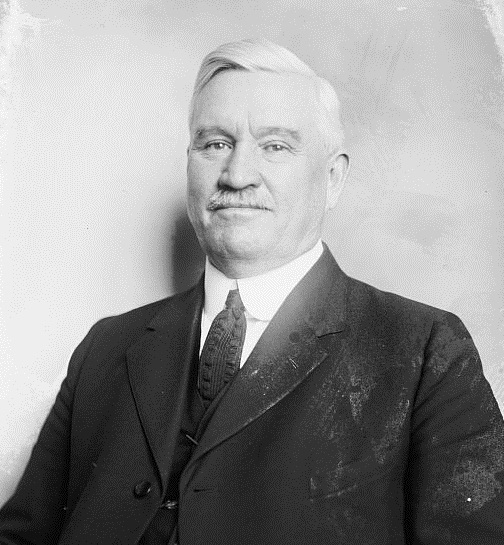
Historical · U.S. House · Ohio · District 9
William Chalmers
Former U.S. Representative · Ohio District 9 · 1921–1931 · Republican
William Chalmers represented Ohio's District 9 in the United States House of Representatives (1921–1931) for the Republican party. The page below collects sourced biographical facts, term history, committee roles, and provenance for Chalmers.
Bioguide ID: C000274
Key facts
- Full name
- William Chalmers
- State
- Ohio
- District
- District 9
- Party
- Republican
- House service
- 1921–1931
- First House term
- 1921
- Status
- Left office
- Current term ends
- —
- Born
- 1861
- Bioguide ID
- C000274
- Committee assignments
- —
- Dataset version
- 1.20260606
Biographical narrative
985 words · sourced from the Wikipedia REST extract
William Chalmers was a notable American educator and politician who served as a U.S. Representative for Ohio's 9th congressional district. A member of the Republican Party, Chalmers had a significant impact on both the educational landscape and the political arena during the early 20th century. His tenure in Congress spanned four terms, during which he contributed to various legislative efforts until his last term concluded in 1931. Born in Canada and later becoming a prominent figure in Ohio, Chalmers' career reflects a blend of educational leadership and public service.
Early life and career
William Chalmers was born on November 1, 1861, in Strathroy, Canada West, which is now part of Ontario. In 1865, when he was just a young child, his family relocated to Kent County, near Grand Rapids, Michigan. This move marked the beginning of his life in the United States, where he would eventually pursue a career in education and public service. Chalmers received his early education in public schools, which laid the foundation for his future academic pursuits.
He continued his education at Michigan State Normal School, a teacher training institution, before graduating from the University of Michigan at Ann Arbor in 1887. His academic journey did not stop there; he furthered his education by attending Eureka College, where he graduated in 1889, and later earned a degree from Heidelberg University in Tiffin, Ohio, in 1904. This diverse educational background equipped him with the knowledge and skills necessary for a career in education.
Chalmers began his professional life as a teacher and principal in various schools until 1890. His commitment to education led him to serve as the superintendent of schools in Grand Rapids, Michigan, from 1890 to 1898. Following this role, he took on a similar position in Toledo, Ohio, where he served from 1898 to 1905. His leadership in these educational institutions was characterized by a focus on improving the quality of education and fostering a supportive environment for both students and teachers.
In 1904, Chalmers became the president of the University of Toledo, a position that underscored his dedication to higher education. His tenure at the university was marked by efforts to enhance the institution's academic offerings and expand its reach within the community. In addition to his educational roles, Chalmers engaged in various business ventures, including farming, lumbering, and real estate and insurance in Toledo, Ohio. This multifaceted career provided him with a broad perspective on both education and the economy, which would later inform his political decisions.
House tenure
William Chalmers' political career began when he was elected as a Republican to the Sixty-seventh Congress, serving from March 4, 1921, to March 3, 1923. His election marked the beginning of his involvement in national politics, where he aimed to represent the interests of his constituents in Ohio's 9th congressional district. However, his initial term was followed by an unsuccessful bid for reelection in 1922, which temporarily halted his congressional career.
Despite this setback, Chalmers returned to Congress when he was elected to the Sixty-ninth, Seventieth, and Seventy-first Congresses, serving from March 4, 1925, until March 3, 1931. His return to Congress demonstrated his resilience and continued commitment to public service. During these terms, he participated in various legislative activities and contributed to discussions on key issues affecting his district and the nation.
Throughout his congressional tenure, Chalmers faced the challenges of a rapidly changing political landscape in the United States. The years during which he served were marked by significant events, including the aftermath of World War I, the onset of the Great Depression, and various social and economic reforms. His experience as an educator likely influenced his approach to legislation, as he sought to address the needs of his constituents and advocate for policies that would benefit the broader community.
Chalmers' time in Congress came to an end when he was not renominated in 1930, concluding his four terms in the House of Representatives. His departure from Congress marked the end of an era in which he had worked to influence legislation and represent the interests of Ohioans at the national level.
Legislative focus and committees
During his time in the U.S. House of Representatives, William Chalmers engaged in various legislative efforts that reflected his background in education and his commitment to public service. While specific details regarding the bills he sponsored or the committees he served on are not provided, it can be inferred that his experience as an educator and administrator likely shaped his legislative priorities.
Chalmers' focus on education would have been a natural extension of his professional background, and he may have advocated for policies that aimed to improve educational opportunities and resources for students and teachers. Given the historical context of his tenure, he may have also been involved in discussions related to economic recovery and social welfare, particularly as the nation faced the challenges of the Great Depression.
His involvement in various committees would have allowed him to collaborate with other lawmakers and contribute to the development of legislation that addressed pressing issues of the time. As a member of Congress, Chalmers would have had the opportunity to engage with constituents, gather feedback on their needs, and advocate for their interests in the legislative process.
Although specific legislative achievements during his tenure are not detailed, Chalmers' background in education and his experience in public service would have informed his approach to governance. His commitment to improving the lives of his constituents and addressing the challenges facing the nation would have been central to his work in Congress.
William Chalmers passed away on October 1, 1944, in Indianapolis, Indiana. He was interred in Crown Hill Cemetery, leaving behind a legacy that encompassed both his contributions to education and his service as a U.S. Representative. His life and career reflect the intersection of education and politics, highlighting the importance of public service in shaping communities and addressing societal needs.
Notable legislation
Sponsored and co-sponsored legislation for William Chalmers is pending operator curation. The biographical narrative above carries the same provenance trail until per-bill rows are written.
Sources
- [1]https://en.wikipedia.org/wiki/William_W._ChalmersWikipedia · retrieved 2026-06-06
Notable quotes
Sourced quotes for William Chalmers are pending operator curation. Narrative-scope provenance remains attached below.
Sources
- [1]https://en.wikipedia.org/wiki/William_W._ChalmersWikipedia · retrieved 2026-06-06
Key positions
Curated policy positions for William Chalmers are pending operator review. The biographical narrative above carries the same provenance trail until per-topic positions are written.
Sources
- [1]https://en.wikipedia.org/wiki/William_W._ChalmersWikipedia · retrieved 2026-06-06
Terms served
- 1921–1923U.S. House · Term 1 · Republican
- 1925–1927U.S. House · Term 2 · Republican
- 1927–1929U.S. House · Term 3 · Republican
- 1929–1931U.S. House · Term 4 · Republican
Sources & provenance
Every attributable claim above carries a per-section [N] marker that resolves to the corresponding URL below. Each entry records the upstream provider, the canonical URL, and the timestamp at which the source was retrieved by the ingest pipeline.
Key facts
- https://bioguide.congress.gov/search/bio/C000274bioguide · retrieved 2026-06-06
- https://www.govtrack.us/congress/members/402417govtrack · retrieved 2026-06-06
Biographical narrative
- https://en.wikipedia.org/wiki/William_W._Chalmerswikipedia · retrieved 2026-06-06
Find your representative
Every U.S. state elects representatives by district. Browse Ohio’s delegation, the full former-representative roster, or explore the role and term length.
Related on The Candidate
- Preceded by James SouthardEarlier holder of the Ohio District 9 House seat · Republican.Open
- Succeeded by Wilbur WhiteLater holder of the Ohio District 9 House seat · Republican.Open
- Aaron PerryFormer U.S. Representative · Ohio District 1 · RepublicanOpen
- Alexander DuncanFormer U.S. Representative · Ohio District 1 · DemocraticOpen
- Bellamy StorerFormer U.S. Representative · Ohio District 1 · WhigOpen
- Bellamy StorerFormer U.S. Representative · Ohio District 1 · RepublicanOpen