
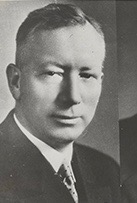
Historical · U.S. House · Oregon · District 3
William Ekwall
Former U.S. Representative · Oregon District 3 · 1935–1937 · Republican
William Ekwall represented Oregon's District 3 in the United States House of Representatives (1935–1937) for the Republican party. The page below collects sourced biographical facts, term history, committee roles, and provenance for Ekwall.
Bioguide ID: E000098
Key facts
- Full name
- William Ekwall
- State
- Oregon
- District
- District 3
- Party
- Republican
- House service
- 1935–1937
- First House term
- 1935
- Status
- Left office
- Current term ends
- —
- Born
- 1887
- Bioguide ID
- E000098
- Committee assignments
- —
- Dataset version
- 1.20260605
Biographical narrative
930 words · sourced from the Wikipedia REST extract
William Ekwall was an American politician, lawyer, and journalist who served as a U.S. Representative for Oregon's 3rd congressional district from 1935 to 1937. A member of the Republican Party, Ekwall's political career was marked by his transition from local judicial roles to national legislative responsibilities. After his single term in Congress, he continued his public service as a judge on the United States Customs Court from 1942 until his death in 1956. Ekwall's life was characterized by his commitment to public service, legal practice, and his contributions to the judiciary.
Early life and career
William Ekwall was born on June 14, 1887, in Ludington, Michigan, to Swedish immigrant parents, Alexander and Emilie Ekwall. His early life was shaped by his family's relocation to Klamathon, California, in 1893, where they sought new opportunities. However, their new home faced a significant setback when a devastating fire destroyed the town in 1902. This event prompted the Ekwall family to move again, ultimately settling in Portland, Oregon, in 1906.
Ekwall's education began in the public schools of Portland, where he demonstrated a strong aptitude for learning. He pursued higher education at the University of Oregon School of Law, which was then located in Portland. He graduated in 1912 with a Bachelor of Laws degree, marking the beginning of his legal career. Shortly after graduation, he was admitted to the bar and began practicing law in Portland with the firm Senn, Ekwall, and Recken.
Ekwall's legal career was interrupted by World War I, during which he served in the United States Army. He enlisted as a private in the Infantry and attended the Central Officers Training School in 1918, where he received training to become an officer. Following the war, Ekwall returned to Portland, where he continued his legal practice. His judicial career began in 1922 when he was appointed as a municipal judge, a position he held until 1927. He then served as a judge of the circuit court for the fourth judicial district (Multnomah County), department 8, until 1935. His experience in the judiciary laid a strong foundation for his subsequent political career.
House tenure
Ekwall's entry into national politics came in the context of a significant shift in Oregon's political landscape. In 1934, the incumbent U.S. Representative for Oregon's 3rd congressional district, Democrat Charles H. Martin, announced his intention to run for Governor of Oregon. Seizing this opportunity, Ekwall entered the race as a Republican candidate. He successfully won the primary election held in May, positioning himself against Walter B. Gleason, a former candidate for the U.S. Senate.
The general election was competitive, featuring several third-party candidates alongside Ekwall and Gleason. Ekwall managed to secure a plurality of the votes, earning approximately 41% compared to Gleason's 38%. This victory allowed him to take office as a member of the 74th United States Congress, where he served from 1935 until early 1937.
During his time in Congress, Ekwall was known for his assertive and sometimes confrontational style. His interactions with fellow representatives were marked by a tendency to use strong language, which contributed to his reputation. For instance, he was known to have made derogatory remarks about colleagues, reflecting a combative approach to political discourse.
Ekwall's congressional tenure was relatively brief, as he sought re-election in 1936. He faced a formidable challenge from Nan Wood Honeyman, a community activist and a family friend of President Franklin D. Roosevelt. Honeyman's campaign was characterized by an aggressive door-to-door strategy, which resonated with voters. Additionally, the political climate was influenced by Roosevelt's landslide re-election, which further bolstered Honeyman's candidacy. Ultimately, Ekwall was defeated in the election, receiving approximately 33% of the vote compared to Honeyman's 51%. Following this loss, he returned to his legal practice in Portland.
Legislative focus and committees
During his time in the House of Representatives, Ekwall's legislative focus and committee assignments are not extensively documented in the available records. However, as a member of the Republican Party during the mid-1930s, he would have been involved in discussions and debates surrounding key issues of the time, including economic recovery efforts in the wake of the Great Depression and various New Deal policies proposed by the Roosevelt administration.
Ekwall's approach to legislation was likely influenced by his background in law and his experience as a judge. His legal training would have provided him with a unique perspective on the implications of proposed legislation and its impact on the judicial system. Although specific bills or committee assignments are not detailed, it can be inferred that his legal expertise would have informed his contributions to discussions on law and governance.
After his congressional tenure, Ekwall remained active in public service. He was a delegate to the Republican National Convention in 1940, demonstrating his continued involvement in political affairs. His career took a significant turn in 1942 when he was nominated by President Franklin D. Roosevelt to serve as a judge on the United States Customs Court. Ekwall was confirmed by the Senate and began his judicial service, which lasted until his death in 1956. His appointment to the Customs Court reflected a recognition of his legal acumen and commitment to public service.
William Ekwall passed away on October 16, 1956, while on vacation in Portland. His contributions to the legal and political landscape of Oregon and the United States are remembered through his service as a congressman and later as a federal judge. He was interred in Portland Memorial Cemetery. Ekwall was survived by his wife, Lina, and their two daughters, leaving behind a legacy of public service that spanned several decades.
Notable legislation
Sponsored and co-sponsored legislation for William Ekwall is pending operator curation. The biographical narrative above carries the same provenance trail until per-bill rows are written.
Sources
- [1]https://en.wikipedia.org/wiki/William_A._EkwallWikipedia · retrieved 2026-06-05
Notable quotes
Sourced quotes for William Ekwall are pending operator curation. Narrative-scope provenance remains attached below.
Sources
- [1]https://en.wikipedia.org/wiki/William_A._EkwallWikipedia · retrieved 2026-06-05
Key positions
Curated policy positions for William Ekwall are pending operator review. The biographical narrative above carries the same provenance trail until per-topic positions are written.
Sources
- [1]https://en.wikipedia.org/wiki/William_A._EkwallWikipedia · retrieved 2026-06-05
Terms served
- 1935–1937U.S. House · Term 1 · Republican
Sources & provenance
Every attributable claim above carries a per-section [N] marker that resolves to the corresponding URL below. Each entry records the upstream provider, the canonical URL, and the timestamp at which the source was retrieved by the ingest pipeline.
Key facts
- https://bioguide.congress.gov/search/bio/E000098bioguide · retrieved 2026-06-05
- https://www.govtrack.us/congress/members/403789govtrack · retrieved 2026-06-05
Biographical narrative
- https://en.wikipedia.org/wiki/William_A._Ekwallwikipedia · retrieved 2026-06-05
Find your representative
Every U.S. state elects representatives by district. Browse Oregon’s delegation, the full former-representative roster, or explore the role and term length.
Related on The Candidate
- Preceded by Charles MartinEarlier holder of the Oregon District 3 House seat · Democratic.Open
- Succeeded by Nan HoneymanLater holder of the Oregon District 3 House seat · Democratic.Open
- Albin Norblad Jr.Former U.S. Representative · Oregon District 1 · RepublicanOpen
- Andrew ThayerFormer U.S. Representative · Oregon District 1 · DemocraticOpen
- Binger HermannFormer U.S. Representative · Oregon District 1 · RepublicanOpen
- David WuFormer U.S. Representative · Oregon District 1 · DemocraticOpen