
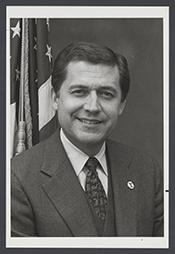
Historical · U.S. House · Oregon · District 5
Denny Smith
Former U.S. Representative · Oregon District 5 · 1981–1991 · Republican
Denny Smith represented Oregon's District 5 in the United States House of Representatives (1981–1991) for the Republican party. The page below collects sourced biographical facts, term history, committee roles, and provenance for Smith.
Bioguide ID: S000527
Key facts
- Full name
- Denny Smith
- State
- Oregon
- District
- District 5
- Party
- Republican
- House service
- 1981–1991
- First House term
- 1981
- Status
- Left office
- Current term ends
- —
- Born
- 1938
- Bioguide ID
- S000527
- Committee assignments
- —
- Dataset version
- 1.20260605
Biographical narrative
947 words · sourced from the Wikipedia REST extract
Dennis Alan Smith is a former U.S. Representative who served Oregon's 5th congressional district as a member of the Republican Party from 1981 until 1991. Born on January 19, 1938, in Ontario, Oregon, he has a diverse background that includes military service, business, and a significant political career. Smith is also the son of Elmo Smith, a former governor of Oregon, which places him within a notable political lineage.
Early life and career
Dennis Smith was born in Eastern Oregon and grew up in a politically active family. His father, Elmo Smith, served as the governor of Oregon, which likely influenced Smith's later political aspirations. He completed his high school education at Grant Union High School in John Day in 1956 before enrolling at Willamette University in Salem, Oregon. His academic pursuits were interrupted by military service, as he joined the United States Air Force in 1958. Smith served in the Air Force until 1960, after which he joined the Oregon Air National Guard.
In 1961, Smith earned a Bachelor of Arts degree from Willamette University. He returned to active duty in the Air Force in 1962 and served until 1967. During his military career, he was a fighter pilot in the Vietnam War, flying the F-4C Phantom and completing approximately 180 missions. After his military service, Smith transitioned to the commercial aviation sector, working as a flight engineer and co-pilot for a commercial airline from 1967 until 1976.
In 1968, following the death of his father, Smith took over the family newspaper business. His experience in the media sector was further complemented by his work with Pan American Airlines. In 1974, he was elected by his colleagues to serve as the union's lobbyist in Washington, D.C., which marked his initial foray into political advocacy. His contributions to aviation were recognized in 2009 when he was inducted into the Oregon Aviation Hall of Honor.
House tenure
Dennis Smith's political career began in earnest when he was elected to the United States House of Representatives in 1980. He represented Oregon's 2nd congressional district as a Republican, defeating the long-serving Democratic incumbent Al Ullman by a narrow margin. His victory was bolstered by the broader political climate, including Ronald Reagan's popularity, which resonated throughout the district.
During his first term, Smith represented a large and diverse district that extended from Salem to the Idaho border. Following the 1980 census, Oregon gained an additional congressional district, and Smith's home in Salem was incorporated into the newly established 5th district. He was elected to this district in 1982 and subsequently secured re-election three more times, demonstrating a solid base of support among his constituents.
Smith's re-election campaigns in 1984 and 1986 were successful, reflecting his ability to connect with voters. However, in 1988, he faced a more challenging race against Democratic State Representative Mike Kopetski, winning by a slim margin of just 707 votes. The following election cycle in 1990 saw Kopetski mount a rematch, successfully capitalizing on Smith's connections to several failed savings and loan institutions, which became a focal point of the campaign.
Throughout his tenure in Congress, Smith was active on several key committees, including the Budget Committee, the Committee on Interior and Insular Affairs, and the Committee on Veterans' Affairs. His involvement in these committees allowed him to influence legislation on a range of issues pertinent to his constituents and the nation.
In addition to his legislative work, Smith was instrumental in establishing Oregonians Against Crime, an organization that played a significant role in advocating for the passage of the 1988 Anti-crime Bill in Oregon. This initiative was placed on the ballot through a petition process, showcasing Smith's commitment to addressing crime-related issues in the state.
Legislative focus and committees
During his time in the House of Representatives, Dennis Smith's legislative focus encompassed a variety of issues, reflecting both his personal interests and the needs of his constituents. His work on the Budget Committee involved scrutinizing federal spending and advocating for fiscal responsibility, a priority for many Republicans during the 1980s. Smith's participation in the Committee on Interior and Insular Affairs allowed him to engage with matters related to natural resources, public lands, and the management of federal territories, which are significant concerns for many Oregonians.
His role on the Committee on Veterans' Affairs was particularly relevant given his own military background. Smith's experiences as a veteran informed his advocacy for policies aimed at improving the lives of those who have served in the armed forces. This included efforts to enhance veterans' healthcare and benefits, ensuring that they received the support they deserved after their service.
Smith's political career extended beyond his congressional tenure. In 1994, he ran as the Republican nominee for Governor of Oregon but was defeated by Democratic candidate John Kitzhaber. Additionally, he served as the Republican National Committeeman for Oregon until 2000, continuing his involvement in party politics.
After leaving Congress, Smith transitioned back into the business sector, becoming the chairman of Eagle Newspapers, a printing and publishing company based in the Pacific Northwest. His contributions to the newspaper industry were recognized in 2012 when he was inducted into the Oregon Newspaper Hall of Fame by the Oregon Newspaper Publishers Association.
In his personal life, Smith has experienced several marriages and family changes. He married Sandra in 1962, but the couple divorced in 1967 after having one son. He later married Kathleen Barrett, with whom he had three children, but they divorced in 1986. In 1989, he married Deanna Marie Koenig, who passed away in 2011. Smith's family background and connections to notable political figures, including his father and cousin Steve Symms, further highlight his ties to Oregon's political landscape.
Notable legislation
Sponsored and co-sponsored legislation for Denny Smith is pending operator curation. The biographical narrative above carries the same provenance trail until per-bill rows are written.
Sources
- [1]https://en.wikipedia.org/wiki/Denny_SmithWikipedia · retrieved 2026-06-05
Notable quotes
Sourced quotes for Denny Smith are pending operator curation. Narrative-scope provenance remains attached below.
Sources
- [1]https://en.wikipedia.org/wiki/Denny_SmithWikipedia · retrieved 2026-06-05
Key positions
Curated policy positions for Denny Smith are pending operator review. The biographical narrative above carries the same provenance trail until per-topic positions are written.
Sources
- [1]https://en.wikipedia.org/wiki/Denny_SmithWikipedia · retrieved 2026-06-05
Terms served
- 1981–1983U.S. House · Term 1 · Republican
- 1983–1985U.S. House · Term 2 · Republican
- 1985–1987U.S. House · Term 3 · Republican
- 1987–1989U.S. House · Term 4 · Republican
- 1989–1991U.S. House · Term 5 · Republican
Sources & provenance
Every attributable claim above carries a per-section [N] marker that resolves to the corresponding URL below. Each entry records the upstream provider, the canonical URL, and the timestamp at which the source was retrieved by the ingest pipeline.
Key facts
- https://bioguide.congress.gov/search/bio/S000527bioguide · retrieved 2026-06-05
- https://www.govtrack.us/congress/members/410010govtrack · retrieved 2026-06-05
Biographical narrative
- https://en.wikipedia.org/wiki/Denny_Smithwikipedia · retrieved 2026-06-05
Find your representative
Every U.S. state elects representatives by district. Browse Oregon’s delegation, the full former-representative roster, or explore the role and term length.
Related on The Candidate
- Succeeded by Michael KopetskiLater holder of the Oregon District 5 House seat · Democratic.Open
- Albin Norblad Jr.Former U.S. Representative · Oregon District 1 · RepublicanOpen
- Andrew ThayerFormer U.S. Representative · Oregon District 1 · DemocraticOpen
- Binger HermannFormer U.S. Representative · Oregon District 1 · RepublicanOpen
- David WuFormer U.S. Representative · Oregon District 1 · DemocraticOpen
- Republican PartyFederal candidates and office holders on the Republican line.Open