
Historical · U.S. House · Pennsylvania · District 11
Daniel Flood
Former U.S. Representative · Pennsylvania District 11 · 1945–1981 · Democratic
Daniel Flood represented Pennsylvania's District 11 in the United States House of Representatives (1945–1981) for the Democratic party. The page below collects sourced biographical facts, term history, committee roles, and provenance for Flood.
Bioguide ID: F000209
Key facts
- Full name
- Daniel Flood
- State
- Pennsylvania
- District
- District 11
- Party
- Democratic
- House service
- 1945–1981
- First House term
- 1945
- Status
- Left office
- Current term ends
- —
- Born
- 1903
- Bioguide ID
- F000209
- Committee assignments
- —
- Dataset version
- 1.20260605
Biographical narrative
982 words · sourced from the Wikipedia REST extract
Daniel J. Flood was a prominent American attorney and politician who served as a U.S. Representative for Pennsylvania's 11th congressional district. A member of the Democratic Party, Flood's political career spanned over three decades, during which he was elected to the House of Representatives for a total of 16 terms, although these were not all consecutive. His tenure was marked by significant legislative contributions, particularly in the areas of economic development and disaster recovery. Flood's career, however, was also marred by legal controversies that ultimately led to his resignation from Congress.
Early life and career
Daniel John Flood was born on November 26, 1903, in Hazleton, Pennsylvania, to an Irish immigrant family. His parents, Sarah McCarthy and Patrick Flood, instilled in him the values of hard work and community service. Flood attended public schools in Wilkes-Barre, Pennsylvania, and St. Augustine, Florida, before pursuing higher education. He graduated from Syracuse University in 1924 and later attended Harvard Law School, ultimately earning his law degree from Dickinson School of Law in Carlisle in 1929.
After being admitted to the bar in 1930, Flood established a legal practice in Wilkes-Barre. His early career included a position as an attorney for the federal Home Owners' Loan Corporation during the Great Depression, which provided him with valuable experience in public service. His political inclinations were shaped by the New Deal policies of President Franklin D. Roosevelt, leading him to join the Democratic Party. Flood's early professional life also included roles as deputy attorney general for Pennsylvania and counsel for the Pennsylvania Liquor Control Board from 1935 to 1939. In 1941, he was appointed director of the State Bureau of Public Assistance Disbursements, serving until 1944.
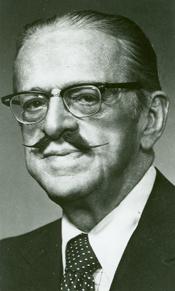
In addition to his legal and political pursuits, Flood had a passion for the performing arts. He studied acting in his youth and maintained a flair for theatricality throughout his career. Known for his distinctive waxed moustache and penchant for wearing white suits, Flood's flamboyant style and speech often drew comparisons to a Shakespearean actor. His involvement in local theater also led him to encourage others, including actor James Karen, to pursue careers in acting. Flood met his wife, Catherine Swank, during a theater production, further intertwining his personal and professional lives.
House tenure
Flood's political career at the federal level began with his first run for Congress in 1942, when he was the Democratic candidate in a special election to replace Congressman J. Harold Flannery in Pennsylvania's 12th congressional district. Although he narrowly lost to Republican Thomas B. Miller, Flood persisted and ran against Miller again in the general election later that year, suffering a wider defeat. However, he successfully won a seat in the newly renumbered 11th District in 1944.
Flood's early congressional career was marked by ups and downs. He faced defeat in the 1946 election due to a nationwide Republican surge but regained his seat in 1948. He was reelected in 1950, only to lose again in 1952 amidst a Republican landslide during Dwight D. Eisenhower's presidential campaign. Flood's political fortunes changed once more when he defeated Congressman Bonin in a rematch in 1954. Following a closely contested reelection in 1956, he secured 11 additional terms in Congress with relatively little opposition.
Throughout his tenure, Flood established seniority that allowed him to serve on the influential House Appropriations Committee. His position enabled him to advocate for significant legislation, including Medicare and initiatives aimed at economic development in Appalachia. Flood's legislative efforts were particularly focused on addressing the challenges faced by his constituents, especially in the wake of economic downturns in the coal mining industry.
Flood's influence extended beyond legislation; he played a role in national politics as well. He was instrumental in persuading Senator John F. Kennedy to campaign in his district and supported Kennedy's presidential aspirations. Flood's commitment to his district was evident in his response to the devastation caused by Hurricane Agnes in 1972, which resulted in severe flooding in Wilkes-Barre. As subcommittee chairman of the House Appropriations Committee, he worked to streamline federal assistance for recovery efforts, earning recognition for his leadership during this crisis.
Legislative focus and committees
During his time in Congress, Flood was known for his focus on economic development and disaster recovery. He sponsored key legislation such as the Area Redevelopment Act in 1961, which aimed to revitalize economically distressed areas, and the Federal Coal Mine Health and Safety Act of 1969, which sought to improve safety conditions for coal miners. His efforts in these areas reflected a commitment to addressing the needs of his constituents and adapting to the changing economic landscape of his district.
Flood's response to the aftermath of Hurricane Agnes was particularly notable. The flooding caused extensive damage in Wilkes-Barre, and Flood's leadership was credited with facilitating a swift federal response. He worked to mobilize resources for rescue and recovery operations, and his efforts to limit bureaucratic obstacles were seen as crucial in the recovery process. His catchphrase, "It took a Flood to tame a flood," became emblematic of his role in managing the disaster response.
Despite his contributions, Flood's career was not without controversy. He faced investigations from multiple U.S. Attorney's offices, and allegations of corruption ultimately culminated in legal challenges. A trial regarding bribery charges resulted in a hung jury, and subsequent retrials were delayed due to health issues. In 1980, Flood resigned from Congress before pleading guilty to a charge related to payoffs, receiving a sentence of probation.
Flood's political legacy is complex, characterized by significant legislative achievements alongside legal controversies. His long tenure in the House of Representatives and his efforts to address the needs of his constituents left a lasting impact on Pennsylvania's 11th congressional district. Following his resignation, Flood's career serves as a reminder of the challenges and responsibilities faced by public officials. He passed away on May 28, 1994, leaving behind a multifaceted legacy in American politics.
Notable legislation
Sponsored and co-sponsored legislation for Daniel Flood is pending operator curation. The biographical narrative above carries the same provenance trail until per-bill rows are written.
Sources
- [1]https://en.wikipedia.org/wiki/Daniel_FloodWikipedia · retrieved 2026-06-05
Notable quotes
Sourced quotes for Daniel Flood are pending operator curation. Narrative-scope provenance remains attached below.
Sources
- [1]https://en.wikipedia.org/wiki/Daniel_FloodWikipedia · retrieved 2026-06-05
Key positions
Curated policy positions for Daniel Flood are pending operator review. The biographical narrative above carries the same provenance trail until per-topic positions are written.
Sources
- [1]https://en.wikipedia.org/wiki/Daniel_FloodWikipedia · retrieved 2026-06-05
Terms served
- 1945–1947U.S. House · Term 1 · Democratic
- 1949–1951U.S. House · Term 2 · Democratic
- 1951–1953U.S. House · Term 3 · Democratic
- 1955–1957U.S. House · Term 4 · Democratic
- 1957–1959U.S. House · Term 5 · Democratic
- 1959–1961U.S. House · Term 6 · Democratic
- 1961–1963U.S. House · Term 7 · Democratic
- 1963–1965U.S. House · Term 8 · Democratic
- 1965–1967U.S. House · Term 9 · Democratic
- 1967–1969U.S. House · Term 10 · Democratic
- 1969–1971U.S. House · Term 11 · Democratic
- 1971–1973U.S. House · Term 12 · Democratic
- 1973–1975U.S. House · Term 13 · Democratic
- 1975–1977U.S. House · Term 14 · Democratic
- 1977–1979U.S. House · Term 15 · Democratic
- 1979–1981U.S. House · Term 16 · Democratic
Sources & provenance
Every attributable claim above carries a per-section [N] marker that resolves to the corresponding URL below. Each entry records the upstream provider, the canonical URL, and the timestamp at which the source was retrieved by the ingest pipeline.
Key facts
- https://bioguide.congress.gov/search/bio/F000209bioguide · retrieved 2026-06-05
- https://www.govtrack.us/congress/members/404164govtrack · retrieved 2026-06-05
Biographical narrative
- https://en.wikipedia.org/wiki/Daniel_Floodwikipedia · retrieved 2026-06-05
Find your representative
Every U.S. state elects representatives by district. Browse Pennsylvania’s delegation, the full former-representative roster, or explore the role and term length.
Related on The Candidate
- Preceded by Patrick BolandEarlier holder of the Pennsylvania District 11 House seat · Democratic.Open
- Succeeded by James NelliganLater holder of the Pennsylvania District 11 House seat · Republican.Open
- Adam SeybertFormer U.S. Representative · Pennsylvania District 1 · RepublicanOpen
- Benjamin SayFormer U.S. Representative · Pennsylvania District 1 · RepublicanOpen
- Chapman FreemanFormer U.S. Representative · Pennsylvania District 1 · RepublicanOpen
- Harry RansleyFormer U.S. Representative · Pennsylvania District 1 · RepublicanOpen