
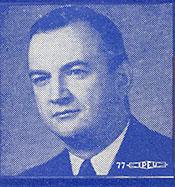
Historical · U.S. House · Pennsylvania · District 12
John Saylor
Former U.S. Representative · Pennsylvania District 12 · 1949–1975 · Republican
John Saylor represented Pennsylvania's District 12 in the United States House of Representatives (1949–1975) for the Republican party. The page below collects sourced biographical facts, term history, committee roles, and provenance for Saylor.
Bioguide ID: S000102
Key facts
- Full name
- John Saylor
- State
- Pennsylvania
- District
- District 12
- Party
- Republican
- House service
- 1949–1975
- First House term
- 1949
- Status
- Left office
- Current term ends
- —
- Born
- 1908
- Bioguide ID
- S000102
- Committee assignments
- —
- Dataset version
- 1.20260605
Biographical narrative
822 words · sourced from the Wikipedia REST extract
John P. Saylor was a prominent American lawyer and politician who served as a Republican member of the U.S. House of Representatives from Pennsylvania's 12th congressional district. His congressional career spanned from 1949 until his death in 1973, during which he was known for his commitment to environmental issues and civil rights. Saylor's legislative efforts were marked by a focus on preserving natural resources and advocating for social justice, earning him recognition as a significant figure in American politics during the mid-20th century.
Early life and career
John Phillips Saylor was born on July 23, 1908, in Conemaugh Township, located in Somerset County, Pennsylvania. He pursued higher education at Franklin and Marshall College in Lancaster, Pennsylvania, where he graduated in 1929. Following his undergraduate studies, Saylor attended Dickinson School of Law in Carlisle, Pennsylvania, earning his law degree in 1933. His legal career began in earnest when he was elected city solicitor for Johnstown, Pennsylvania, a position he held from 1938 until 1940.
Saylor's professional journey was interrupted by World War II, during which he enlisted in the United States Navy on August 6, 1943. He served his country until January 1946, gaining valuable experiences that would later inform his public service. After the war, Saylor returned to his legal practice and entered the political arena, setting the stage for his future congressional career.
House tenure
Saylor's political career in the U.S. House of Representatives began when he was elected by special election on September 13, 1949, to fill the vacancy left by the death of Robert L. Coffey. He was a member of the Republican Party and quickly established himself as a dedicated legislator. Over the course of his career, Saylor was reelected to twelve consecutive Congresses, serving until his death on January 3, 1975. His tenure in the House was characterized by a strong commitment to various causes, particularly those related to environmental protection and civil rights.
Throughout his time in Congress, Saylor developed a reputation as a liberal Republican, which was somewhat atypical for his party during that era. His legislative work included significant contributions to environmental legislation, where he became a leading advocate for the preservation of natural resources. His efforts in this area earned him the nickname "St. John" among environmental advocates, reflecting his dedication to these causes.
Legislative focus and committees
Saylor's legislative focus was notably centered on environmental issues. He played a crucial role in the passage of several key pieces of legislation aimed at protecting the environment and promoting sustainable resource management. Among his notable contributions were his support for the Wilderness Act of 1964, the Ozark National Scenic Riverways Act, and the National Wild and Scenic Rivers Act. He also opposed projects that he believed would harm the environment, such as the Kinzua Dam Project. His advocacy for environmental preservation was recognized by organizations such as the Izaak Walton League of America, which awarded him the Founders' Award in 1970 for his leadership in resource management and environmental protection.
In addition to his environmental work, Saylor was an advocate for civil rights. He voted in favor of several landmark civil rights measures, including the Civil Rights Acts of 1957, 1960, 1964, and 1968, as well as the Voting Rights Act of 1965 and the 24th Amendment to the U.S. Constitution. His support for these initiatives demonstrated his commitment to social justice and equality, aligning with the broader civil rights movement of the time.
Saylor's involvement in various committees during his congressional career further highlighted his legislative priorities. He served on committees that addressed issues related to the environment, natural resources, and civil rights, allowing him to influence policy directly. His work in these areas contributed to shaping the legislative landscape of the United States during a transformative period in American history.
Saylor's dedication to public service extended beyond his legislative achievements. He was known for his willingness to engage with constituents and advocate for their needs. His commitment to environmental causes and civil rights left a lasting impact on his district and the nation as a whole.
In his personal life, Saylor was married to Grace, and together they had two children. His life was marked by a blend of professional achievement and personal dedication to family and community. Saylor's health declined in the early 1970s, and he underwent surgery for an aortic aneurysm on October 24, 1973. Although the surgery was initially deemed successful, he suffered a heart attack shortly after and passed away on October 28, 1973, at the age of 65. He was laid to rest in Grandview Cemetery in Johnstown, Pennsylvania.
In recognition of his contributions, the John P. Saylor Trail in Gallitzin State Forest was named in his honor, serving as a testament to his legacy in environmental advocacy. Saylor's career in the U.S. House of Representatives remains a significant chapter in the history of Pennsylvania politics and American legislative efforts during the mid-20th century.
Notable legislation
Sponsored and co-sponsored legislation for John Saylor is pending operator curation. The biographical narrative above carries the same provenance trail until per-bill rows are written.
Sources
- [1]https://en.wikipedia.org/wiki/John_P._SaylorWikipedia · retrieved 2026-06-05
Notable quotes
Sourced quotes for John Saylor are pending operator curation. Narrative-scope provenance remains attached below.
Sources
- [1]https://en.wikipedia.org/wiki/John_P._SaylorWikipedia · retrieved 2026-06-05
Key positions
Curated policy positions for John Saylor are pending operator review. The biographical narrative above carries the same provenance trail until per-topic positions are written.
Sources
- [1]https://en.wikipedia.org/wiki/John_P._SaylorWikipedia · retrieved 2026-06-05
Terms served
- 1949–1951U.S. House · Term 1 · Republican
- 1951–1953U.S. House · Term 2 · Republican
- 1953–1955U.S. House · Term 3 · Republican
- 1955–1957U.S. House · Term 4 · Republican
- 1957–1959U.S. House · Term 5 · Republican
- 1959–1961U.S. House · Term 6 · Republican
- 1961–1963U.S. House · Term 7 · Republican
- 1963–1965U.S. House · Term 8 · Republican
- 1965–1967U.S. House · Term 9 · Republican
- 1967–1969U.S. House · Term 10 · Republican
- 1969–1971U.S. House · Term 11 · Republican
- 1971–1973U.S. House · Term 12 · Republican
- 1973–1975U.S. House · Term 13 · Republican
Sources & provenance
Every attributable claim above carries a per-section [N] marker that resolves to the corresponding URL below. Each entry records the upstream provider, the canonical URL, and the timestamp at which the source was retrieved by the ingest pipeline.
Key facts
- https://bioguide.congress.gov/search/bio/S000102bioguide · retrieved 2026-06-05
- https://www.govtrack.us/congress/members/409612govtrack · retrieved 2026-06-05
Biographical narrative
- https://en.wikipedia.org/wiki/John_P._Saylorwikipedia · retrieved 2026-06-05
Find your representative
Every U.S. state elects representatives by district. Browse Pennsylvania’s delegation, the full former-representative roster, or explore the role and term length.
Related on The Candidate
- Preceded by Thomas MillerEarlier holder of the Pennsylvania District 12 House seat · Republican.Open
- Succeeded by Mark CritzLater holder of the Pennsylvania District 12 House seat · Democratic.Open
- Adam SeybertFormer U.S. Representative · Pennsylvania District 1 · RepublicanOpen
- Benjamin SayFormer U.S. Representative · Pennsylvania District 1 · RepublicanOpen
- Chapman FreemanFormer U.S. Representative · Pennsylvania District 1 · RepublicanOpen
- Harry RansleyFormer U.S. Representative · Pennsylvania District 1 · RepublicanOpen