
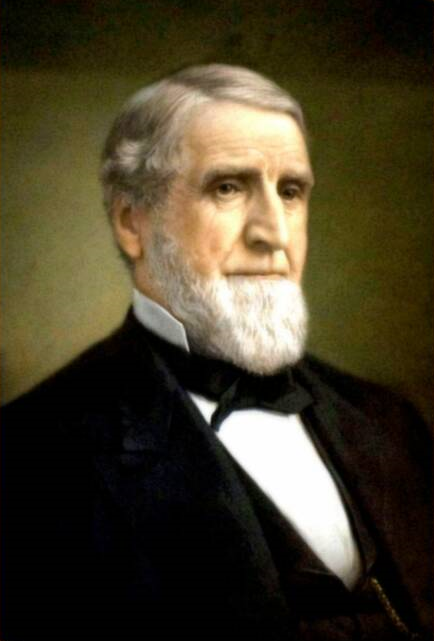
Historical · U.S. House · Pennsylvania · District 13
Asa Packer
Former U.S. Representative · Pennsylvania District 13 · 1853–1857 · Democratic
Asa Packer represented Pennsylvania's District 13 in the United States House of Representatives (1853–1857) for the Democratic party. The page below collects sourced biographical facts, term history, committee roles, and provenance for Packer.
Bioguide ID: P000006
Key facts
- Full name
- Asa Packer
- State
- Pennsylvania
- District
- District 13
- Party
- Democratic
- House service
- 1853–1857
- First House term
- 1853
- Status
- Left office
- Current term ends
- —
- Born
- 1805
- Bioguide ID
- P000006
- Committee assignments
- —
- Dataset version
- 1.20260606
Biographical narrative
902 words · sourced from the Wikipedia REST extract
Asa Packer was an American businessman and politician who served as a U.S. Representative for Pennsylvania's 13th congressional district from 1853 to 1857. A member of the Democratic Party, Packer was also a prominent figure in the railroad industry and played a significant role in the establishment of Lehigh University in Bethlehem, Pennsylvania. His contributions to both business and education have left a lasting impact on the region and beyond.
Early life and career
Asa Packer was born on December 29, 1805, in Mystic, Connecticut. He moved to Pennsylvania at a young age, where he began his career as a carpenter's apprentice under the guidance of his cousin Edward Packer in Brooklyn Township. This early experience in carpentry laid the foundation for his future endeavors in construction and business. Packer also worked seasonally in New York City as a carpenter, which further honed his skills in the trade.
After marrying Sarah Minerva Blakslee, Packer and his wife settled on a farm. During the winter months, he traveled to Tunkhannock, Pennsylvania, located along the Susquehanna River, where he utilized his carpentry skills to build and repair canal boats. This work continued for approximately eleven years, allowing him to gain valuable experience in the transportation industry.
In 1833, Packer relocated to Mauch Chunk, now known as Jim Thorpe, Pennsylvania. There, he became the owner of a canal boat that transported anthracite coal from the Coal Region of Pennsylvania to Philadelphia. His entrepreneurial spirit led him to establish a firm named A. & R. W. Packer, which specialized in building canal boats and locks for the Lehigh Coal & Navigation Company. This venture marked the beginning of Packer's significant involvement in the coal and transportation industries.
Packer's vision for improving transportation led him to advocate for the adoption of steam railways as a means of coal transportation. Although initially met with skepticism, his persistence paid off when he became the major stockholder of the Delaware, Lehigh, Schuylkill & Susquehanna Railroad Company in 1851. This company would later evolve into the Lehigh Valley Railroad, which was officially established in January 1853. Under Packer's leadership, the railroad constructed a line from Mauch Chunk to Easton between November 1852 and September 1855, significantly enhancing coal transport in the region.
House tenure
Asa Packer's political career began in earnest when he was elected to the Pennsylvania House of Representatives in 1842 and 1843. He later served as a county judge in Carbon County from 1843 to 1844. His political involvement and growing influence in Pennsylvania politics culminated in his election to the U.S. House of Representatives, where he served two terms as a Democratic member from 1853 until 1857.
During his time in Congress, Packer was involved in various legislative activities, although specific details about his legislative initiatives and voting record are not extensively documented. His tenure coincided with a period of significant national tension leading up to the Civil War, and he was part of a Congress that faced numerous challenges related to issues such as slavery and states' rights.
After completing his congressional terms, Packer remained active in politics. He was considered a potential candidate for the Democratic Party's presidential nomination in 1868, although he did not actively campaign for the position. Despite not securing the nomination, his name was put forward at the Democratic National Convention, where he garnered a modest number of delegates.
Packer also sought the Democratic nomination for the governorship of Pennsylvania in 1869. Although he lost the election to John W. Geary by a narrow margin, this campaign further solidified his status as a notable figure in Pennsylvania politics.
Legislative focus and committees
Throughout his congressional career, Asa Packer's legislative focus reflected his background in business and transportation. While specific committee assignments during his time in the House are not detailed, it can be inferred that his experience in the railroad and coal industries likely influenced his perspectives on infrastructure and economic development.
Packer's contributions extended beyond his legislative duties, as he was deeply invested in the establishment of Lehigh University. His vision for the university was rooted in his belief in the importance of education and technical training for the industrial workforce of the Lehigh Valley. In 1865, Packer made a substantial donation of $500,000 and provided land for the university's establishment. Lehigh University was chartered in 1866 and began instruction shortly thereafter, with Packer Hall, the first main building, completed in 1869.
Packer's commitment to education was further demonstrated by his ongoing support for Lehigh University, which included a significant bequest in his will. His legacy at the university is honored through various means, including the naming of buildings and the continued recognition of his contributions to higher education in Pennsylvania.
In addition to his work in education, Packer was known for his philanthropic efforts, particularly in support of St. Mark's Episcopal Church in Jim Thorpe, where he was a member. His contributions to the church and the community have been recognized, with the church itself being designated a National Historic Landmark.
Asa Packer passed away on May 17, 1879, in Philadelphia at the age of 73. His life and career reflect a blend of entrepreneurship, political involvement, and a commitment to education, leaving a lasting legacy in Pennsylvania and the broader American landscape. His residence, the Asa Packer Mansion, has been preserved as a museum and serves as a testament to his contributions to the region.
Notable legislation
Sponsored and co-sponsored legislation for Asa Packer is pending operator curation. The biographical narrative above carries the same provenance trail until per-bill rows are written.
Sources
- [1]https://en.wikipedia.org/wiki/Asa_PackerWikipedia · retrieved 2026-06-06
Notable quotes
Sourced quotes for Asa Packer are pending operator curation. Narrative-scope provenance remains attached below.
Sources
- [1]https://en.wikipedia.org/wiki/Asa_PackerWikipedia · retrieved 2026-06-06
Key positions
Curated policy positions for Asa Packer are pending operator review. The biographical narrative above carries the same provenance trail until per-topic positions are written.
Sources
- [1]https://en.wikipedia.org/wiki/Asa_PackerWikipedia · retrieved 2026-06-06
Terms served
- 1853–1855U.S. House · Term 1 · Democratic
- 1855–1857U.S. House · Term 2 · Democratic
Sources & provenance
Every attributable claim above carries a per-section [N] marker that resolves to the corresponding URL below. Each entry records the upstream provider, the canonical URL, and the timestamp at which the source was retrieved by the ingest pipeline.
Key facts
- https://bioguide.congress.gov/search/bio/P000006bioguide · retrieved 2026-06-06
- https://www.govtrack.us/congress/members/408417govtrack · retrieved 2026-06-06
Biographical narrative
- https://en.wikipedia.org/wiki/Asa_Packerwikipedia · retrieved 2026-06-06
Find your representative
Every U.S. state elects representatives by district. Browse Pennsylvania’s delegation, the full former-representative roster, or explore the role and term length.
Related on The Candidate
- Preceded by Joseph CaseyEarlier holder of the Pennsylvania District 13 House seat · Whig.Open
- Succeeded by William DimmickLater holder of the Pennsylvania District 13 House seat · Democratic.Open
- Adam SeybertFormer U.S. Representative · Pennsylvania District 1 · RepublicanOpen
- Benjamin SayFormer U.S. Representative · Pennsylvania District 1 · RepublicanOpen
- Chapman FreemanFormer U.S. Representative · Pennsylvania District 1 · RepublicanOpen
- Harry RansleyFormer U.S. Representative · Pennsylvania District 1 · RepublicanOpen