
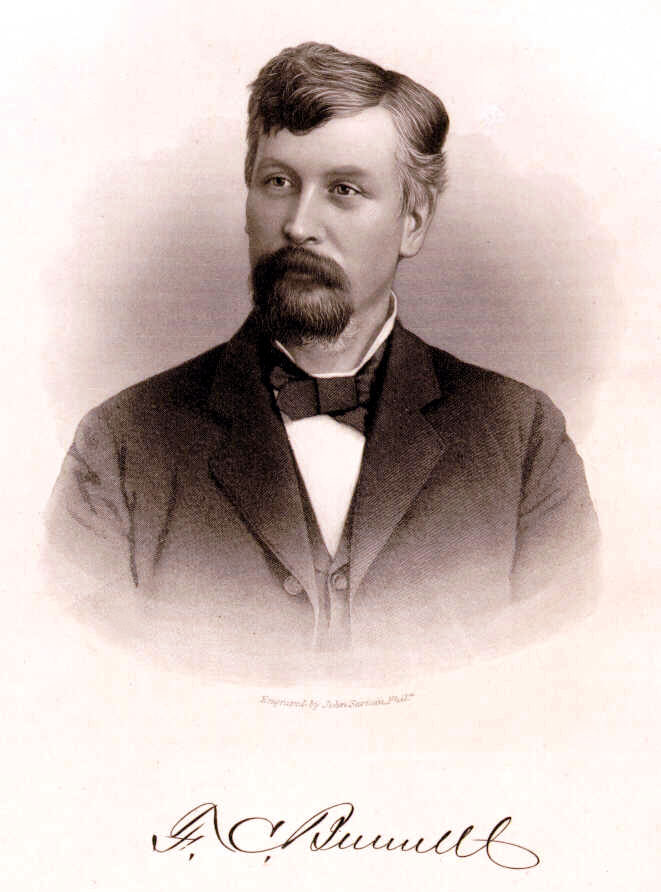
Historical · U.S. House · Pennsylvania · District 15
Frank Bunnell
Former U.S. Representative · Pennsylvania District 15 · 1871–1889 · Republican
Frank Bunnell represented Pennsylvania's District 15 in the United States House of Representatives (1871–1889) for the Republican party. The page below collects sourced biographical facts, term history, committee roles, and provenance for Bunnell.
Bioguide ID: B001064
Key facts
- Full name
- Frank Bunnell
- State
- Pennsylvania
- District
- District 15
- Party
- Republican
- House service
- 1871–1889
- First House term
- 1871
- Status
- Left office
- Current term ends
- —
- Born
- 1842
- Bioguide ID
- B001064
- Committee assignments
- —
- Dataset version
- 1.20260606
Biographical narrative
800 words · sourced from the Wikipedia REST extract
Frank Bunnell was a Republican politician who served as a U.S. Representative for Pennsylvania's 15th congressional district. His congressional career spanned three terms, beginning in 1871 and concluding in 1889. Bunnell's life was marked by his early involvement in the Civil War, his subsequent career in local business and agriculture, and his political endeavors at both the local and national levels.
Early life and career
Frank Bunnell was born on March 19, 1842, in Washington Township, Wyoming County, Pennsylvania. He was the son of James Bunnell and Mary Harding Bunnell, both of whom were natives of Pennsylvania. Bunnell grew up alongside his sister, Savannah, and received his early education in the common schools of Dauphin County. He later attended the Wyoming Seminary in Kingston, Pennsylvania, where he furthered his education.
At the age of 19, Bunnell responded to President Abraham Lincoln's call for volunteers during the Civil War. He enlisted on September 20, 1861, in Mehoopany, Pennsylvania, and was mustered into service on October 11, 1861, as a private in Company B of the 52nd Pennsylvania Infantry. Throughout his military service, Bunnell demonstrated leadership potential and was promoted to quartermaster sergeant on March 1, 1862. His regiment participated in significant battles, including the Battle of Williamsburg and the Battle of Seven Pines. However, Bunnell's military career was cut short when he was discharged on April 2, 1863, due to a surgeon's certificate of disability.
After the war, Bunnell returned to Luzerne County, where he worked as a merchant from 1864 to 1869. He later moved to Tunkhannock, Pennsylvania, where he engaged in agricultural and banking activities. His involvement in the local community extended to a long-term role as president of the Wyoming County Agricultural Society, where he contributed to the promotion of agricultural practices and community events.
In his personal life, Bunnell married Martha A. Smith, a resident of Stroudsburg, Pennsylvania, on October 1, 1898, in Tunkhannock. His early political career included an unsuccessful bid for federal office in 1872, but he later achieved success when he was elected to the Forty-second Congress to fill a vacancy left by the resignation of Ulysses Mercur. This marked the beginning of his congressional tenure.
House tenure
Bunnell's congressional career began in 1871 when he was elected to the U.S. House of Representatives. He served a total of three terms, with his first term commencing in the Forty-second Congress. His election to the House was notable as it followed a period of political instability and shifting allegiances in the post-Civil War era. Bunnell's tenure in the House included service during a time when the Republican Party was solidifying its influence in American politics, particularly in the aftermath of the Civil War.
During his time in Congress, Bunnell was re-elected to the Forty-ninth and Fiftieth Congresses, reflecting his continued support among constituents in Pennsylvania's 15th district. However, he chose not to seek renomination in 1888, marking the end of his formal legislative career. His decision not to run again may have been influenced by personal health issues, as he was later documented as suffering from rheumatism and deafness.
Bunnell's political activities were not limited to his congressional service. He also held local offices, including serving as the burgess and borough treasurer of Tunkhannock in 1884. These roles allowed him to maintain a connection with his community and address local issues while serving in the House of Representatives.
Legislative focus and committees
While specific details regarding the legislation Bunnell supported or the committees on which he served during his congressional tenure are not extensively documented, his role as a Republican representative during a transformative period in American history suggests that he was involved in discussions and decisions that shaped post-war policies. The Republican Party at the time was focused on issues such as Reconstruction, economic development, and the integration of formerly enslaved individuals into society.
Bunnell's background as a businessman and his involvement in agricultural organizations likely influenced his perspectives on economic and agricultural policies. His experience in local governance and community leadership may have also informed his legislative priorities, particularly in areas affecting his constituents in Pennsylvania.
After leaving Congress, Bunnell continued to reside in Tunkhannock until around the turn of the century, at which point he moved to Philadelphia. His later years were marked by health challenges, including Bright's Disease and aortic regurgitation, which ultimately led to his death on September 11, 1911. Following his passing, Bunnell was laid to rest in Gravel Hill Cemetery in Tunkhannock, Pennsylvania.
Frank Bunnell's life and career reflect a commitment to public service, both in military and political capacities. His contributions to his community and his role in the U.S. House of Representatives during a pivotal time in American history underscore the complexities of governance and the impact of local leaders on national policies.
Notable legislation
Sponsored and co-sponsored legislation for Frank Bunnell is pending operator curation. The biographical narrative above carries the same provenance trail until per-bill rows are written.
Sources
- [1]https://en.wikipedia.org/wiki/Frank_C._BunnellWikipedia · retrieved 2026-06-06
Notable quotes
Sourced quotes for Frank Bunnell are pending operator curation. Narrative-scope provenance remains attached below.
Sources
- [1]https://en.wikipedia.org/wiki/Frank_C._BunnellWikipedia · retrieved 2026-06-06
Key positions
Curated policy positions for Frank Bunnell are pending operator review. The biographical narrative above carries the same provenance trail until per-topic positions are written.
Sources
- [1]https://en.wikipedia.org/wiki/Frank_C._BunnellWikipedia · retrieved 2026-06-06
Terms served
- 1871–1873U.S. House · Term 1 · Republican
- 1885–1887U.S. House · Term 2 · Republican
- 1887–1889U.S. House · Term 3 · Republican
Sources & provenance
Every attributable claim above carries a per-section [N] marker that resolves to the corresponding URL below. Each entry records the upstream provider, the canonical URL, and the timestamp at which the source was retrieved by the ingest pipeline.
Key facts
- https://bioguide.congress.gov/search/bio/B001064bioguide · retrieved 2026-06-06
- https://www.govtrack.us/congress/members/402011govtrack · retrieved 2026-06-06
Biographical narrative
- https://en.wikipedia.org/wiki/Frank_C._Bunnellwikipedia · retrieved 2026-06-06
Find your representative
Every U.S. state elects representatives by district. Browse Pennsylvania’s delegation, the full former-representative roster, or explore the role and term length.
Related on The Candidate
- Preceded by Adam GlossbrennerEarlier holder of the Pennsylvania District 15 House seat · Democratic.Open
- Succeeded by Myron WrightLater holder of the Pennsylvania District 15 House seat · Republican.Open
- Adam SeybertFormer U.S. Representative · Pennsylvania District 1 · RepublicanOpen
- Benjamin SayFormer U.S. Representative · Pennsylvania District 1 · RepublicanOpen
- Chapman FreemanFormer U.S. Representative · Pennsylvania District 1 · RepublicanOpen
- Harry RansleyFormer U.S. Representative · Pennsylvania District 1 · RepublicanOpen