
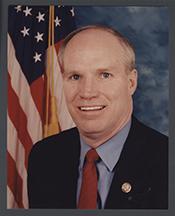
Historical · U.S. House · Pennsylvania · District 17
Tim Holden
Former U.S. Representative · Pennsylvania District 17 · 1993–2013 · Democratic
Tim Holden represented Pennsylvania's District 17 in the United States House of Representatives (1993–2013) for the Democratic party. The page below collects sourced biographical facts, term history, committee roles, and provenance for Holden.
Bioguide ID: H000712
Key facts
- Full name
- Tim Holden
- State
- Pennsylvania
- District
- District 17
- Party
- Democratic
- House service
- 1993–2013
- First House term
- 1993
- Status
- Left office
- Current term ends
- —
- Born
- 1957
- Bioguide ID
- H000712
- Committee assignments
- —
- Dataset version
- 1.20260605
Biographical narrative
1,102 words · sourced from the Wikipedia REST extract
Thomas Timothy Holden is a former American politician who served as a Democratic U.S. Representative for Pennsylvania's 17th congressional district from 1993 until 2013. Over the course of his ten terms in Congress, Holden became known for his ability to navigate a challenging political landscape, particularly in a district that underwent significant changes due to redistricting. He was recognized as the dean of the Pennsylvania congressional delegation during his final term in the 112th United States Congress. Following his congressional career, he took on the role of chairman of the Pennsylvania Liquor Control Board in 2015, a position he held until his retirement in 2024.
Early life and career
Tim Holden was born on March 5, 1957, in St. Clair, Pennsylvania, where he spent his formative years. He graduated from St. Clair Area High School in 1975 and went on to pursue higher education at Bloomsburg University of Pennsylvania, where he earned a bachelor's degree in sociology in 1980. His early career was marked by a diverse range of occupations, reflecting his commitment to public service and community engagement. Holden became a licensed real estate agent and later transitioned into the insurance industry, obtaining his broker's license in 1983.
In addition to his work in real estate and insurance, Holden's career included significant roles in law enforcement and public administration. He served as a probation officer, which provided him with insights into the challenges faced by individuals within the criminal justice system. His political career began in earnest when he was elected as the sheriff of Schuylkill County, a position he held from 1985 until 1993. This role allowed him to connect with the community and understand the needs of his constituents, particularly those from working-class backgrounds, which would later influence his legislative priorities.
Holden's political identity was shaped by his upbringing and experiences in St. Clair, where he developed a strong connection to the ordinary working people of his district. His Roman Catholic faith also played a role in shaping his values and approach to public service. These elements of his early life and career laid the groundwork for his subsequent political endeavors, culminating in his election to the U.S. House of Representatives.
House tenure
Holden's tenure in the U.S. House of Representatives began in 1993 when he won a competitive election to represent Pennsylvania's 6th congressional district. This district, which included parts of Berks and Schuylkill counties, was characterized by a demographic that had historically leaned toward Republican candidates. Despite this challenge, Holden was able to secure re-election multiple times throughout the 1990s, demonstrating his ability to connect with constituents and address their concerns.
In the 1992 Democratic primary, he emerged victorious against notable opponents, including the Mayor of Reading, Warren Haggerty, and John Reusing. In the general election, Holden faced Republican nominee John E. Jones III, a local government solicitor, and won by a narrow margin. His subsequent re-elections in 1994, 1996, 1998, and 2000 were marked by increasing margins of victory, showcasing his growing support within the district.
However, significant changes occurred following the 2000 United States census, which resulted in the redistricting of Pennsylvania's congressional map. The Republican-controlled General Assembly dismantled Holden's original district, redistributing its territory among other districts. This redistricting process was seen by some as an attempt to weaken Holden's electoral prospects, as the newly drawn 17th district was perceived to favor Republican candidates. Despite these challenges, Holden chose to run for the newly configured 17th district, which included a substantial portion of territory that was unfamiliar to him.
In a surprising turn of events, Holden defeated incumbent Republican Congressman George Gekas in the 2002 election, marking one of the significant upsets in recent political history. This victory was attributed to Holden's ability to connect with voters in previously neglected neighborhoods and his strategic outreach efforts. He continued to win re-election in subsequent cycles, facing various Republican challengers, including Scott Paterno in 2004 and Matthew Wertz in 2006, both of whom he defeated comfortably.
Holden's electoral success persisted through 2008, where he faced retired Pennsylvania State Trooper Toni Gilhooley and secured another victory. In 2010, he encountered a more formidable challenge from State Senator Dave Argall, who had a strong local presence. Despite this, Holden managed to win re-election, although he faced a primary challenge from within his own party, which he successfully navigated.
However, Holden's political career faced a significant turning point in 2012 when he was defeated in the Democratic primary after the district boundaries were redrawn once again. This loss marked the end of his tenure in Congress, concluding a two-decade-long career that had seen him navigate both the challenges of a changing political landscape and the complexities of representing a diverse constituency.
Legislative focus and committees
During his time in the U.S. House of Representatives, Tim Holden focused on a range of legislative issues that reflected the interests and needs of his constituents. His background in sociology and public service informed his approach to policy-making, particularly in areas such as public safety, healthcare, and economic development. Holden's experience as a sheriff and probation officer provided him with a unique perspective on law enforcement and criminal justice issues, which he prioritized during his congressional tenure.
Holden served on several committees that allowed him to influence legislation in key areas. His work on the House Committee on Agriculture was particularly notable, as he represented a district with significant agricultural interests. He advocated for policies that supported farmers and rural communities, recognizing the importance of agriculture to the local economy.
In addition to his work on agricultural issues, Holden was involved in committees that addressed healthcare and education. He sought to improve access to healthcare services for his constituents and advocated for educational initiatives that would benefit students in Pennsylvania. His legislative efforts were often characterized by a pragmatic approach, seeking bipartisan support for initiatives that would benefit the community.
Throughout his time in Congress, Holden maintained a focus on the needs of working-class families, often aligning his legislative priorities with the interests of ordinary citizens. His ability to connect with constituents and understand their concerns contributed to his electoral success and his reputation as a dedicated public servant.
After leaving Congress, Holden continued his public service by taking on the role of chairman of the Pennsylvania Liquor Control Board in 2015. He held this position until his retirement in 2024, further demonstrating his commitment to serving the people of Pennsylvania. Throughout his career, Holden's dedication to public service and his ability to navigate complex political landscapes have left a lasting impact on his community and the state of Pennsylvania.
Notable legislation
Sponsored and co-sponsored legislation for Tim Holden is pending operator curation. The biographical narrative above carries the same provenance trail until per-bill rows are written.
Sources
- [1]https://en.wikipedia.org/wiki/Tim_HoldenWikipedia · retrieved 2026-06-05
Notable quotes
Sourced quotes for Tim Holden are pending operator curation. Narrative-scope provenance remains attached below.
Sources
- [1]https://en.wikipedia.org/wiki/Tim_HoldenWikipedia · retrieved 2026-06-05
Key positions
Curated policy positions for Tim Holden are pending operator review. The biographical narrative above carries the same provenance trail until per-topic positions are written.
Sources
- [1]https://en.wikipedia.org/wiki/Tim_HoldenWikipedia · retrieved 2026-06-05
Terms served
- 1993–1995U.S. House · Term 1 · Democratic
- 1995–1997U.S. House · Term 2 · Democratic
- 1997–1999U.S. House · Term 3 · Democratic
- 1999–2001U.S. House · Term 4 · Democratic
- 2001–2003U.S. House · Term 5 · Democratic
- 2003–2005U.S. House · Term 6 · Democratic
- 2005–2007U.S. House · Term 7 · Democratic
- 2007–2009U.S. House · Term 8 · Democratic
- 2009–2011U.S. House · Term 9 · Democratic
- 2011–2013U.S. House · Term 10 · Democratic
Sources & provenance
Every attributable claim above carries a per-section [N] marker that resolves to the corresponding URL below. Each entry records the upstream provider, the canonical URL, and the timestamp at which the source was retrieved by the ingest pipeline.
Key facts
- https://bioguide.congress.gov/search/bio/H000712bioguide · retrieved 2026-06-05
- http://www.holden.house.govhouse.gov · retrieved 2026-06-05
Biographical narrative
- https://en.wikipedia.org/wiki/Tim_Holdenwikipedia · retrieved 2026-06-05
Find your representative
Every U.S. state elects representatives by district. Browse Pennsylvania’s delegation, the full former-representative roster, or explore the role and term length.
Related on The Candidate
- Preceded by Allen ErtelEarlier holder of the Pennsylvania District 17 House seat · Democratic.Open
- Succeeded by Conor LambLater holder of the Pennsylvania District 17 House seat · Democratic.Open
- Adam SeybertFormer U.S. Representative · Pennsylvania District 1 · RepublicanOpen
- Benjamin SayFormer U.S. Representative · Pennsylvania District 1 · RepublicanOpen
- Chapman FreemanFormer U.S. Representative · Pennsylvania District 1 · RepublicanOpen
- Harry RansleyFormer U.S. Representative · Pennsylvania District 1 · RepublicanOpen