
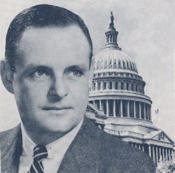
Historical · U.S. House · Pennsylvania · District 18
Douglas Elliott
Former U.S. Representative · Pennsylvania District 18 · 1959–1961 · Republican
Douglas Elliott represented Pennsylvania's District 18 in the United States House of Representatives (1959–1961) for the Republican party. The page below collects sourced biographical facts, term history, committee roles, and provenance for Elliott.
Bioguide ID: E000121
Key facts
- Full name
- Douglas Elliott
- State
- Pennsylvania
- District
- District 18
- Party
- Republican
- House service
- 1959–1961
- First House term
- 1959
- Status
- Left office
- Current term ends
- —
- Born
- 1921
- Bioguide ID
- E000121
- Committee assignments
- —
- Dataset version
- 1.20260605
Biographical narrative
1,112 words · sourced from the Wikipedia REST extract
Douglas Elliott was a Republican politician who served as a U.S. Representative for Pennsylvania's 18th congressional district. His tenure in the House of Representatives was brief, spanning from 1960 until his untimely death later that same year. Elliott's career was marked by his involvement in various professional roles prior to his congressional service, including significant positions in education and public relations. His life and career were ultimately cut short, leaving a legacy that is remembered within the context of his contributions to Pennsylvania politics.
Early life and career
Douglas Hemphill Elliott was born on June 3, 1921, in Philadelphia, Pennsylvania. Growing up in a major urban center, he attended local schools and demonstrated academic promise. He graduated from the Haverford School, an independent preparatory school known for its rigorous academic standards, in 1938. Following his secondary education, Elliott pursued higher education at the University of Virginia, where he studied from 1938 until 1940. His time at the university would have provided him with a foundation in critical thinking and public discourse, which would later serve him in his political career.
With the onset of World War II, Elliott enlisted in the United States Navy, where he served from 1941 until his discharge in 1945. Rising to the rank of chief petty officer, he contributed to the war effort during a pivotal time in American history. His military service likely instilled in him a sense of duty and leadership, qualities that would be important in his subsequent professional endeavors.
After the war, Elliott transitioned into the civilian workforce, initially working for various insurance companies from 1945 to 1952. This experience would have equipped him with skills in management and communication, as well as an understanding of the financial sector. In 1950, he took on the role of director of public relations at the Franklin Institute in Philadelphia, a prominent science museum and center for education. This position allowed him to engage with the public and promote scientific literacy, further enhancing his communication skills and public engagement.
In 1952, Elliott moved into academia, serving as vice president of Wilson College in Chambersburg, Pennsylvania. His tenure at the college lasted until 1960, during which he would have been involved in administrative decision-making and the promotion of educational initiatives. This role not only demonstrated his commitment to education but also positioned him as a respected figure within the community. His leadership at Wilson College likely helped him build a network of contacts that would later benefit his political career.
Elliott's political journey began in earnest when he was elected to the Pennsylvania State Senate in 1956. His time in the state legislature allowed him to gain valuable experience in governance and public policy. He served in the Senate until he was elected to the U.S. House of Representatives in 1960, filling a vacancy created by the death of Richard Simpson. His election to the House marked a significant step in his political career, reflecting his growing influence and the trust placed in him by his constituents.
House tenure
Douglas Elliott's congressional career began in April 1960 when he was sworn in as a member of the Eighty-sixth Congress. His time in the House was notably brief, as he served until his death in June of the same year. Despite the short duration of his tenure, Elliott's election to the House represented a culmination of his previous experiences in public service and education. He was part of a legislative body that was addressing numerous critical issues facing the nation during that period, including civil rights, economic policy, and foreign relations.
As a member of the Republican Party, Elliott aligned himself with the party's platform, which at the time included a focus on limited government, fiscal conservatism, and a strong national defense. His background in public relations and education may have influenced his approach to communication and advocacy within the House. However, specific details regarding his legislative actions, committee assignments, or particular issues he championed during his time in Congress remain limited due to the brevity of his service.
Elliott's time in the House was marked by the political climate of the late 1950s and early 1960s, a period characterized by significant social change and political upheaval. The civil rights movement was gaining momentum, and debates over economic policies were intensifying. As a new member of Congress, Elliott would have had the opportunity to engage with these pressing issues, although the specifics of his contributions are not well-documented.
Tragically, Elliott's congressional career came to an abrupt end when he died on June 19, 1960. His death was ruled a suicide, and the circumstances surrounding it raised questions about the pressures faced by public figures. The loss of a sitting member of Congress is always felt deeply within the political community and among constituents, and Elliott's passing marked a significant moment in Pennsylvania's political landscape.
Legislative focus and committees
While Douglas Elliott's time in the U.S. House of Representatives was limited, his background in education, public relations, and state politics likely informed his legislative focus and priorities. However, due to the short duration of his service, detailed records of his specific legislative initiatives or committee assignments are not extensively documented.
Elliott's experience as vice president of Wilson College and his role in public relations may have influenced his perspective on education policy and community engagement. It is reasonable to assume that he would have been interested in issues related to education, particularly in advocating for policies that support educational institutions and promote access to quality education for all citizens.
In addition to education, Elliott's military service in the Navy may have led him to prioritize issues related to national defense and veterans' affairs. Given the context of the Cold War during his time in office, he may have been involved in discussions surrounding military readiness and support for service members returning to civilian life.
While specific legislative achievements are not recorded, Elliott's commitment to public service and his previous roles in education and public relations suggest that he would have approached his responsibilities in Congress with a focus on community needs and effective communication. His background provided him with a unique perspective on the challenges facing both his constituents and the nation as a whole.
In summary, Douglas Elliott's life and career reflect a trajectory marked by public service, education, and a commitment to community engagement. His brief tenure in the U.S. House of Representatives was a culmination of his experiences, although it was cut short by his untimely death. Elliott's legacy continues to be remembered within the context of Pennsylvania's political history and the broader narrative of American governance during a time of significant change.
Notable legislation
Sponsored and co-sponsored legislation for Douglas Elliott is pending operator curation. The biographical narrative above carries the same provenance trail until per-bill rows are written.
Sources
- [1]https://en.wikipedia.org/wiki/Douglas_Hemphill_ElliottWikipedia · retrieved 2026-06-05
Notable quotes
Sourced quotes for Douglas Elliott are pending operator curation. Narrative-scope provenance remains attached below.
Sources
- [1]https://en.wikipedia.org/wiki/Douglas_Hemphill_ElliottWikipedia · retrieved 2026-06-05
Key positions
Curated policy positions for Douglas Elliott are pending operator review. The biographical narrative above carries the same provenance trail until per-topic positions are written.
Sources
- [1]https://en.wikipedia.org/wiki/Douglas_Hemphill_ElliottWikipedia · retrieved 2026-06-05
Terms served
- 1959–1961U.S. House · Term 1 · Republican
Sources & provenance
Every attributable claim above carries a per-section [N] marker that resolves to the corresponding URL below. Each entry records the upstream provider, the canonical URL, and the timestamp at which the source was retrieved by the ingest pipeline.
Key facts
- https://bioguide.congress.gov/search/bio/E000121bioguide · retrieved 2026-06-05
- https://www.govtrack.us/congress/members/403812govtrack · retrieved 2026-06-05
Biographical narrative
- https://en.wikipedia.org/wiki/Douglas_Hemphill_Elliottwikipedia · retrieved 2026-06-05
Find your representative
Every U.S. state elects representatives by district. Browse Pennsylvania’s delegation, the full former-representative roster, or explore the role and term length.
Related on The Candidate
- Preceded by Benjamin FochtEarlier holder of the Pennsylvania District 18 House seat · Republican.Open
- Succeeded by Douglas WalgrenLater holder of the Pennsylvania District 18 House seat · Democratic.Open
- Adam SeybertFormer U.S. Representative · Pennsylvania District 1 · RepublicanOpen
- Benjamin SayFormer U.S. Representative · Pennsylvania District 1 · RepublicanOpen
- Chapman FreemanFormer U.S. Representative · Pennsylvania District 1 · RepublicanOpen
- Harry RansleyFormer U.S. Representative · Pennsylvania District 1 · RepublicanOpen