
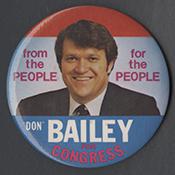
Historical · U.S. House · Pennsylvania · District 21
Donald Bailey
Former U.S. Representative · Pennsylvania District 21 · 1979–1983 · Democratic
Donald Bailey represented Pennsylvania's District 21 in the United States House of Representatives (1979–1983) for the Democratic party. The page below collects sourced biographical facts, term history, committee roles, and provenance for Bailey.
Bioguide ID: B000037
Key facts
- Full name
- Donald Bailey
- State
- Pennsylvania
- District
- District 21
- Party
- Democratic
- House service
- 1979–1983
- First House term
- 1979
- Status
- Left office
- Current term ends
- —
- Born
- 1945
- Bioguide ID
- B000037
- Committee assignments
- —
- Dataset version
- 1.20260605
Biographical narrative
839 words · sourced from the Wikipedia REST extract
Donald A. Bailey was an American lawyer and politician who served as a Democratic member of the United States House of Representatives from Pennsylvania's 21st congressional district from 1979 to 1983. Born on July 21, 1945, in Allegheny County, Pennsylvania, Bailey's career spanned various roles in public service and law, including a term as Pennsylvania's Auditor General from 1985 to 1989. He was known for his moderate-to-conservative stance within the Democratic Party and was involved in several significant legislative efforts during his time in Congress.
Early life and career
Donald A. Bailey was born to Glenn and Anna Bailey in Allegheny County, Pennsylvania. He spent his formative years in both Allegheny and Westmoreland counties. After completing his secondary education at Greensburg High School in 1963, Bailey pursued higher education at the University of Michigan, where he earned a Bachelor of Arts degree in 1967. During his time at the university, he was a member of the Michigan Wolverines football team, playing as a guard from 1964 to 1966. His athletic career included participation in the 1965 Rose Bowl and the North/South All-Star Game.
Following his graduation, Bailey served in the United States Army, where he was deployed to Vietnam and served with the 82nd and 101st Airborne Divisions. His military service was distinguished; he received several honors, including the Silver Star and three Bronze Stars, two of which were awarded for acts of valor. He also earned the Army Commendation Medal with a "V" device for valor, an Air Medal, and a second Army Commendation Medal for meritorious service.
After returning from military service, Bailey transitioned into the workforce, taking on various blue-collar jobs, including a position as a steelworker at J. & L. Steel Corporation. During this time, he became a member of the United Steelworkers of America. In pursuit of a legal career, he attended Duquesne University School of Law, graduating with a Juris Doctor degree in 1976, funded by the G.I. Bill. He was admitted to the Pennsylvania bar the same year, marking the beginning of his legal practice.
House tenure
Bailey's political career began in earnest when he ran for the U.S. House of Representatives in 1978, following the retirement of incumbent Democrat John Dent from Pennsylvania's 21st congressional district. He successfully secured the Democratic primary nomination with a plurality of votes in a crowded field of eleven candidates. Bailey went on to win the general election, receiving a majority of the votes cast.
During his first term, which began in 1979, Bailey was recognized as a moderate-to-conservative Democrat. His legislative efforts included sponsoring funding for synthetic fuel initiatives. He was known for his critical stance toward the policies of Democratic President Jimmy Carter, although he ultimately supported Carter during a primary challenge from Senator Ted Kennedy, aligning himself with the prevailing sentiment among many Western Pennsylvania Democrats.
Bailey faced a competitive primary in 1980 but emerged victorious, securing re-election with a significant majority of the votes. His second term was marked by challenges, particularly due to redistricting that occurred in 1982, which resulted in the elimination of his congressional district. Despite most of his constituents being merged into the district represented by fellow Democrat John Murtha, Bailey chose to run in the newly drawn Pennsylvania's 12th congressional district. However, he was defeated in the primary by Murtha.
Legislative focus and committees
During his tenure in the House, Bailey served on several important committees that shaped his legislative focus. He was a member of the United States House Committee on Ways and Means, which is responsible for taxation and revenue generation, as well as the United States House Committee on Education and Labor, which oversees education policy and labor issues. Additionally, he served on the United States House Ethics Committee and the United States House Committee on Armed Services, reflecting his interest in both military and ethical oversight matters.
Bailey's legislative record included negotiations for loans to support the Wheeling-Pittsburgh Steel company, demonstrating his commitment to the steel industry, which was vital to Pennsylvania's economy. He was also known for opposing certain policies proposed by Republican President Ronald Reagan, including spending cuts and a balanced budget amendment. In 1981, he took a stand against raising the retirement age, aligning with the interests of his constituents.
After leaving Congress in 1983, Bailey continued his public service career by being elected as Pennsylvania's Auditor General in 1984. He held this position until 1989, during which he implemented several reforms, including the establishment of the first work-site child daycare facility in Pennsylvania government and setting minimum education standards for state auditors.
Bailey's career in law continued after his tenure as Auditor General, focusing on civil rights and other legal matters. However, he faced professional challenges later in his career, including a suspension from practicing law due to misconduct.
Donald A. Bailey passed away on March 9, 2020, at the age of 74. His legacy includes his contributions to Pennsylvania's political landscape and his service to the state and nation in various capacities throughout his career.
Notable legislation
Sponsored and co-sponsored legislation for Donald Bailey is pending operator curation. The biographical narrative above carries the same provenance trail until per-bill rows are written.
Sources
- [1]https://en.wikipedia.org/wiki/Donald_A._BaileyWikipedia · retrieved 2026-06-05
Notable quotes
Sourced quotes for Donald Bailey are pending operator curation. Narrative-scope provenance remains attached below.
Sources
- [1]https://en.wikipedia.org/wiki/Donald_A._BaileyWikipedia · retrieved 2026-06-05
Key positions
Curated policy positions for Donald Bailey are pending operator review. The biographical narrative above carries the same provenance trail until per-topic positions are written.
Sources
- [1]https://en.wikipedia.org/wiki/Donald_A._BaileyWikipedia · retrieved 2026-06-05
Terms served
- 1979–1981U.S. House · Term 1 · Democratic
- 1981–1983U.S. House · Term 2 · Democratic
Sources & provenance
Every attributable claim above carries a per-section [N] marker that resolves to the corresponding URL below. Each entry records the upstream provider, the canonical URL, and the timestamp at which the source was retrieved by the ingest pipeline.
Key facts
- https://bioguide.congress.gov/search/bio/B000037bioguide · retrieved 2026-06-05
- https://www.govtrack.us/congress/members/401042govtrack · retrieved 2026-06-05
Biographical narrative
- https://en.wikipedia.org/wiki/Donald_A._Baileywikipedia · retrieved 2026-06-05
Find your representative
Every U.S. state elects representatives by district. Browse Pennsylvania’s delegation, the full former-representative roster, or explore the role and term length.
Related on The Candidate
- Preceded by John DentEarlier holder of the Pennsylvania District 21 House seat · Democratic.Open
- Succeeded by Thomas RidgeLater holder of the Pennsylvania District 21 House seat · Republican.Open
- Adam SeybertFormer U.S. Representative · Pennsylvania District 1 · RepublicanOpen
- Benjamin SayFormer U.S. Representative · Pennsylvania District 1 · RepublicanOpen
- Chapman FreemanFormer U.S. Representative · Pennsylvania District 1 · RepublicanOpen
- Harry RansleyFormer U.S. Representative · Pennsylvania District 1 · RepublicanOpen