
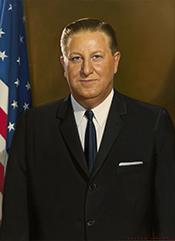
Historical · U.S. House · Pennsylvania · District 22
Thomas Morgan
Former U.S. Representative · Pennsylvania District 22 · 1945–1977 · Democratic
Thomas Morgan represented Pennsylvania's District 22 in the United States House of Representatives (1945–1977) for the Democratic party. The page below collects sourced biographical facts, term history, committee roles, and provenance for Morgan.
Bioguide ID: M000958
Key facts
- Full name
- Thomas Morgan
- State
- Pennsylvania
- District
- District 22
- Party
- Democratic
- House service
- 1945–1977
- First House term
- 1945
- Status
- Left office
- Current term ends
- —
- Born
- 1906
- Bioguide ID
- M000958
- Committee assignments
- —
- Dataset version
- 1.20260605
Biographical narrative
933 words · sourced from the Wikipedia REST extract
Thomas E. Morgan was a prominent Democratic politician who served as a U.S. Representative for Pennsylvania's 22nd congressional district from 1945 until 1977. His lengthy tenure in the House of Representatives spanned over three decades, during which he played a significant role in shaping U.S. foreign policy and international relations. Morgan's background in medicine and his commitment to public service defined his career, making him a notable figure in Pennsylvania's political landscape.
Early life and career
Thomas E. Morgan was born on October 13, 1906, in Ellsworth, Pennsylvania. He was the son of immigrant parents, with his mother hailing from England and his father from Wales. This diverse heritage influenced his worldview and approach to public service. Morgan pursued higher education at Waynesburg College, where he completed his undergraduate studies in 1930. Following his graduation, he attended the Detroit College of Medicine and Surgery, earning his medical degree in 1933. He furthered his education at Wayne University in Detroit, Michigan, graduating in 1934.
After completing his education, Morgan began his medical career in 1935, establishing a practice in Fredericktown, Pennsylvania. His background in medicine provided him with a unique perspective on health-related issues, which would later inform his legislative priorities. Morgan's early career in medicine was marked by a commitment to serving his community, a value that would carry through to his later work in Congress.
Morgan's entry into politics came during a time of significant change in the United States. The nation was grappling with the aftermath of the Great Depression and the onset of World War II. His medical background and community involvement likely contributed to his understanding of the pressing issues facing his constituents. In 1944, he successfully ran for a seat in the U.S. House of Representatives, marking the beginning of a long and impactful political career.
House tenure
Morgan was first elected to the U.S. House of Representatives in 1945, representing Pennsylvania's 22nd congressional district. Over the course of his political career, he was re-elected to 15 additional terms, serving a total of 16 consecutive terms in office. His tenure in Congress was characterized by a commitment to addressing both domestic and international issues, reflecting the evolving priorities of the nation during the mid-20th century.
During his time in the House, Morgan was involved in numerous legislative initiatives and debates. He served as the Chairman of the United States House Committee on Foreign Affairs from the 86th through the 93rd Congresses, a position that placed him at the forefront of U.S. foreign policy discussions. His leadership in this committee allowed him to influence key decisions regarding international relations, particularly during the Cold War era.
Morgan's role as Chairman of the Foreign Affairs Committee was significant, as it involved overseeing matters related to diplomacy, international trade, and national security. He was known for his ability to navigate complex geopolitical issues and work collaboratively with colleagues across party lines. His expertise in foreign affairs was further recognized when he continued to serve as the Chairman of the United States House Committee on International Relations during the 94th Congress.
Throughout his congressional career, Morgan was an advocate for various causes, including healthcare, education, and civil rights. His medical background informed his perspective on health-related legislation, and he often championed initiatives aimed at improving public health and access to medical care. Morgan's dedication to his constituents was evident in his efforts to address their concerns and advocate for policies that would benefit the people of Pennsylvania.
Morgan's political career came to an end when he chose not to seek re-election in 1976. His decision marked the conclusion of a notable chapter in Pennsylvania's political history, as he left behind a legacy of service and commitment to public welfare.
Legislative focus and committees
Throughout his extensive career in the U.S. House of Representatives, Thomas E. Morgan focused on a range of legislative issues, with a particular emphasis on foreign affairs and international relations. His role as Chairman of the House Committee on Foreign Affairs allowed him to shape U.S. policy on critical global issues, including diplomacy, trade, and military engagement. Morgan's leadership in this committee was marked by a commitment to fostering international cooperation and understanding.
In addition to his work on foreign affairs, Morgan was also involved in various other legislative initiatives. His background in medicine and surgery influenced his approach to healthcare policy, and he advocated for measures aimed at improving public health and access to medical services. Morgan's understanding of the healthcare system and its challenges informed his legislative priorities, as he sought to address issues affecting the well-being of his constituents.
Morgan's tenure on the House Committee on International Relations further underscored his dedication to global issues. In this role, he continued to address the complexities of international diplomacy and the United States' role in the world. His efforts in this capacity were instrumental in shaping U.S. responses to international crises and fostering relationships with other nations.
Throughout his career, Morgan demonstrated a commitment to bipartisanship and collaboration. He worked with colleagues from both parties to advance legislation that addressed pressing issues facing the nation and the world. His ability to build consensus and navigate complex political landscapes contributed to his effectiveness as a legislator.
In summary, Thomas E. Morgan's career in the U.S. House of Representatives was marked by a dedication to public service, a commitment to addressing both domestic and international issues, and a focus on improving the lives of his constituents. His legacy as a long-serving member of Congress reflects the evolving priorities of the nation during a transformative period in American history.
Notable legislation
Sponsored and co-sponsored legislation for Thomas Morgan is pending operator curation. The biographical narrative above carries the same provenance trail until per-bill rows are written.
Sources
- [1]https://en.wikipedia.org/wiki/Thomas_E._MorganWikipedia · retrieved 2026-06-05
Notable quotes
Sourced quotes for Thomas Morgan are pending operator curation. Narrative-scope provenance remains attached below.
Sources
- [1]https://en.wikipedia.org/wiki/Thomas_E._MorganWikipedia · retrieved 2026-06-05
Key positions
Curated policy positions for Thomas Morgan are pending operator review. The biographical narrative above carries the same provenance trail until per-topic positions are written.
Sources
- [1]https://en.wikipedia.org/wiki/Thomas_E._MorganWikipedia · retrieved 2026-06-05
Terms served
- 1945–1947U.S. House · Term 1 · Democratic
- 1947–1949U.S. House · Term 2 · Democratic
- 1949–1951U.S. House · Term 3 · Democratic
- 1951–1953U.S. House · Term 4 · Democratic
- 1953–1955U.S. House · Term 5 · Democratic
- 1955–1957U.S. House · Term 6 · Democratic
- 1957–1959U.S. House · Term 7 · Democratic
- 1959–1961U.S. House · Term 8 · Democratic
- 1961–1963U.S. House · Term 9 · Democratic
- 1963–1965U.S. House · Term 10 · Democratic
- 1965–1967U.S. House · Term 11 · Democratic
- 1967–1969U.S. House · Term 12 · Democratic
- 1969–1971U.S. House · Term 13 · Democratic
- 1971–1973U.S. House · Term 14 · Democratic
- 1973–1975U.S. House · Term 15 · Democratic
- 1975–1977U.S. House · Term 16 · Democratic
Sources & provenance
Every attributable claim above carries a per-section [N] marker that resolves to the corresponding URL below. Each entry records the upstream provider, the canonical URL, and the timestamp at which the source was retrieved by the ingest pipeline.
Key facts
- https://bioguide.congress.gov/search/bio/M000958bioguide · retrieved 2026-06-05
- https://www.govtrack.us/congress/members/407926govtrack · retrieved 2026-06-05
Biographical narrative
- https://en.wikipedia.org/wiki/Thomas_E._Morganwikipedia · retrieved 2026-06-05
Find your representative
Every U.S. state elects representatives by district. Browse Pennsylvania’s delegation, the full former-representative roster, or explore the role and term length.
Related on The Candidate
- Preceded by Harry HainesEarlier holder of the Pennsylvania District 22 House seat · Democratic.Open
- Adam SeybertFormer U.S. Representative · Pennsylvania District 1 · RepublicanOpen
- Benjamin SayFormer U.S. Representative · Pennsylvania District 1 · RepublicanOpen
- Chapman FreemanFormer U.S. Representative · Pennsylvania District 1 · RepublicanOpen
- Harry RansleyFormer U.S. Representative · Pennsylvania District 1 · RepublicanOpen
- Democratic PartyFederal candidates and office holders on the Democratic line.Open