
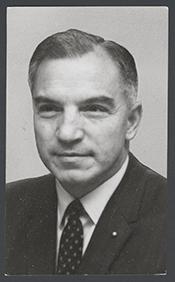
Historical · U.S. House · Pennsylvania · District 24
Joseph Vigorito
Former U.S. Representative · Pennsylvania District 24 · 1965–1977 · Democratic
Joseph Vigorito represented Pennsylvania's District 24 in the United States House of Representatives (1965–1977) for the Democratic party. The page below collects sourced biographical facts, term history, committee roles, and provenance for Vigorito.
Bioguide ID: V000098
Key facts
- Full name
- Joseph Vigorito
- State
- Pennsylvania
- District
- District 24
- Party
- Democratic
- House service
- 1965–1977
- First House term
- 1965
- Status
- Left office
- Current term ends
- —
- Born
- 1918
- Bioguide ID
- V000098
- Committee assignments
- —
- Dataset version
- 1.20260605
Biographical narrative
968 words · sourced from the Wikipedia REST extract
Joseph P. Vigorito was a Democratic politician who served as a U.S. Representative for Pennsylvania's 24th congressional district from 1965 until 1977. His tenure in Congress was marked by a significant electoral victory during a period of Democratic dominance in national politics. Vigorito's background as a veteran and educator contributed to his political career, and he was known for his involvement in various legislative matters during his time in office. After leaving Congress, he continued his career in academia before passing away in 2003.
Early life and career
Joseph Phillip Vigorito was born on November 10, 1918, in Niles, Ohio, to Italian immigrant parents. His early life was shaped by the experiences of his family, which instilled in him values of hard work and perseverance. Vigorito's formative years were marked by the challenges faced by immigrant families in America, which likely influenced his later political perspectives and priorities.
During World War II, Vigorito served in the United States Army from 1942 to 1945. His military service was a significant aspect of his life, and he was awarded the Purple Heart for his bravery. This experience not only shaped his character but also provided him with a unique perspective on issues related to veterans and military affairs, which would later inform his legislative work.
After returning from military service, Vigorito pursued higher education. He graduated from the Wharton School of Finance at the University of Pennsylvania in 1947, where he gained a solid foundation in finance and economics. Following this, he earned a Master of Business Administration (MBA) degree from the University of Denver in 1949. His academic achievements positioned him well for a career in both business and education.
Vigorito began his professional career as a faculty member at Penn State University in State College, Pennsylvania, where he taught from 1949 until 1964. His role as an educator allowed him to engage with students and contribute to the academic community, further developing his skills in communication and leadership. This experience in academia would later serve him well in his political career, as he was able to articulate complex issues to a diverse audience.
House tenure
In 1964, Vigorito entered the political arena by running for a seat in the U.S. House of Representatives. He was elected to represent Pennsylvania's 24th congressional district during a time of significant political change, as the Democratic Party experienced a substantial electoral victory across the country. His election was part of a larger trend that saw many Democrats gain seats in Congress, reflecting the public's support for the party's platform during that era.
Vigorito's first term in the House began in 1965, and he would go on to serve a total of six terms in Congress. Throughout his tenure, he was known for his commitment to representing the interests of his constituents in Erie, Pennsylvania, and the surrounding areas. He was re-elected five additional times, demonstrating a level of support from the electorate that allowed him to maintain his position in a competitive political landscape.
However, Vigorito's congressional career came to an end in 1976 when he was defeated by Marc L. Marks, who was serving as the Mercer County Solicitor at the time. This loss marked a significant turning point in Vigorito's political journey, as he was unable to secure a seventh term in office. His defeat was part of a broader trend in which many incumbents faced challenges as political dynamics shifted in the late 1970s.
Legislative focus and committees
During his time in Congress, Vigorito was involved in various legislative initiatives and served on several committees. His background in finance and education likely influenced his focus on issues related to economic development, education policy, and veterans' affairs. As a member of the House, he worked to address the needs of his constituents, advocating for policies that would benefit the local community in Erie and beyond.
Vigorito's legislative record reflects the priorities of the Democratic Party during the 1960s and 1970s, a period characterized by significant social and economic changes in the United States. He participated in discussions and debates surrounding key issues of the time, including civil rights, healthcare, and education reform. His contributions to these discussions were informed by his experiences as a veteran and educator, allowing him to bring a unique perspective to the legislative process.
Despite his efforts and contributions, Vigorito's time in Congress was not without challenges. He was noted by some commentators for being perceived as less effective compared to his peers, which was highlighted by a media mention that labeled him as one of the less capable members of Congress. This characterization reflects the complexities of political life and the varying perceptions of effectiveness among elected officials.
After leaving Congress in 1977, Vigorito transitioned to a teaching role at Georgetown University in Washington, D.C., where he served on the faculty until 1978. This move allowed him to continue his involvement in education and share his experiences with a new generation of students. In 1978, he attempted to regain his congressional seat but was unsuccessful in his bid against Marks, marking the end of his direct political career.
Vigorito's legacy in Pennsylvania politics is notable, as he was only the third Democrat to represent the Erie area in the 20th century. His tenure was significant in the context of local political history, and since his departure, only one other Democrat, Kathy Dahlkemper, has held the seat for a single term from 2009 to 2011.
Joseph P. Vigorito passed away on February 5, 2003, in Washington, D.C. His life and career reflect the journey of an individual who navigated the complexities of American politics during a transformative period in the nation's history. His contributions to education and public service continue to be recognized as part of the broader narrative of Pennsylvania's political landscape.
Notable legislation
Sponsored and co-sponsored legislation for Joseph Vigorito is pending operator curation. The biographical narrative above carries the same provenance trail until per-bill rows are written.
Sources
- [1]https://en.wikipedia.org/wiki/Joseph_P._VigoritoWikipedia · retrieved 2026-06-05
Notable quotes
Sourced quotes for Joseph Vigorito are pending operator curation. Narrative-scope provenance remains attached below.
Sources
- [1]https://en.wikipedia.org/wiki/Joseph_P._VigoritoWikipedia · retrieved 2026-06-05
Key positions
Curated policy positions for Joseph Vigorito are pending operator review. The biographical narrative above carries the same provenance trail until per-topic positions are written.
Sources
- [1]https://en.wikipedia.org/wiki/Joseph_P._VigoritoWikipedia · retrieved 2026-06-05
Terms served
- 1965–1967U.S. House · Term 1 · Democratic
- 1967–1969U.S. House · Term 2 · Democratic
- 1969–1971U.S. House · Term 3 · Democratic
- 1971–1973U.S. House · Term 4 · Democratic
- 1973–1975U.S. House · Term 5 · Democratic
- 1975–1977U.S. House · Term 6 · Democratic
Sources & provenance
Every attributable claim above carries a per-section [N] marker that resolves to the corresponding URL below. Each entry records the upstream provider, the canonical URL, and the timestamp at which the source was retrieved by the ingest pipeline.
Key facts
- https://bioguide.congress.gov/search/bio/V000098bioguide · retrieved 2026-06-05
- https://www.govtrack.us/congress/members/411153govtrack · retrieved 2026-06-05
Biographical narrative
- https://en.wikipedia.org/wiki/Joseph_P._Vigoritowikipedia · retrieved 2026-06-05
Find your representative
Every U.S. state elects representatives by district. Browse Pennsylvania’s delegation, the full former-representative roster, or explore the role and term length.
Related on The Candidate
- Preceded by James WeaverEarlier holder of the Pennsylvania District 24 House seat · Republican.Open
- Succeeded by Marc MarksLater holder of the Pennsylvania District 24 House seat · Republican.Open
- Adam SeybertFormer U.S. Representative · Pennsylvania District 1 · RepublicanOpen
- Benjamin SayFormer U.S. Representative · Pennsylvania District 1 · RepublicanOpen
- Chapman FreemanFormer U.S. Representative · Pennsylvania District 1 · RepublicanOpen
- Harry RansleyFormer U.S. Representative · Pennsylvania District 1 · RepublicanOpen