
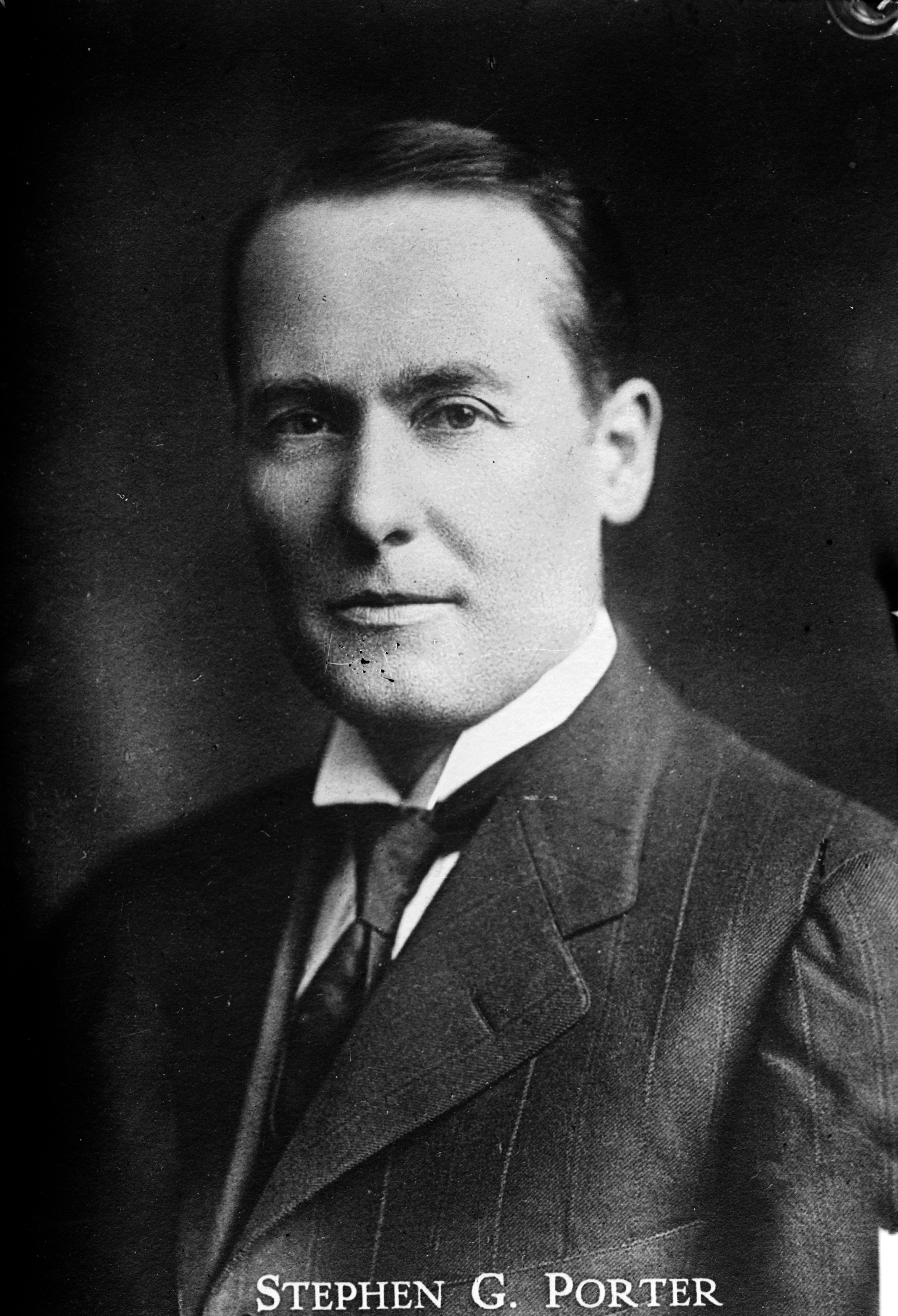
Historical · U.S. House · Pennsylvania · District 32
Stephen Porter
Former U.S. Representative · Pennsylvania District 32 · 1911–1931 · Republican
Stephen Porter represented Pennsylvania's District 32 in the United States House of Representatives (1911–1931) for the Republican party. The page below collects sourced biographical facts, term history, committee roles, and provenance for Porter.
Bioguide ID: P000447
Key facts
- Full name
- Stephen Porter
- State
- Pennsylvania
- District
- District 32
- Party
- Republican
- House service
- 1911–1931
- First House term
- 1911
- Status
- Left office
- Current term ends
- —
- Born
- 1869
- Bioguide ID
- P000447
- Committee assignments
- —
- Dataset version
- 1.20260606
Biographical narrative
923 words · sourced from the Wikipedia REST extract
Stephen Porter was a prominent Republican politician who served as a U.S. Representative for Pennsylvania's 32nd congressional district from 1911 until his death in 1930. Throughout his lengthy tenure in the House of Representatives, Porter established himself as a significant figure in American politics, particularly in matters of foreign affairs. His career was marked by a commitment to public service and a focus on international relations, which was reflected in his leadership roles within various congressional committees.
Early life and career
Stephen Geyer Porter was born on May 18, 1869, near Salem, Ohio. He spent his formative years in Ohio before relocating to Pennsylvania in 1877 with his family. They settled in Allegheny, Pennsylvania, which is now part of the larger city of Pittsburgh. Porter's early education took place at Allegheny High School, where he laid the groundwork for his future academic and professional pursuits.
Initially, Porter pursued a career in medicine, studying for two years before shifting his focus to law. This transition proved to be pivotal, as he was admitted to the bar in December 1893, allowing him to commence his legal practice in Pittsburgh. His legal career began to flourish, and he gained recognition in the community. In addition to his private practice, Porter served as the city solicitor of Allegheny from 1903 to 1906, a role that further solidified his reputation as a capable public servant.
Porter's political involvement began to take shape during this period. In 1912, he was appointed as the chairman of the Republican State Convention, a position that highlighted his growing influence within the Republican Party in Pennsylvania. His legal background and political engagement set the stage for his election to the U.S. House of Representatives, where he would go on to serve for two decades.
House tenure
Porter's congressional career began with his election to the Sixty-second Congress in 1911. He was subsequently re-elected to nine additional terms, demonstrating a sustained level of support from his constituents in Pennsylvania's 32nd district. His tenure in the House was characterized by a commitment to his party's values and a focus on legislative issues that were pertinent to both his district and the nation as a whole.
During his time in Congress, Porter was appointed as the Chairman of the United States House Committee on Foreign Affairs, a position he held during the Sixty-sixth through Seventy-first Congresses. This role placed him at the forefront of significant discussions regarding U.S. foreign policy and international relations during a period marked by global upheaval and change. His leadership on this committee allowed him to influence key legislation and engage with pressing international issues.
In addition to his committee work, Porter was involved in various diplomatic efforts. He was appointed in 1921 to represent the House of Representatives on the advisory committee for the Washington Conference on Armament Limitations, a significant event aimed at addressing naval disarmament and promoting peace among major world powers. Furthermore, he represented the United States at the centennial celebration of Brazil's independence in 1922, showcasing his role in fostering international relations.
Despite his extensive political career, Porter also faced challenges. In 1913, he ran for the position of Mayor of Pittsburgh but was unsuccessful. This setback did not deter him from his congressional duties, and he continued to focus on his legislative responsibilities.
Legislative focus and committees
Throughout his time in the House, Porter was particularly focused on foreign affairs, which was evident in his leadership roles and the legislation he championed. As Chairman of the House Committee on Foreign Affairs, he played a critical role in shaping U.S. foreign policy during a transformative era. One of his notable contributions was the drafting of the "Porter Resolution," which authorized the President to establish equal diplomatic relations with China. This resolution was significant in the context of U.S.-China relations and reflected Porter's commitment to promoting equality in international diplomacy.
In addition to his work on the Foreign Affairs Committee, Porter was also involved in the Foreign Service Buildings Commission, serving as its chairman from 1926 to 1930. This commission was responsible for overseeing the construction and maintenance of U.S. diplomatic facilities abroad, further emphasizing Porter's dedication to enhancing the United States' global presence.
Porter's international engagements extended beyond legislative matters. He was a member and chairman of the American delegation to the Second International Conference on Opium, held in Geneva in 1924 and 1925. This conference aimed to address the growing concerns surrounding drug control and the opium trade. However, Porter unexpectedly withdrew the American delegation before the conference concluded, a decision that reflected the complexities and challenges of international negotiations.
Porter's legislative focus was not limited to foreign affairs; he was also involved in various domestic issues that affected his constituents. His long tenure in Congress allowed him to develop a comprehensive understanding of the needs and concerns of the people he represented. He worked on legislation that aimed to improve the quality of life for his constituents, although specific details of these initiatives are not extensively documented.
Stephen Porter passed away on June 27, 1930, in Pittsburgh, Pennsylvania. His death marked the end of a significant chapter in Pennsylvania's political history, as he had served in the House of Representatives for nearly two decades. He was interred in Highwood Cemetery, leaving behind a legacy of public service and a commitment to the principles of his party. Porter's contributions to U.S. foreign policy and his role in shaping legislative discussions during a critical time in American history remain noteworthy aspects of his career.
Notable legislation
Sponsored and co-sponsored legislation for Stephen Porter is pending operator curation. The biographical narrative above carries the same provenance trail until per-bill rows are written.
Sources
- [1]https://en.wikipedia.org/wiki/Stephen_G._PorterWikipedia · retrieved 2026-06-06
Notable quotes
Sourced quotes for Stephen Porter are pending operator curation. Narrative-scope provenance remains attached below.
Sources
- [1]https://en.wikipedia.org/wiki/Stephen_G._PorterWikipedia · retrieved 2026-06-06
Key positions
Curated policy positions for Stephen Porter are pending operator review. The biographical narrative above carries the same provenance trail until per-topic positions are written.
Sources
- [1]https://en.wikipedia.org/wiki/Stephen_G._PorterWikipedia · retrieved 2026-06-06
Terms served
- 1911–1913U.S. House · Term 1 · Republican
- 1913–1915U.S. House · Term 2 · Republican
- 1915–1917U.S. House · Term 3 · Republican
- 1917–1919U.S. House · Term 4 · Republican
- 1919–1921U.S. House · Term 5 · Republican
- 1921–1923U.S. House · Term 6 · Republican
- 1923–1925U.S. House · Term 7 · Republican
- 1925–1927U.S. House · Term 8 · Republican
- 1927–1929U.S. House · Term 9 · Republican
- 1929–1931U.S. House · Term 10 · Republican
Sources & provenance
Every attributable claim above carries a per-section [N] marker that resolves to the corresponding URL below. Each entry records the upstream provider, the canonical URL, and the timestamp at which the source was retrieved by the ingest pipeline.
Key facts
- https://bioguide.congress.gov/search/bio/P000447bioguide · retrieved 2026-06-06
- https://www.govtrack.us/congress/members/408836govtrack · retrieved 2026-06-06
Biographical narrative
- https://en.wikipedia.org/wiki/Stephen_G._Porterwikipedia · retrieved 2026-06-06
Find your representative
Every U.S. state elects representatives by district. Browse Pennsylvania’s delegation, the full former-representative roster, or explore the role and term length.
Related on The Candidate
- Preceded by James BrownEarlier holder of the Pennsylvania District 32 House seat · Ind. Republican.Open
- Succeeded by Michael MuldowneyLater holder of the Pennsylvania District 32 House seat · Republican.Open
- Adam SeybertFormer U.S. Representative · Pennsylvania District 1 · RepublicanOpen
- Benjamin SayFormer U.S. Representative · Pennsylvania District 1 · RepublicanOpen
- Chapman FreemanFormer U.S. Representative · Pennsylvania District 1 · RepublicanOpen
- Harry RansleyFormer U.S. Representative · Pennsylvania District 1 · RepublicanOpen