
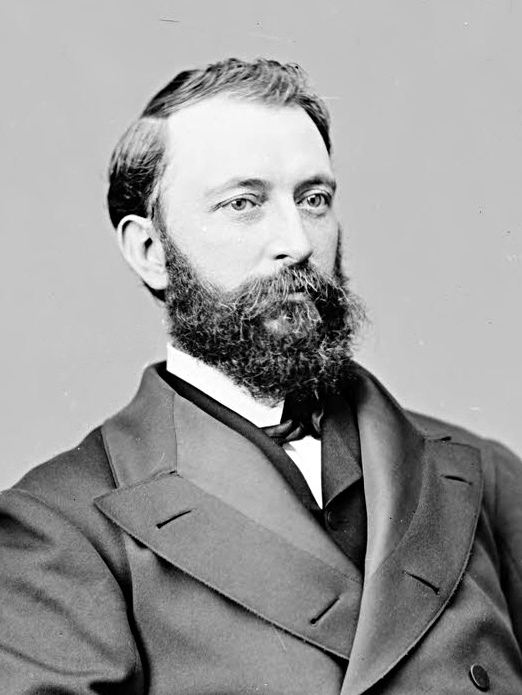
Historical · U.S. House · Tennessee · District 5
William Prosser
Former U.S. Representative · Tennessee District 5 · 1869–1871 · Republican
William Prosser represented Tennessee's District 5 in the United States House of Representatives (1869–1871) for the Republican party. The page below collects sourced biographical facts, term history, committee roles, and provenance for Prosser.
Bioguide ID: P000550
Key facts
- Full name
- William Prosser
- State
- Tennessee
- District
- District 5
- Party
- Republican
- House service
- 1869–1871
- First House term
- 1869
- Status
- Left office
- Current term ends
- —
- Born
- 1834
- Bioguide ID
- P000550
- Committee assignments
- —
- Dataset version
- 1.20260606
Biographical narrative
830 words · sourced from the Wikipedia REST extract
William Prosser was a notable American politician and military officer who served as a U.S. Representative for Tennessee's 5th congressional district. A member of the Republican Party, Prosser's political career was preceded by significant military service during the American Civil War, where he attained the rank of Colonel. His tenure in the U.S. House of Representatives spanned from 1869 to 1871, and he later held various positions in public service and local government, including postmaster and mayor in different regions. After his congressional service, he moved to Washington State, where he continued to contribute to civic life and historical scholarship until his death in 1911.
Early life and career
William Farrand Prosser was born on March 16, 1834, in Williamsport, Pennsylvania, to David and Rachel Williams Prosser, who were Welsh immigrants. His family relocated to Johnstown, Pennsylvania, during his early childhood. In Johnstown, Prosser received a limited formal education but demonstrated an early interest in teaching and law. Although he studied law, he never practiced as an attorney. In pursuit of opportunities, he moved to California in 1854, where he engaged in mining, a common occupation during the Gold Rush era.
With the onset of the Civil War in 1861, Prosser returned to Pennsylvania to enlist in the Union Army. His military career was marked by a rapid ascent through the ranks, ultimately achieving the rank of Colonel. Throughout the war, he participated in several significant battles, including the Battle of Shiloh, the Battle of Stones River, and the Siege of Knoxville. His service was not without hardship; he was briefly captured and held as a prisoner of war in 1862. Prosser's military experience would later inform his leadership style and public service.
House tenure
Following the conclusion of the Civil War, Prosser settled on a farm near Nashville, Tennessee. His involvement in local politics began with his election to the Tennessee House of Representatives, where he served from 1867 to 1869. His political career advanced when he was elected as a Republican to the Forty-first United States Congress, beginning his term on March 4, 1869. During his time in the House, Prosser focused on issues pertinent to his constituents and the post-war recovery of the South.
Prosser's congressional term lasted until March 3, 1871, after which he continued to engage in public service. In 1872, he was appointed as the postmaster of Nashville, a role he held until 1875. His involvement in transportation and infrastructure was evident through his position as a director of the Tennessee, Edgefield & Kentucky Railroad. Additionally, he was appointed as one of the state commissioners for the Centennial Exposition in Philadelphia in 1872, where he played a role in promoting Tennessee's participation in this significant event.
Legislative focus and committees
During his time in Congress, Prosser's legislative focus primarily revolved around the challenges faced by the South in the aftermath of the Civil War. He was part of a period in American history marked by reconstruction and the effort to reintegrate Southern states into the Union. While specific details of his legislative initiatives are not extensively documented, his background as a military officer and a state legislator likely influenced his perspectives on issues related to governance, civil rights, and economic development in the South.
After concluding his congressional service, Prosser's career continued to evolve. In 1879, he was appointed by President Rutherford B. Hayes as a special agent for the United States Department of the Interior, overseeing matters in Oregon, Washington, and Idaho. This appointment marked a significant transition in his career, leading him to relocate to Washington State. In 1880, he married Flora Louise Thornton in Seattle, and by 1882, he had settled in the Yakima River valley, where he founded the town of Prosser, Washington.
In addition to his role as a founder of the town, Prosser was actively involved in the civic and cultural life of Washington State. He served as a delegate at the first Washington State Constitutional Convention in 1889, contributing to the establishment of the state's governance framework. His commitment to historical preservation was evident in his role as one of the founders of the Washington State Historical Society, where he served as president for a period. Prosser also authored a two-volume history titled "A History of the Puget Sound Country," published in 1903, which reflects his dedication to documenting the region's history.
Throughout his later years, Prosser held various local government positions, including serving as the mayor of North Yakima from 1890 to 1903 and as city treasurer of Seattle from 1908 to 1910. His contributions to local governance and historical scholarship left a lasting impact on the communities he served.
William Prosser passed away on September 23, 1911, at the age of 77. He was interred at Lake View Cemetery in Seattle, Washington. His life and career exemplify the diverse paths of public service and civic engagement in the post-Civil War United States, reflecting the complexities of American history during a transformative era.
Notable legislation
Sponsored and co-sponsored legislation for William Prosser is pending operator curation. The biographical narrative above carries the same provenance trail until per-bill rows are written.
Sources
- [1]https://en.wikipedia.org/wiki/William_F._ProsserWikipedia · retrieved 2026-06-06
Notable quotes
Sourced quotes for William Prosser are pending operator curation. Narrative-scope provenance remains attached below.
Sources
- [1]https://en.wikipedia.org/wiki/William_F._ProsserWikipedia · retrieved 2026-06-06
Key positions
Curated policy positions for William Prosser are pending operator review. The biographical narrative above carries the same provenance trail until per-topic positions are written.
Sources
- [1]https://en.wikipedia.org/wiki/William_F._ProsserWikipedia · retrieved 2026-06-06
Terms served
- 1869–1871U.S. House · Term 1 · Republican
Sources & provenance
Every attributable claim above carries a per-section [N] marker that resolves to the corresponding URL below. Each entry records the upstream provider, the canonical URL, and the timestamp at which the source was retrieved by the ingest pipeline.
Key facts
- https://bioguide.congress.gov/search/bio/P000550bioguide · retrieved 2026-06-06
- https://www.govtrack.us/congress/members/408934govtrack · retrieved 2026-06-06
Biographical narrative
- https://en.wikipedia.org/wiki/William_F._Prosserwikipedia · retrieved 2026-06-06
Find your representative
Every U.S. state elects representatives by district. Browse Tennessee’s delegation, the full former-representative roster, or explore the role and term length.
Related on The Candidate
- Preceded by John TrimbleEarlier holder of the Tennessee District 5 House seat · Republican.Open
- Succeeded by Edward GolladayLater holder of the Tennessee District 5 House seat · Democratic.Open
- Albert WatkinsFormer U.S. Representative · Tennessee District 1 · DemocraticOpen
- Alfred TaylorFormer U.S. Representative · Tennessee District 1 · RepublicanOpen
- Augustus PettiboneFormer U.S. Representative · Tennessee District 1 · RepublicanOpen
- Bill JenkinsFormer U.S. Representative · Tennessee District 1 · RepublicanOpen