
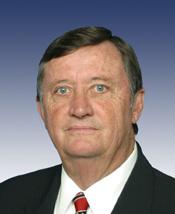
Historical · U.S. House · Tennessee · District 1
Bill Jenkins
Former U.S. Representative · Tennessee District 1 · 1997–2007 · Republican
Bill Jenkins represented Tennessee's District 1 in the United States House of Representatives (1997–2007) for the Republican party. The page below collects sourced biographical facts, term history, committee roles, and provenance for Jenkins.
Bioguide ID: J000082
Key facts
- Full name
- Bill Jenkins
- State
- Tennessee
- District
- District 1
- Party
- Republican
- House service
- 1997–2007
- First House term
- 1997
- Status
- Left office
- Current term ends
- —
- Born
- 1936
- Bioguide ID
- J000082
- Committee assignments
- —
- Dataset version
- 1.20260605
Biographical narrative
935 words · sourced from the Wikipedia REST extract
William L. Jenkins is a former American politician who served as a U.S. Representative for Tennessee's 1st congressional district from 1997 until 2007. A member of the Republican Party, Jenkins had a notable political career that included significant roles in both state and federal government. His tenure in Congress was marked by a conservative voting record and a focus on local issues pertinent to his constituents in the Tri-Cities area of Tennessee.
Early life and career
William L. Jenkins was born on November 29, 1936, in Detroit, Michigan. His family has deep roots in Tennessee, as he is a seventh-generation Tennessean, with his parents hailing from Rogersville, Tennessee. Jenkins' early life was characterized by a commitment to education and public service. He served in the United States Army from 1959 to 1960, which provided him with valuable experience and insight into military and veteran affairs.
After his military service, Jenkins pursued higher education, graduating from Tennessee Technological University and later earning a law degree from the University of Tennessee College of Law. His academic background laid the foundation for his future career in politics and law.
Jenkins began his political career in 1962 when he was elected to the Tennessee General Assembly as a Republican. He quickly rose through the ranks and became the Speaker of the House from 1969 to 1971. His election to this position was historically significant, as he was the first Republican to serve as Speaker since the Reconstruction era and remained the only Republican to hold this office in the 20th century. Jenkins was one of the youngest individuals to assume the role, reflecting his early influence in Tennessee politics.
In addition to his legislative work, Jenkins held various positions in state government. He was appointed as a Commissioner of the Tennessee Department of Conservation, serving under Governor Winfield Dunn. He also worked as a senior policy advisor on energy and legislative issues for Governor Lamar Alexander. His extensive experience in state government provided him with a strong foundation for his later congressional career.
Jenkins served on the board of directors of the Tennessee Valley Authority from 1971 to 1978, where he contributed to the management of one of the nation's largest public power providers. Following this role, he was appointed as a circuit court judge for Tennessee's Third Judicial District, serving from 1990 until 1996. His judicial experience further enhanced his understanding of the legal and legislative processes.
House tenure
Jenkins' congressional career began when he resigned from his judgeship on May 10, 1996, to run for the U.S. House of Representatives. He sought to represent Tennessee's 1st congressional district, which had been held by long-serving incumbent Jimmy Quillen. Quillen's retirement opened the door for Jenkins, who entered a competitive primary election that featured twelve candidates. The Republican primary was particularly significant, as the district had a strong Republican majority, making the primary winner the likely successor in the general election.
Despite not receiving Quillen's endorsement, Jenkins won the primary with a narrow margin, securing approximately 18% of the vote. His victory in the primary positioned him favorably for the general election, which he won with relative ease in November 1996. Jenkins went on to serve a total of five terms in the House, beginning his first term in January 1997 and concluding his service on January 3, 2007.
Throughout his time in Congress, Jenkins was reelected four times, often facing little to no opposition. He ran unopposed in the 2000 and 2002 elections and secured a fifth term in 2004 with a significant majority of the vote. His ability to maintain a low profile in Congress contrasted with the more prominent roles of his predecessors, Quillen and B. Carroll Reece, who had dominated the district's representation for decades. Jenkins' voting record was consistently conservative, aligning with the Republican Party's principles and the expectations of his constituents.
Legislative focus and committees
During his tenure in the House, Jenkins focused on a range of legislative issues that were important to his district and aligned with his party's agenda. His conservative voting record reflected his commitment to traditional Republican values, and he often prioritized issues related to local economic development, energy policy, and infrastructure improvements.
Jenkins was known for his involvement in various committees, although specific committee assignments during his tenure are not detailed in the available information. His legislative efforts were likely influenced by his background in state government and his experience as a circuit court judge, which provided him with a unique perspective on the legal implications of proposed legislation.
In addition to his legislative work, Jenkins gained recognition for his participation in recreational activities, particularly fishing. He was noted for his skills as an angler and was recognized as one of the best bass fishermen in Congress. His participation in fishing events, including competitions, highlighted his personal interests and helped to humanize his public persona.
As Jenkins approached the end of his congressional career, he announced on February 15, 2006, that he would not seek a sixth term. He cited a desire to spend more time with his family, particularly as he was approaching his 70th birthday later that year. His decision to retire marked the conclusion of a significant chapter in his political career, during which he had made lasting contributions to both state and national politics.
William L. Jenkins' career reflects a blend of public service, legal expertise, and a commitment to the constituents of Tennessee's 1st congressional district. His legacy includes a notable tenure in the U.S. House of Representatives, where he upheld conservative values and engaged with the community he represented.
Notable legislation
Sponsored and co-sponsored legislation for Bill Jenkins is pending operator curation. The biographical narrative above carries the same provenance trail until per-bill rows are written.
Sources
- [1]https://en.wikipedia.org/wiki/Bill_Jenkins_(politician)Wikipedia · retrieved 2026-06-05
Notable quotes
Sourced quotes for Bill Jenkins are pending operator curation. Narrative-scope provenance remains attached below.
Sources
- [1]https://en.wikipedia.org/wiki/Bill_Jenkins_(politician)Wikipedia · retrieved 2026-06-05
Key positions
Curated policy positions for Bill Jenkins are pending operator review. The biographical narrative above carries the same provenance trail until per-topic positions are written.
Sources
- [1]https://en.wikipedia.org/wiki/Bill_Jenkins_(politician)Wikipedia · retrieved 2026-06-05
Terms served
- 1997–1999U.S. House · Term 1 · Republican
- 1999–2001U.S. House · Term 2 · Republican
- 2001–2003U.S. House · Term 3 · Republican
- 2003–2005U.S. House · Term 4 · Republican
- 2005–2007U.S. House · Term 5 · Republican
Sources & provenance
Every attributable claim above carries a per-section [N] marker that resolves to the corresponding URL below. Each entry records the upstream provider, the canonical URL, and the timestamp at which the source was retrieved by the ingest pipeline.
Key facts
- https://bioguide.congress.gov/search/bio/J000082bioguide · retrieved 2026-06-05
- http://www.house.gov/jenkinshouse.gov · retrieved 2026-06-05
Biographical narrative
- https://en.wikipedia.org/wiki/Bill_Jenkins_(politician)wikipedia · retrieved 2026-06-05
Find your representative
Every U.S. state elects representatives by district. Browse Tennessee’s delegation, the full former-representative roster, or explore the role and term length.
Related on The Candidate
- Preceded by James QuillenEarlier holder of the Tennessee District 1 House seat · Republican.Open
- Succeeded by David DavisLater holder of the Tennessee District 1 House seat · Republican.Open
- Albert WatkinsFormer U.S. Representative · Tennessee District 1 · DemocraticOpen
- Alfred TaylorFormer U.S. Representative · Tennessee District 1 · RepublicanOpen
- Augustus PettiboneFormer U.S. Representative · Tennessee District 1 · RepublicanOpen
- Brazilla ReeceFormer U.S. Representative · Tennessee District 1 · RepublicanOpen