
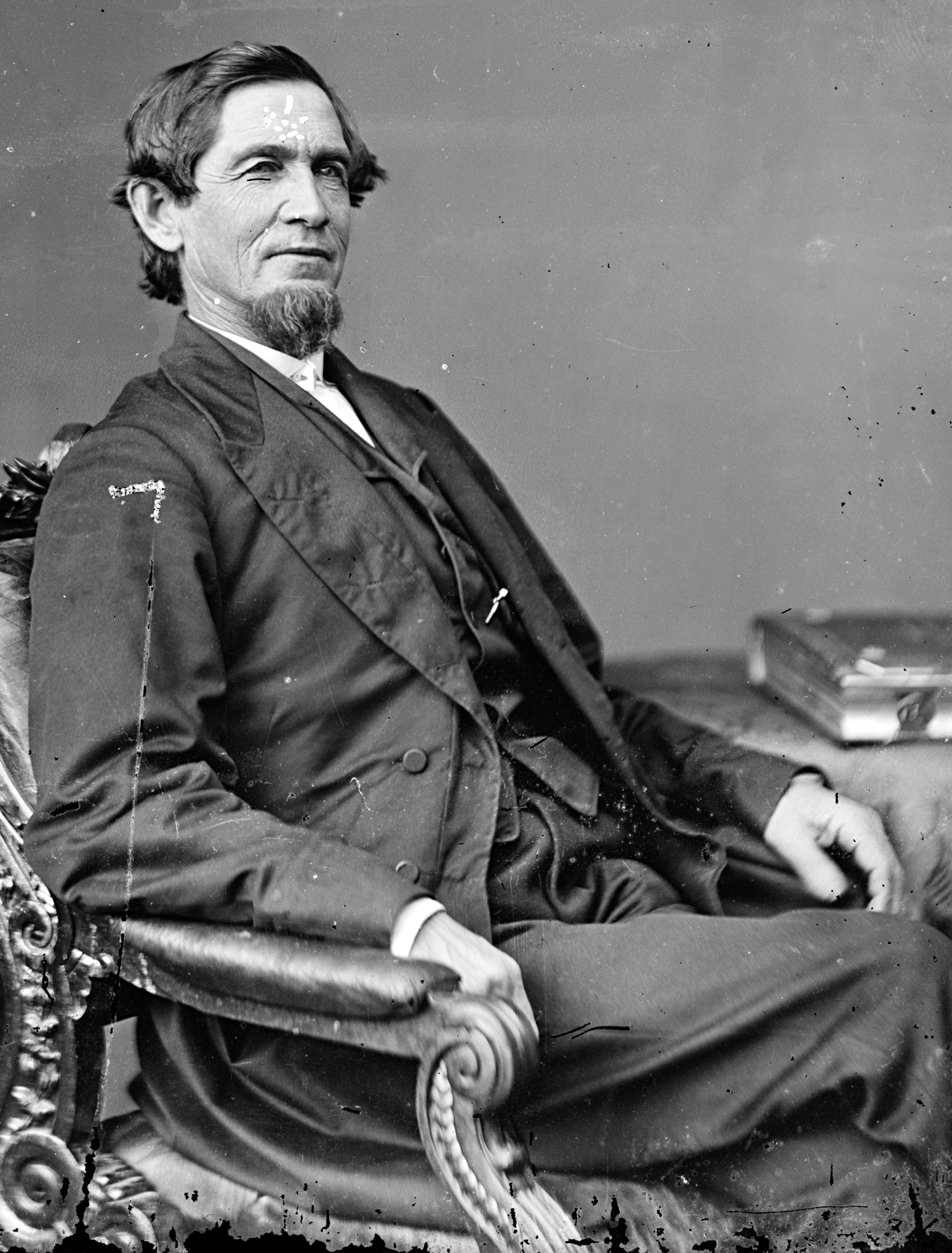
Historical · U.S. House · Tennessee · District 7
Isaac Hawkins
Former U.S. Representative · Tennessee District 7 · 1865–1871 · Republican
Isaac Hawkins represented Tennessee's District 7 in the United States House of Representatives (1865–1871) for the Republican party. The page below collects sourced biographical facts, term history, committee roles, and provenance for Hawkins.
Bioguide ID: H000370
Key facts
- Full name
- Isaac Hawkins
- State
- Tennessee
- District
- District 7
- Party
- Republican
- House service
- 1865–1871
- First House term
- 1865
- Status
- Left office
- Current term ends
- —
- Born
- 1818
- Bioguide ID
- H000370
- Committee assignments
- —
- Dataset version
- 1.20260606
Biographical narrative
965 words · sourced from the Wikipedia REST extract
Isaac Hawkins was an American soldier and politician who served as a U.S. Representative for Tennessee's 7th congressional district. A member of the Republican Party, he held office during a transformative period in American history, marked by the aftermath of the Civil War and the Reconstruction era. His congressional tenure spanned from 1865 to 1871, during which he was involved in various legislative efforts and served on important committees.
Early life and career
Isaac Roberts Hawkins was born on May 16, 1818, near Columbia in Maury County, Tennessee. He was the son of Samuel and Nancy Roberts Hawkins. His maternal lineage included notable figures in early Tennessee history; his mother was the granddaughter of General Isaac Roberts and Mary "Polly" Johnston Roberts, and she was also related to Ann Robertson Johnston Cockrill, a pioneer who was connected to James Robertson, a founder of Nashville. This familial background placed Hawkins within a network of early Tennessee settlers and leaders.
In 1828, Hawkins's family moved to Carroll County, Tennessee, where he attended local common schools. The land they settled on was part of a 1790 land grant awarded to General Roberts. As a young man, Hawkins engaged in agricultural work while also pursuing legal studies. He was admitted to the bar in 1843 and began practicing law in Huntingdon, Tennessee.
Hawkins's early career was marked by military service; he served as a lieutenant during the Mexican-American War. After the war, he returned to his legal practice but remained active in civic affairs. His political involvement deepened during the tumultuous years leading up to the Civil War. A staunch Unionist, Hawkins participated in a peace conference in Washington, D.C., in 1861, aimed at finding a way to avert the impending conflict. He was also elected to a convention that focused on Federal relations.
In 1862, Hawkins was appointed as a judge of the circuit court, further establishing his legal and political credentials. Later that year, he joined the Union Army as a lieutenant colonel of the 7th Tennessee Volunteer Cavalry. His military service continued until he was captured in 1864 during a battle in Union City, Tennessee. After spending time as a prisoner of war, he was exchanged in August 1864 and resumed his military duties, commanding cavalry forces in western Kentucky until the Civil War concluded.
Following the war, Hawkins was appointed by Governor William Gannaway Brownlow as one of the chancellors of Tennessee, although he declined the position. His political career was revitalized with Tennessee's readmission to the Union, leading to his election to the U.S. Congress.
House tenure
Hawkins's congressional career began when he was elected as an Unconditional Unionist to the 39th Congress, which convened in December 1865. His election came at a time when the nation was grappling with the challenges of Reconstruction and the reintegration of Southern states into the Union. He was subsequently re-elected as a Republican to the 40th and 41st Congresses, serving until March 3, 1871. During his time in office, Hawkins was involved in legislative discussions that addressed the pressing issues of the post-war era, including civil rights and economic recovery.
As a member of Congress, Hawkins participated in the legislative process during a critical period in American history. His tenure coincided with significant national debates regarding the rights of newly freed African Americans and the rebuilding of Southern states. Hawkins's role as a legislator was shaped by his background as a Unionist and his experiences during the Civil War, which influenced his perspectives on governance and policy.
In addition to his legislative responsibilities, Hawkins was active in party politics. He served as a delegate to the 1868 Republican National Convention, where he contributed to the shaping of the party's platform during a pivotal moment in its history. His involvement in the convention highlighted his commitment to the Republican Party and its goals during the Reconstruction era.
During the 41st Congress, Hawkins held the position of chairman of the United States House Committee on Mileage, a role that involved overseeing matters related to the reimbursement of travel expenses for members of Congress. This position underscored his active engagement in the administrative functions of the House, as well as his responsibilities in managing the logistical aspects of congressional operations.
Legislative focus and committees
Throughout his congressional tenure, Hawkins focused on various legislative issues that were pertinent to his constituents and the broader national context. His background as a lawyer and military officer informed his approach to governance. While specific details about the legislation he supported or opposed are not documented, it is clear that his experiences during the Civil War and his commitment to Unionist principles influenced his legislative priorities.
Hawkins's role on the House Committee on Mileage indicated his involvement in the operational aspects of Congress, which included managing travel reimbursements for members. This committee work was essential for ensuring that congressional operations ran smoothly, particularly in a time when the nation was still recovering from the Civil War.
As a representative from Tennessee, Hawkins was part of a larger effort to address the needs of a state that had been deeply affected by the war. The Reconstruction era was characterized by significant social and economic challenges, and Hawkins's legislative focus likely included efforts to support the rebuilding of infrastructure and the establishment of civil rights for formerly enslaved individuals.
Hawkins's service in Congress concluded on March 3, 1871, after which he returned to Tennessee. His contributions to the legislative process during a transformative period in American history remain part of his legacy. He passed away on August 12, 1880, in Huntingdon, Tennessee, at the age of 62. Hawkins was interred at the Hawkins family burial ground near his home, marking the end of a life that spanned significant changes in American society and governance.
Notable legislation
Sponsored and co-sponsored legislation for Isaac Hawkins is pending operator curation. The biographical narrative above carries the same provenance trail until per-bill rows are written.
Sources
- [1]https://en.wikipedia.org/wiki/Isaac_Roberts_HawkinsWikipedia · retrieved 2026-06-06
Notable quotes
Sourced quotes for Isaac Hawkins are pending operator curation. Narrative-scope provenance remains attached below.
Sources
- [1]https://en.wikipedia.org/wiki/Isaac_Roberts_HawkinsWikipedia · retrieved 2026-06-06
Key positions
Curated policy positions for Isaac Hawkins are pending operator review. The biographical narrative above carries the same provenance trail until per-topic positions are written.
Sources
- [1]https://en.wikipedia.org/wiki/Isaac_Roberts_HawkinsWikipedia · retrieved 2026-06-06
Terms served
- 1865–1867U.S. House · Term 1 · Unionist
- 1867–1869U.S. House · Term 2 · Republican
- 1869–1871U.S. House · Term 3 · Republican
Sources & provenance
Every attributable claim above carries a per-section [N] marker that resolves to the corresponding URL below. Each entry records the upstream provider, the canonical URL, and the timestamp at which the source was retrieved by the ingest pipeline.
Key facts
- https://bioguide.congress.gov/search/bio/H000370bioguide · retrieved 2026-06-06
- https://www.govtrack.us/congress/members/405239govtrack · retrieved 2026-06-06
Biographical narrative
- https://en.wikipedia.org/wiki/Isaac_Roberts_Hawkinswikipedia · retrieved 2026-06-06
Find your representative
Every U.S. state elects representatives by district. Browse Tennessee’s delegation, the full former-representative roster, or explore the role and term length.
Related on The Candidate
- Preceded by John WrightEarlier holder of the Tennessee District 7 House seat · Democratic.Open
- Succeeded by Robert CaldwellLater holder of the Tennessee District 7 House seat · Democratic.Open
- Albert WatkinsFormer U.S. Representative · Tennessee District 1 · DemocraticOpen
- Alfred TaylorFormer U.S. Representative · Tennessee District 1 · RepublicanOpen
- Augustus PettiboneFormer U.S. Representative · Tennessee District 1 · RepublicanOpen
- Bill JenkinsFormer U.S. Representative · Tennessee District 1 · RepublicanOpen