
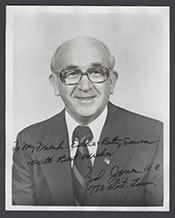
Historical · U.S. House · Tennessee · District 8
Ed Jones
Former U.S. Representative · Tennessee District 8 · 1969–1989 · Democratic
Ed Jones represented Tennessee's District 8 in the United States House of Representatives (1969–1989) for the Democratic party. The page below collects sourced biographical facts, term history, committee roles, and provenance for Jones.
Bioguide ID: J000216
Key facts
- Full name
- Ed Jones
- State
- Tennessee
- District
- District 8
- Party
- Democratic
- House service
- 1969–1989
- First House term
- 1969
- Status
- Left office
- Current term ends
- —
- Born
- 1912
- Bioguide ID
- J000216
- Committee assignments
- —
- Dataset version
- 1.20260605
Biographical narrative
1,023 words · sourced from the Wikipedia REST extract
Ed Jones was a prominent U.S. Representative from Tennessee, serving from 1969 until 1989. A member of the Democratic Party, Jones represented the 8th congressional district, which encompasses parts of Northwest Tennessee. His background in agriculture and public service, combined with his long tenure in Congress, made him a significant figure in Tennessee politics. Prior to his legislative career, he served as the Tennessee Commissioner of Agriculture, where he played a crucial role in shaping agricultural policy during a time of significant change in the sector.
Early life and career
Ed Jones was born on April 20, 1912, in Yorkville, Tennessee, as the eldest of three sons to Will "Gabe" Jones and Sibbie Hortense Pipkin. His upbringing in a rural environment instilled in him a strong work ethic, as his father, a laborer, required him to assist with various tasks after school and on weekends. Jones pursued his education at the University of Tennessee Junior College, now known as the University of Tennessee at Martin, graduating in 1932. He continued his studies at the University of Tennessee, focusing on agriculture, which would later inform his professional and political endeavors.
In 1934, Jones began his career as a dairy inspector for the state of Tennessee, a position he held until 1941. He then transitioned to a supervisory role with the Tennessee Dairy Products Association. His career took a significant turn in 1944 when he became an agricultural agent for the Illinois Central Railroad, a role he maintained until he entered Congress in 1969, with a brief interruption when he served as Commissioner of Agriculture.
Jones's appointment as Tennessee's Commissioner of Agriculture in 1949 by Governor Gordon Browning marked a pivotal point in his career. At the time, he was the youngest individual to hold this position. His tenure was characterized by efforts to modernize agricultural practices in Tennessee, addressing the shift from small family farms to larger commercial operations. He implemented various initiatives, including the establishment of a surplus food distribution program for schools and improvements in animal health and food safety inspections. His work during this period helped to solidify his reputation as a knowledgeable advocate for the agricultural community.
In addition to his professional life, Jones married Llewellyn Wyatt in 1938, the daughter of a local doctor. Together, they had two daughters, one of whom, Dr. Jennifer Jones Kinnard, became a nephrologist. Jones remained actively involved in dairy farming throughout his life, even during his congressional service. His commitment to agriculture and community was further exemplified by his induction into the Tennessee Agricultural Hall of Fame in 2011, posthumously recognizing his contributions to the field.
House tenure
Jones's political career in the U.S. House of Representatives began in March 1969 when he won the Democratic nomination for a special election to fill the vacancy left by the late Congressman Robert "Fats" Everett. This election was notable for its competitiveness, as it featured candidates from both the Republican Party and the American Independent Party. Jones emerged victorious with a substantial plurality, marking the start of a lengthy congressional career.
Following his initial election, Jones was re-elected to a full term in 1970 with less opposition. The redistricting process in 1972 merged his district with that of fellow Democrat Ray Blanton, resulting in a new district that retained Blanton's number but was geographically more aligned with Jones's previous constituency. Despite the political landscape shifting, Jones maintained his seat in Congress, even as Richard Nixon won a significant majority in Tennessee during the 1972 presidential election.
Jones faced his first serious challenge in the 1976 Democratic primary from Larry Bates, a businessman and state representative. Bates's conservative platform contrasted with Jones's moderate approach, but he failed to make significant inroads into Jones's support and was decisively defeated. Following this challenge, Jones enjoyed a period of relative ease in his re-elections, including an unopposed run in 1984.
After serving for nearly two decades, Jones chose not to seek a 10th full term in 1988, citing a desire to spend more time with his family. His decision to retire was reported in local media, indicating that he felt it was simply time to step back from public service.
Legislative focus and committees
During his time in Congress, Ed Jones was an active legislator, co-sponsoring over 100 bills that successfully became law. His legislative focus primarily revolved around agricultural issues, reflecting his background and expertise in the field. As the primary author of five bills that passed into law, he played a significant role in shaping agricultural policy at the national level. Notably, one of his key legislative achievements was the Egg Research and Consumer Information Act of 1974, which aimed to enhance consumer knowledge and support the egg industry.
Throughout his congressional career, Jones served on various committees that aligned with his interests and expertise. His experience as Commissioner of Agriculture and his extensive background in the agricultural sector provided him with valuable insights that he brought to his legislative work. His contributions were particularly relevant during a time when the agricultural landscape was undergoing significant changes due to technological advancements and shifts in societal norms.
Jones's approach to legislation was characterized by a commitment to addressing the needs of his constituents, particularly those involved in agriculture. His understanding of the challenges faced by farmers and rural communities informed his policy positions and legislative priorities. By focusing on agricultural issues, he aimed to support the economic viability of farming in Tennessee and ensure that farmers had access to the resources and information necessary for success.
Ed Jones's tenure in the U.S. House of Representatives was marked by a dedication to public service and a focus on agricultural policy. His long career in Congress, combined with his earlier experience as Commissioner of Agriculture, positioned him as a knowledgeable advocate for the agricultural community in Tennessee. After retiring from Congress, he continued to be remembered for his contributions to both the agricultural sector and his constituents, leaving a lasting legacy in Tennessee politics. Ed Jones passed away on December 11, 1999, in Dyer, Tennessee, leaving behind a significant impact on the state's agricultural and political landscape.
Notable legislation
Sponsored and co-sponsored legislation for Ed Jones is pending operator curation. The biographical narrative above carries the same provenance trail until per-bill rows are written.
Sources
- [1]https://en.wikipedia.org/wiki/Ed_Jones_(Tennessee_politician)Wikipedia · retrieved 2026-06-05
Notable quotes
Sourced quotes for Ed Jones are pending operator curation. Narrative-scope provenance remains attached below.
Sources
- [1]https://en.wikipedia.org/wiki/Ed_Jones_(Tennessee_politician)Wikipedia · retrieved 2026-06-05
Key positions
Curated policy positions for Ed Jones are pending operator review. The biographical narrative above carries the same provenance trail until per-topic positions are written.
Sources
- [1]https://en.wikipedia.org/wiki/Ed_Jones_(Tennessee_politician)Wikipedia · retrieved 2026-06-05
Terms served
- 1969–1971U.S. House · Term 1 · Democratic
- 1971–1973U.S. House · Term 2 · Democratic
- 1973–1975U.S. House · Term 3 · Democratic
- 1975–1977U.S. House · Term 4 · Democratic
- 1977–1979U.S. House · Term 5 · Democratic
- 1979–1981U.S. House · Term 6 · Democratic
- 1981–1983U.S. House · Term 7 · Democratic
- 1983–1985U.S. House · Term 8 · Democratic
- 1985–1987U.S. House · Term 9 · Democratic
- 1987–1989U.S. House · Term 10 · Democratic
Sources & provenance
Every attributable claim above carries a per-section [N] marker that resolves to the corresponding URL below. Each entry records the upstream provider, the canonical URL, and the timestamp at which the source was retrieved by the ingest pipeline.
Key facts
- https://bioguide.congress.gov/search/bio/J000216bioguide · retrieved 2026-06-05
- https://www.govtrack.us/congress/members/406111govtrack · retrieved 2026-06-05
Biographical narrative
- https://en.wikipedia.org/wiki/Ed_Jones_(Tennessee_politician)wikipedia · retrieved 2026-06-05
Find your representative
Every U.S. state elects representatives by district. Browse Tennessee’s delegation, the full former-representative roster, or explore the role and term length.
Related on The Candidate
- Preceded by Jere CooperEarlier holder of the Tennessee District 8 House seat · Democratic.Open
- Succeeded by John TannerLater holder of the Tennessee District 8 House seat · Democratic.Open
- Albert WatkinsFormer U.S. Representative · Tennessee District 1 · DemocraticOpen
- Alfred TaylorFormer U.S. Representative · Tennessee District 1 · RepublicanOpen
- Augustus PettiboneFormer U.S. Representative · Tennessee District 1 · RepublicanOpen
- Bill JenkinsFormer U.S. Representative · Tennessee District 1 · RepublicanOpen