
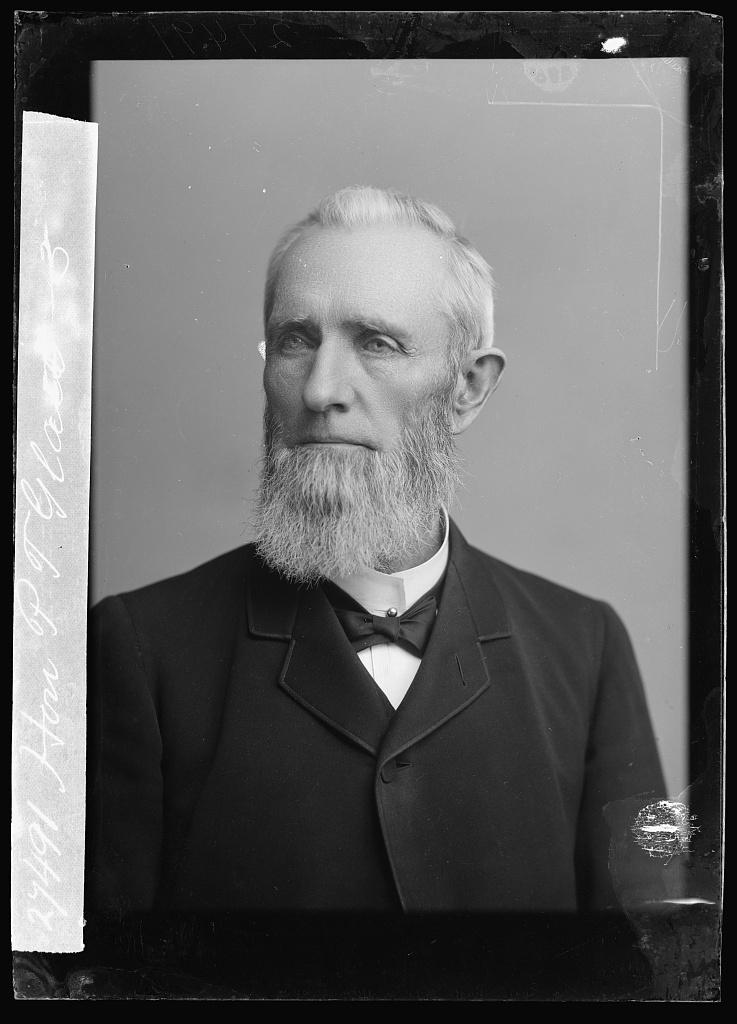
Historical · U.S. House · Tennessee · District 9
Presley Glass
Former U.S. Representative · Tennessee District 9 · 1885–1889 · Democratic
Presley Glass represented Tennessee's District 9 in the United States House of Representatives (1885–1889) for the Democratic party. The page below collects sourced biographical facts, term history, committee roles, and provenance for Glass.
Bioguide ID: G000233
Key facts
- Full name
- Presley Glass
- State
- Tennessee
- District
- District 9
- Party
- Democratic
- House service
- 1885–1889
- First House term
- 1885
- Status
- Left office
- Current term ends
- —
- Born
- 1824
- Bioguide ID
- G000233
- Committee assignments
- —
- Dataset version
- 1.20260606
Biographical narrative
995 words · sourced from the Wikipedia REST extract
Presley Glass was an American politician who served as a U.S. Representative for Tennessee's 9th congressional district during the late 19th century. A member of the Democratic Party, he held office in the Forty-ninth and Fiftieth Congresses from 1885 until 1889. His political career was preceded by a background in law and military service during the Civil War. Glass's life spanned significant historical events in American history, and his contributions to state and national politics reflect the complexities of his time.
Early life and career
Presley Thornton Glass was born on October 18, 1824, in Houston, Virginia, located in Halifax County. He was the son of Dudley Glass and Nancy Carr Glass. In 1828, when he was just four years old, his family relocated to Weakley County, Tennessee. This move marked the beginning of his formative years in a region that would shape his future endeavors. Glass attended Dresden Academy, where he received an education that would lay the groundwork for his later pursuits in law and politics.
At the age of eighteen, Glass was elected to the position of colonel of the local militia, an early indication of his leadership capabilities and community involvement. Following this, he pursued a legal education, attending a course at the Lexington Law School in Kentucky. He was admitted to the bar in 1847, marking the official start of his legal career in Ripley, Tennessee. His practice in law would provide him with the skills necessary for his future political career, as well as a platform to engage with the community on various issues.
In addition to his legal work, Glass entered the political arena early in his career. He served in the Tennessee House of Representatives in 1848, demonstrating his commitment to public service at a young age. His political involvement did not end there; he returned to the Tennessee House of Representatives in 1882, indicating a sustained interest in legislative matters and governance.
In his personal life, Glass married Sarah C. Partee on December 20, 1848. The couple had two children, Hiram D. and James Nelson, who would carry on the Glass family name. His family life, intertwined with his professional pursuits, reflects the values of the time, where personal and public responsibilities often coexisted.
During the tumultuous years of the American Civil War, Glass served as a major in the Confederate Army, holding the position of commissary. This role involved managing supplies and logistics for troops, which was crucial during a time of significant national conflict. His military service added another layer to his experience and perspective, influencing his later political decisions and affiliations.
House tenure
Presley Glass's tenure in the U.S. House of Representatives began on March 4, 1885, when he was elected as a Democrat to represent Tennessee's 9th congressional district. He served in the Forty-ninth and Fiftieth Congresses, during which he participated in the legislative process at a time when the nation was grappling with the aftermath of the Civil War and the complexities of Reconstruction. His election to Congress was a reflection of the political landscape of the time, as the Democratic Party was regaining influence in the South following the war.
Throughout his time in office, Glass was involved in various legislative activities, although specific details about the bills he sponsored or supported are not documented in the available records. His service in Congress lasted until March 3, 1889, when he completed his second term. However, he was not successful in his bid for renomination in 1888, marking the end of his congressional career. The political dynamics of the late 1880s were shifting, and Glass's inability to secure renomination may have been influenced by these changes within the Democratic Party and the broader political climate.
His time in Congress coincided with significant developments in American society, including industrialization, urbanization, and ongoing debates about civil rights and economic policies. While specific legislative achievements during his tenure are not detailed, his role as a representative would have involved addressing the concerns of his constituents in Tennessee, particularly in the context of the social and economic challenges of the era.
Legislative focus and committees
While specific details regarding Presley Glass's legislative focus and committee assignments during his time in the House of Representatives are not extensively documented, it is understood that members of Congress during this period often engaged with issues pertinent to their constituents and the national agenda. As a representative from Tennessee, Glass would have been involved in discussions related to agriculture, economic development, and the social issues facing the South in the post-Civil War era.
The late 19th century was marked by significant changes in American society, including the rise of industrialization and the challenges it posed to rural communities. Representatives like Glass were tasked with addressing the needs of their districts, which often included advocating for infrastructure improvements, economic support for local industries, and addressing the concerns of farmers and laborers. The political landscape was also shaped by the ongoing struggles for civil rights and the integration of formerly enslaved individuals into society, which would have influenced legislative priorities.
As a member of the Democratic Party during this time, Glass would have aligned with the party's platform, which often focused on states' rights, agrarian interests, and opposition to certain federal policies that were perceived as overreaching. His military background may have also influenced his perspectives on issues related to veterans and military affairs, although specific legislative actions in these areas are not detailed in the available records.
Following his departure from Congress in 1889, Glass continued to be involved in his community and local politics. He passed away on October 9, 1902, in Ripley, Tennessee, at the age of 77. His contributions to the state and national political landscape during his lifetime reflect a commitment to public service and the complexities of governance during a transformative period in American history. He is interred at Maplewood Cemetery, where his legacy as a public servant continues to be remembered.
Notable legislation
Sponsored and co-sponsored legislation for Presley Glass is pending operator curation. The biographical narrative above carries the same provenance trail until per-bill rows are written.
Sources
- [1]https://en.wikipedia.org/wiki/Presley_T._GlassWikipedia · retrieved 2026-06-06
Notable quotes
Sourced quotes for Presley Glass are pending operator curation. Narrative-scope provenance remains attached below.
Sources
- [1]https://en.wikipedia.org/wiki/Presley_T._GlassWikipedia · retrieved 2026-06-06
Key positions
Curated policy positions for Presley Glass are pending operator review. The biographical narrative above carries the same provenance trail until per-topic positions are written.
Sources
- [1]https://en.wikipedia.org/wiki/Presley_T._GlassWikipedia · retrieved 2026-06-06
Terms served
- 1885–1887U.S. House · Term 1 · Democratic
- 1887–1889U.S. House · Term 2 · Democratic
Sources & provenance
Every attributable claim above carries a per-section [N] marker that resolves to the corresponding URL below. Each entry records the upstream provider, the canonical URL, and the timestamp at which the source was retrieved by the ingest pipeline.
Key facts
- https://bioguide.congress.gov/search/bio/G000233bioguide · retrieved 2026-06-06
- https://www.govtrack.us/congress/members/404595govtrack · retrieved 2026-06-06
Biographical narrative
- https://en.wikipedia.org/wiki/Presley_T._Glasswikipedia · retrieved 2026-06-06
Find your representative
Every U.S. state elects representatives by district. Browse Tennessee’s delegation, the full former-representative roster, or explore the role and term length.
Related on The Candidate
- Preceded by Charles SimontonEarlier holder of the Tennessee District 9 House seat · Democratic.Open
- Succeeded by James McDearmonLater holder of the Tennessee District 9 House seat · Democratic.Open
- Albert WatkinsFormer U.S. Representative · Tennessee District 1 · DemocraticOpen
- Alfred TaylorFormer U.S. Representative · Tennessee District 1 · RepublicanOpen
- Augustus PettiboneFormer U.S. Representative · Tennessee District 1 · RepublicanOpen
- Bill JenkinsFormer U.S. Representative · Tennessee District 1 · RepublicanOpen