
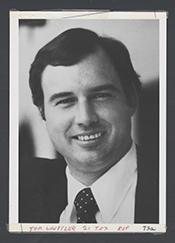
Historical · U.S. House · Texas · District 21
Thomas Loeffler
Former U.S. Representative · Texas District 21 · 1979–1987 · Republican
Thomas Loeffler represented Texas's District 21 in the United States House of Representatives (1979–1987) for the Republican party. The page below collects sourced biographical facts, term history, committee roles, and provenance for Loeffler.
Bioguide ID: L000396
Key facts
- Full name
- Thomas Loeffler
- State
- Texas
- District
- District 21
- Party
- Republican
- House service
- 1979–1987
- First House term
- 1979
- Status
- Left office
- Current term ends
- —
- Born
- 1946
- Bioguide ID
- L000396
- Committee assignments
- —
- Dataset version
- 1.20260605
Biographical narrative
898 words · sourced from the Wikipedia REST extract
Thomas Gilbert Loeffler is a former American politician who served as a Republican member of the United States House of Representatives, representing Texas's 21st congressional district from 1979 to 1987. Over the course of four terms in Congress, Loeffler established himself in the political landscape of central Texas, navigating a shift in the region's political dynamics and contributing to various legislative efforts during his tenure.
Early life and career
Tom Loeffler was born on August 1, 1946, in Fredericksburg, Texas, a town located in the scenic Texas Hill Country. He completed his early education in Mason, Texas, before pursuing higher education at the University of Texas at Austin. There, he earned a Bachelor of Business Administration (BBA) degree, followed by a Juris Doctor (JD) degree from the University of Texas School of Law. During his time at the university, Loeffler was also a member of the football team for a brief period, specifically in the 1965 and 1966 seasons, although he did not earn a letter in the sport.
Upon completing his education, Loeffler began his professional career in law, practicing privately for a year before transitioning to public service. In 1971, he joined the U.S. Department of Commerce, where he began to build his experience in government. His political career took a significant turn when he was appointed as chief counsel to Republican U.S. Senator John Tower in 1972. This role provided him with valuable insights into legislative processes and the workings of Congress. Two years later, he became a deputy at the United States Department of Energy, further solidifying his credentials in federal government.
Loeffler's political involvement deepened when he served as a legislative assistant to U.S. President Gerald Ford from 1975 to 1977. This position allowed him to engage directly with national policy-making and gain experience in the executive branch of government. His background in law and public service laid a strong foundation for his future political ambitions.
House tenure
In 1978, Loeffler successfully ran for a seat in the U.S. House of Representatives, contesting against Democrat Nelson Wolff. This election was notable as it marked a significant political shift in Texas's 21st congressional district, which had historically leaned Democratic. The incumbent, Bob Krueger, had opted to run for the Senate, leaving the seat open for competition. Loeffler's campaign was marked by a decisive victory, as he garnered approximately 57 percent of the vote against Wolff. This outcome was particularly striking given that Krueger had previously won the district with 71 percent of the vote in 1976, indicating a changing political landscape in the area.
Loeffler's initial victory was a pivotal moment in his political career, as he would go on to secure re-election three additional times, each time with over 70 percent of the vote. His ability to maintain such a strong support base reflected his effectiveness as a representative and the growing Republican influence in the district. Throughout his tenure, he participated in all three Republican National Conventions during the 1980s, further solidifying his role within the party.
During his time in the House, Loeffler's legislative activities and initiatives were shaped by the political climate of the era. He was known for his engagement in various issues pertinent to his constituents and the broader national agenda. His tenure lasted until January 3, 1987, when he concluded his service after four terms in office.
Legislative focus and committees
While specific details regarding the committees on which Loeffler served or the precise legislative initiatives he championed during his time in Congress are not provided, it is clear that his role as a U.S. Representative involved addressing the needs and concerns of his constituents in Texas's 21st congressional district. The district, which encompasses a diverse demographic and economic landscape, required a representative who could navigate both local and national issues effectively.
Loeffler's legislative focus likely included matters relevant to central Texas, such as economic development, infrastructure, and community services. His background in law and government would have informed his approach to policy-making, allowing him to engage with complex legislative processes and advocate for the interests of his district.
After concluding his congressional career, Loeffler sought to further his political aspirations by running for governor of Texas. However, he was unsuccessful in the Republican primary against Bill Clements, who went on to win the nomination. Following this setback, Loeffler transitioned to a role in the Office of Legislative Affairs, where he coordinated policies related to Central America.
In 1989, he took on a new challenge as an administrator at the University of Texas, where he contributed to the academic community. He later co-founded a lobbying firm, Gray Loeffler LLC, which represented various clients, including international interests. His career trajectory reflects a continued engagement in public service and advocacy, even after his time in elected office.
Loeffler's family includes notable figures, such as his son Cullen Loeffler, who played as a long snapper for the Minnesota Vikings, and another son, Lance Loeffler, who has had a successful career in the oil and gas sector, including positions with Halliburton and in investment banking.
Overall, Tom Loeffler's career in public service and politics illustrates the evolution of a political figure who navigated the complexities of governance and representation in a changing Texas landscape. His contributions to the U.S. House of Representatives and subsequent endeavors reflect a commitment to public service that extended beyond his time in office.
Notable legislation
Sponsored and co-sponsored legislation for Thomas Loeffler is pending operator curation. The biographical narrative above carries the same provenance trail until per-bill rows are written.
Sources
- [1]https://en.wikipedia.org/wiki/Tom_LoefflerWikipedia · retrieved 2026-06-05
Notable quotes
Sourced quotes for Thomas Loeffler are pending operator curation. Narrative-scope provenance remains attached below.
Sources
- [1]https://en.wikipedia.org/wiki/Tom_LoefflerWikipedia · retrieved 2026-06-05
Key positions
Curated policy positions for Thomas Loeffler are pending operator review. The biographical narrative above carries the same provenance trail until per-topic positions are written.
Sources
- [1]https://en.wikipedia.org/wiki/Tom_LoefflerWikipedia · retrieved 2026-06-05
Terms served
- 1979–1981U.S. House · Term 1 · Republican
- 1981–1983U.S. House · Term 2 · Republican
- 1983–1985U.S. House · Term 3 · Republican
- 1985–1987U.S. House · Term 4 · Republican
Sources & provenance
Every attributable claim above carries a per-section [N] marker that resolves to the corresponding URL below. Each entry records the upstream provider, the canonical URL, and the timestamp at which the source was retrieved by the ingest pipeline.
Key facts
- https://bioguide.congress.gov/search/bio/L000396bioguide · retrieved 2026-06-05
- https://www.govtrack.us/congress/members/406888govtrack · retrieved 2026-06-05
Biographical narrative
- https://en.wikipedia.org/wiki/Tom_Loefflerwikipedia · retrieved 2026-06-05
Find your representative
Every U.S. state elects representatives by district. Browse Texas’s delegation, the full former-representative roster, or explore the role and term length.
Related on The Candidate
- Preceded by Ovie FisherEarlier holder of the Texas District 21 House seat · Democratic.Open
- Succeeded by Lamar SmithLater holder of the Texas District 21 House seat · Republican.Open
- Charles StewartFormer U.S. Representative · Texas District 1 · DemocraticOpen
- David KaufmanFormer U.S. Representative · Texas District 1 · DemocraticOpen
- Eugene BlackFormer U.S. Representative · Texas District 1 · DemocraticOpen
- George SmythFormer U.S. Representative · Texas District 1 · DemocraticOpen