
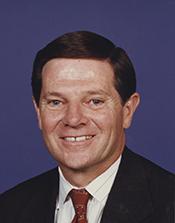
Historical · U.S. House · Texas · District 22
Tom DeLay
Former U.S. Representative · Texas District 22 · 1985–2006 · Republican
Tom DeLay represented Texas's District 22 in the United States House of Representatives (1985–2006) for the Republican party. The page below collects sourced biographical facts, term history, committee roles, and provenance for DeLay.
Bioguide ID: D000217
Key facts
- Full name
- Tom DeLay
- State
- Texas
- District
- District 22
- Party
- Republican
- House service
- 1985–2006
- First House term
- 1985
- Status
- Left office
- Current term ends
- —
- Born
- 1947
- Bioguide ID
- D000217
- Committee assignments
- —
- Dataset version
- 1.20260605
Biographical narrative
884 words · sourced from the Wikipedia REST extract
Thomas Dale DeLay is a former American politician and author who served as a member of the United States House of Representatives, representing Texas's 22nd congressional district from 1985 until 2006. A member of the Republican Party, DeLay held significant leadership roles during his tenure, including serving as House Majority Leader from 2003 to 2005. His political career was marked by his staunch conservative views and involvement in pivotal moments in U.S. legislative history, particularly during the Republican Revolution of the 1990s.
Early life and career
Tom DeLay was born on April 8, 1947, in Laredo, Texas. He was the son of Maxine Evelyn Wimbish and Charles Ray DeLay and grew up alongside two brothers. Due to his father's profession in the petroleum and natural gas sector, DeLay spent a considerable portion of his childhood in Venezuela, which exposed him to diverse cultures and experiences. Upon returning to the United States, he attended Calallen High School in Corpus Christi, Texas, where he was active in sports, particularly football, and also participated in school productions as a lead dancer.
DeLay pursued higher education at Baylor University, initially majoring in pre-med. However, his time at Baylor was cut short due to disciplinary issues, including an incident involving alcohol and vandalism. He later transferred to the University of Houston, where he completed his Bachelor of Science degree in biology in 1970. Following his graduation, DeLay worked for three years at Redwood Chemical, a pesticide manufacturing company. He then founded Albo Pest Control, which he successfully expanded into a significant business, earning him the nickname "the Exterminator." His experiences in the pest control industry shaped his views on government regulation, particularly his opposition to regulatory measures that he believed hindered business operations.
DeLay's early political involvement began in 1978 when he was elected to the Texas House of Representatives, becoming the first Republican to represent Fort Bend County. He was sworn in on January 9, 1979, and served in the Texas House until 1985, gaining valuable experience in state politics.
House tenure
In 1984, DeLay successfully ran for the U.S. House of Representatives, seeking to fill the seat vacated by fellow Republican Ron Paul, who opted to pursue a Senate campaign. DeLay won a competitive six-way primary with a significant portion of the vote and subsequently secured election in November. He was part of a group of six Republican freshmen congressmen from Texas, collectively known as the Texas Six Pack. Throughout his eleven terms in Congress, DeLay faced minimal opposition, as his district became increasingly Republican.
During the early years of his congressional career, DeLay established himself as a vocal critic of the National Endowment for the Arts and the Environmental Protection Agency. His first term included appointments to the Republican Committee on Committees, which assigned members to various House committees, and later to the influential House Appropriations Committee. He retained his position on the Appropriations Committee until he was elected as Majority Leader in 2003. Additionally, he served as chairman of the Republican Study Committee, a group of conservative House Republicans, and as Secretary of the House Republican Conference.
In 1995, following the Republican Party's significant gains in the House during the 1994 elections, DeLay was elected Majority Whip, a position he held until he ascended to the role of Majority Leader after the 2002 midterm elections. His leadership was characterized by a focus on conservative values and a commitment to advancing the Republican agenda. Despite occasional tensions with other Republican leaders, including House Speaker Newt Gingrich, DeLay played a crucial role in shaping legislative strategies and mobilizing support for key initiatives.
Legislative focus and committees
Throughout his congressional career, DeLay was known for his strong conservative stance on various issues, particularly regarding fiscal policy, government regulation, and social conservatism. His leadership in the House was marked by efforts to promote Republican ideals and to counter what he viewed as excessive government intervention in the economy. He was instrumental in the establishment of the K Street Project, an initiative aimed at increasing the influence of Republican lobbyists and aligning corporate interests with the party's legislative goals.
DeLay's tenure as Majority Leader saw significant legislative achievements, including tax cuts and welfare reform, which were central to the Republican platform during the 1990s and early 2000s. He was also involved in the broader strategy of the Republican Party to maintain control of Congress, particularly in the wake of the 2002 elections, which solidified Republican dominance in both chambers.
However, DeLay's career faced challenges in the mid-2000s. In 2005, he was indicted by a grand jury in Travis County, Texas, on charges related to campaign finance violations. Following the indictment, he temporarily stepped down from his position as Majority Leader and later announced that he would not seek re-election. DeLay officially resigned from Congress on June 9, 2006. His legal troubles culminated in a conviction in January 2011, resulting in a three-year prison sentence. However, he remained free on bail while appealing the conviction, which was eventually overturned by the Austin Court of Appeals in 2013, leading to his acquittal.
After leaving Congress, DeLay co-authored a political memoir and established a lobbying firm, First Principles, LLC. His career in politics and subsequent ventures reflect his enduring influence on the Republican Party and his commitment to conservative principles.
Notable legislation
Sponsored and co-sponsored legislation for Tom DeLay is pending operator curation. The biographical narrative above carries the same provenance trail until per-bill rows are written.
Sources
- [1]https://en.wikipedia.org/wiki/Tom_DeLayWikipedia · retrieved 2026-06-05
Notable quotes
Sourced quotes for Tom DeLay are pending operator curation. Narrative-scope provenance remains attached below.
Sources
- [1]https://en.wikipedia.org/wiki/Tom_DeLayWikipedia · retrieved 2026-06-05
Key positions
Curated policy positions for Tom DeLay are pending operator review. The biographical narrative above carries the same provenance trail until per-topic positions are written.
Sources
- [1]https://en.wikipedia.org/wiki/Tom_DeLayWikipedia · retrieved 2026-06-05
Terms served
- 1985–1987U.S. House · Term 1 · Republican
- 1987–1989U.S. House · Term 2 · Republican
- 1989–1991U.S. House · Term 3 · Republican
- 1991–1993U.S. House · Term 4 · Republican
- 1993–1995U.S. House · Term 5 · Republican
- 1995–1997U.S. House · Term 6 · Republican
- 1997–1999U.S. House · Term 7 · Republican
- 1999–2001U.S. House · Term 8 · Republican
- 2001–2003U.S. House · Term 9 · Republican
- 2003–2005U.S. House · Term 10 · Republican
- 2005–2006U.S. House · Term 11 · Republican
Sources & provenance
Every attributable claim above carries a per-section [N] marker that resolves to the corresponding URL below. Each entry records the upstream provider, the canonical URL, and the timestamp at which the source was retrieved by the ingest pipeline.
Key facts
- https://bioguide.congress.gov/search/bio/D000217bioguide · retrieved 2026-06-05
- http://tomdelay.house.govhouse.gov · retrieved 2026-06-05
Biographical narrative
- https://en.wikipedia.org/wiki/Tom_DeLaywikipedia · retrieved 2026-06-05
Find your representative
Every U.S. state elects representatives by district. Browse Texas’s delegation, the full former-representative roster, or explore the role and term length.
Related on The Candidate
- Preceded by Robert GammageEarlier holder of the Texas District 22 House seat · Democratic.Open
- Succeeded by Shelley Sekula-GibbsLater holder of the Texas District 22 House seat · Republican.Open
- Charles StewartFormer U.S. Representative · Texas District 1 · DemocraticOpen
- David KaufmanFormer U.S. Representative · Texas District 1 · DemocraticOpen
- Eugene BlackFormer U.S. Representative · Texas District 1 · DemocraticOpen
- George SmythFormer U.S. Representative · Texas District 1 · DemocraticOpen