
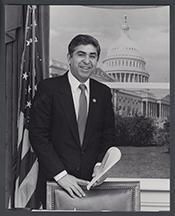
Historical · U.S. House · Texas · District 23
Albert Bustamante
Former U.S. Representative · Texas District 23 · 1985–1993 · Democratic
Albert Bustamante represented Texas's District 23 in the United States House of Representatives (1985–1993) for the Democratic party. The page below collects sourced biographical facts, term history, committee roles, and provenance for Bustamante.
Bioguide ID: B001172
Key facts
- Full name
- Albert Bustamante
- State
- Texas
- District
- District 23
- Party
- Democratic
- House service
- 1985–1993
- First House term
- 1985
- Status
- Left office
- Current term ends
- —
- Born
- 1935
- Bioguide ID
- B001172
- Committee assignments
- —
- Dataset version
- 1.20260605
Biographical narrative
993 words · sourced from the Wikipedia REST extract
Albert G. Bustamante was an American politician who served as a U.S. Representative for Texas's 23rd congressional district from 1985 until 1993. A member of the Democratic Party, Bustamante was notable for his role as a member and former Chair of the Congressional Hispanic Caucus. His political career was marked by significant legislative involvement, particularly in areas related to military and environmental issues, as well as a focus on drug policy and education. His tenure, however, was overshadowed by legal troubles that culminated in a conviction for bribery and racketeering.
Early life and career
Albert Garza Bustamante was born on April 8, 1935, in Asherton, Texas, into a family of Mexican migrant workers. Growing up in a rural setting, he experienced firsthand the challenges faced by working-class families. After completing high school, Bustamante enlisted in the United States Army, where he served as a paratrooper for two years. This military service provided him with discipline and a sense of duty that would later influence his political career.
Following his time in the military, Bustamante pursued higher education. He enrolled in San Antonio College, where he earned an associate degree. He continued his studies at Sul Ross State University, obtaining a Bachelor of Arts degree in education. After completing his education, he began his professional career as a teacher at Cooper Junior High School in San Antonio, Texas. This experience in education likely shaped his views on public policy, particularly regarding educational funding and reform.
Bustamante's entry into politics began in 1968 when he took a position as an aide to Congressman Henry B. González. This role allowed him to gain valuable insights into the legislative process and the workings of Congress. In 1972, he ran for elective office for the first time and was elected as a Bexar County Commissioner. His political career continued to advance when he was elected as the county judge in 1978, during which he also served on the state's Jail Standard Commission. These positions provided him with a foundation in governance and public service, setting the stage for his future congressional career.
House tenure
In 1984, Bustamante entered the race for the U.S. House of Representatives, challenging the nine-term incumbent, Abraham Kazen, in the Democratic primary for Texas's 23rd congressional district. This district was characterized by a heavy Democratic majority and a significant Hispanic population, which played a crucial role in Bustamante's electoral success. He won the primary, marking a significant upset, and subsequently secured his position in Congress, where he began his first term in January 1985.
During his time in the House, Bustamante was reelected three times, representing a district that spanned approximately 800 miles from San Antonio to El Paso. His tenure was marked by active participation in various committees, including the Armed Services Committee, where he contributed to discussions on military procurement and nuclear systems. He was also involved in the Subcommittee on Energy and the Natural Resources Subcommittee, where he expressed concerns regarding environmental safety and the management of nuclear production facilities.
In addition to his committee work, Bustamante was elected president of his Democratic freshman class in the House of Representatives in 1985. He was a member of the Select Committee on Hunger, where he focused on issues related to food security and poverty. His involvement in the House Democratic Steering and Policy Committee beginning in December 1990 further underscored his commitment to addressing key policy issues facing his constituents.
Bustamante's legislative record included a complex stance on U.S. foreign policy, particularly regarding Nicaragua. Initially, he supported an aid package for the Contras in 1986 but later reversed his position, voting against further aid in subsequent years. His advocacy for tighter border controls to combat drug trafficking from Mexico was another significant aspect of his legislative focus. He called for a balanced approach to fiscal policy, advocating for deficit reduction while emphasizing the need for increased investment in education and healthcare.
Legislative focus and committees
Throughout his congressional career, Bustamante's legislative focus was multifaceted, reflecting the diverse needs of his constituents and the broader national landscape. His work on the Armed Services Committee allowed him to engage with critical issues related to military funding and national security. He was particularly concerned with the implications of nuclear energy and weapons, advocating for amendments aimed at establishing a nuclear test ban and addressing safety concerns associated with nuclear production plants.
Bustamante's role on the Select Committee on Hunger highlighted his commitment to addressing poverty and food insecurity. He recognized the importance of nutrition and access to food as fundamental issues affecting the well-being of his constituents. His participation in the House Task Force on Drugs and Crime underscored his focus on public safety and the need for effective drug policy, particularly in relation to border security.
Despite his legislative achievements, Bustamante's career faced significant challenges. In 1992, he was under investigation for fraud and racketeering, which ultimately affected his reelection bid. The redistricting process following the 1990 census further complicated his political landscape, as it altered the demographics of his district, making it more competitive. In the 1992 election, he lost to Republican candidate Henry Bonilla by a substantial margin, marking a significant defeat for an incumbent.
Following his departure from Congress, Bustamante faced legal consequences for his actions while in office. In 1993, he was convicted of accepting bribes and racketeering, resulting in a prison sentence of 42 months. He was released in 1998 and subsequently stepped back from the political arena, living in San Antonio with his wife, Rebecca. His son, John Bustamante, later attempted to follow in his father's footsteps by running for the same congressional seat in 2012, although he was unsuccessful.
Albert G. Bustamante passed away on November 30, 2021, at the age of 86, after a prolonged illness. His life and career reflect the complexities of American politics, particularly the challenges faced by public officials in navigating the intersection of service, accountability, and personal integrity.
Notable legislation
Sponsored and co-sponsored legislation for Albert Bustamante is pending operator curation. The biographical narrative above carries the same provenance trail until per-bill rows are written.
Sources
- [1]https://en.wikipedia.org/wiki/Albert_BustamanteWikipedia · retrieved 2026-06-05
Notable quotes
Sourced quotes for Albert Bustamante are pending operator curation. Narrative-scope provenance remains attached below.
Sources
- [1]https://en.wikipedia.org/wiki/Albert_BustamanteWikipedia · retrieved 2026-06-05
Key positions
Curated policy positions for Albert Bustamante are pending operator review. The biographical narrative above carries the same provenance trail until per-topic positions are written.
Sources
- [1]https://en.wikipedia.org/wiki/Albert_BustamanteWikipedia · retrieved 2026-06-05
Terms served
- 1985–1987U.S. House · Term 1 · Democratic
- 1987–1989U.S. House · Term 2 · Democratic
- 1989–1991U.S. House · Term 3 · Democratic
- 1991–1993U.S. House · Term 4 · Democratic
Sources & provenance
Every attributable claim above carries a per-section [N] marker that resolves to the corresponding URL below. Each entry records the upstream provider, the canonical URL, and the timestamp at which the source was retrieved by the ingest pipeline.
Key facts
- https://bioguide.congress.gov/search/bio/B001172bioguide · retrieved 2026-06-05
- https://www.govtrack.us/congress/members/402114govtrack · retrieved 2026-06-05
Biographical narrative
- https://en.wikipedia.org/wiki/Albert_Bustamantewikipedia · retrieved 2026-06-05
Find your representative
Every U.S. state elects representatives by district. Browse Texas’s delegation, the full former-representative roster, or explore the role and term length.
Related on The Candidate
- Preceded by Abraham Kazen Jr.Earlier holder of the Texas District 23 House seat · Democratic.Open
- Succeeded by Henry BonillaLater holder of the Texas District 23 House seat · Republican.Open
- Charles StewartFormer U.S. Representative · Texas District 1 · DemocraticOpen
- David KaufmanFormer U.S. Representative · Texas District 1 · DemocraticOpen
- Eugene BlackFormer U.S. Representative · Texas District 1 · DemocraticOpen
- George SmythFormer U.S. Representative · Texas District 1 · DemocraticOpen