
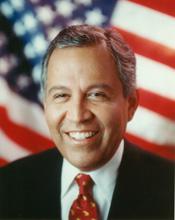
Historical · U.S. House · Texas · District 23
Henry Bonilla
Former U.S. Representative · Texas District 23 · 1993–2007 · Republican
Henry Bonilla represented Texas's District 23 in the United States House of Representatives (1993–2007) for the Republican party. The page below collects sourced biographical facts, term history, committee roles, and provenance for Bonilla.
Bioguide ID: B000617
Key facts
- Full name
- Henry Bonilla
- State
- Texas
- District
- District 23
- Party
- Republican
- House service
- 1993–2007
- First House term
- 1993
- Status
- Left office
- Current term ends
- —
- Born
- 1954
- Bioguide ID
- B000617
- Committee assignments
- —
- Dataset version
- 1.20260605
Biographical narrative
940 words · sourced from the Wikipedia REST extract
Henry Bonilla is a former U.S. Representative who served Texas's 23rd congressional district from 1993 until 2007. A member of the Republican Party, Bonilla's political career is marked by his tenure in Congress, where he developed a conservative voting record and engaged in various political initiatives. His electoral journey included both significant victories and challenges, culminating in a defeat during his final bid for re-election.
Early life and career
Henry Bonilla was born on January 2, 1954, in San Antonio, Texas. He is the son of Anita Arellano and Enrique A. Bonilla. Growing up in a city with a rich cultural heritage, Bonilla was influenced by his surroundings and the educational opportunities available to him. He participated in the TRIO Educational Talent Search program, which aims to provide academic support and promote college readiness among students from disadvantaged backgrounds. This early involvement in educational initiatives shaped his understanding of the importance of education and community engagement.
Bonilla graduated from South San Antonio High School in 1972 and went on to pursue higher education at the University of Texas at Austin, where he earned a Bachelor of Journalism degree in 1976. Prior to entering politics, he worked as a television news executive at KENS-TV, a CBS affiliate in San Antonio. His experience in journalism provided him with insights into public communication and the media landscape, which would later play a role in his political career. Bonilla was previously married to Deborah Knapp, a prominent news anchor at KENS-TV, and later married Sheryl White Shelby.
House tenure
Bonilla's political career in the U.S. House of Representatives began when he won the Republican nomination for Texas's 23rd congressional district in March 1992. At that time, the district had been held by Democrats since its establishment in 1967. Bonilla's campaign focused on criticizing the incumbent, Albert G. Bustamante, accusing him of neglecting the needs of his constituents and being involved in financial misconduct. Despite being outspent in the election, Bonilla achieved a significant victory, winning by a margin of 21 points, which was notable given the district's Democratic leanings.
During his time in Congress, Bonilla served a total of seven terms. He was appointed to Governor George W. Bush's presidential exploratory committee in 1999, becoming the only Texan on the committee. In this role, he represented Bush in various national media appearances and political events. Although the 23rd district had a slight Democratic inclination, Bonilla maintained a conservative voting record, which resonated with many constituents in San Antonio.
Bonilla faced a credible challenge in 2002 from Democrat Henry Cuellar, who came within a narrow margin of defeating him. This close race highlighted the shifting political dynamics in the district. In 2004, Bonilla benefited from a controversial mid-decade redistricting that altered the boundaries of the 23rd district, removing much of Laredo, a core area of the district, and incorporating more Republican-leaning suburbs. This change solidified his position and contributed to his re-election.
However, Bonilla's tenure was not without controversy. He faced criticism for proposing a procedural rule change that would allow House leaders to retain their positions despite facing indictments. This proposal was perceived by many as a political favor to then-Majority Leader Tom DeLay, who was under investigation for campaign finance violations. The political implications of this proposal raised questions about Bonilla's motivations and the influence of party leadership on legislative processes.
In 2006, Bonilla's political career faced a significant turning point. He was defeated in a special election runoff by Ciro Rodriguez, a former Democratic congressman. This loss marked the end of his tenure in the House, with his term officially expiring on January 3, 2007, coinciding with the beginning of the 110th Congress.
Legislative focus and committees
Throughout his congressional career, Bonilla's legislative focus included a range of issues that were significant to his constituents and aligned with his party's platform. He developed a reputation for advocating conservative policies and initiatives, reflecting the values of his Republican base in Texas. His voting record indicated a commitment to fiscal conservatism, national security, and limited government intervention in various sectors.
Bonilla's involvement in the American Dream PAC, an independent political fund he led starting in 1999, aimed to support minority Republican candidates. However, the PAC's record of financial assistance to minority candidates was scrutinized, as a significant portion of its funds was allocated to party organizations rather than directly to minority office-seekers. Bonilla defended the PAC's efforts, emphasizing the challenges of identifying qualified minority candidates.
The 2003 redistricting process in Texas, which Bonilla contributed to, was a pivotal moment in his career. The redistricting aimed to enhance Republican representation in the state, but it also drew legal challenges. In 2006, the U.S. Supreme Court ruled that the redistricting violated the Civil Rights Act by undermining the voting power of Latino constituents in the district. This ruling underscored the complexities of electoral politics and the legal ramifications of redistricting efforts.
Bonilla's legislative career was characterized by his engagement in various committees and his participation in national discussions on key issues. His role as a congressman allowed him to influence policy decisions and represent the interests of his constituents, particularly in areas related to economic development, education, and community services.
In summary, Henry Bonilla's career as a U.S. Representative for Texas's 23rd congressional district reflects a significant chapter in the political landscape of the region. His journey from local journalism to national politics illustrates the diverse pathways individuals can take in public service. Despite the challenges and controversies he faced, Bonilla's tenure in Congress contributed to the ongoing dialogue about representation, electoral integrity, and the role of political leadership in shaping public policy.
Notable legislation
Sponsored and co-sponsored legislation for Henry Bonilla is pending operator curation. The biographical narrative above carries the same provenance trail until per-bill rows are written.
Sources
- [1]https://en.wikipedia.org/wiki/Henry_BonillaWikipedia · retrieved 2026-06-05
Notable quotes
Sourced quotes for Henry Bonilla are pending operator curation. Narrative-scope provenance remains attached below.
Sources
- [1]https://en.wikipedia.org/wiki/Henry_BonillaWikipedia · retrieved 2026-06-05
Key positions
Curated policy positions for Henry Bonilla are pending operator review. The biographical narrative above carries the same provenance trail until per-topic positions are written.
Sources
- [1]https://en.wikipedia.org/wiki/Henry_BonillaWikipedia · retrieved 2026-06-05
Terms served
- 1993–1995U.S. House · Term 1 · Republican
- 1995–1997U.S. House · Term 2 · Republican
- 1997–1999U.S. House · Term 3 · Republican
- 1999–2001U.S. House · Term 4 · Republican
- 2001–2003U.S. House · Term 5 · Republican
- 2003–2005U.S. House · Term 6 · Republican
- 2005–2007U.S. House · Term 7 · Republican
Sources & provenance
Every attributable claim above carries a per-section [N] marker that resolves to the corresponding URL below. Each entry records the upstream provider, the canonical URL, and the timestamp at which the source was retrieved by the ingest pipeline.
Key facts
- https://bioguide.congress.gov/search/bio/B000617bioguide · retrieved 2026-06-05
- http://www.house.gov/bonillahouse.gov · retrieved 2026-06-05
Biographical narrative
- https://en.wikipedia.org/wiki/Henry_Bonillawikipedia · retrieved 2026-06-05
Find your representative
Every U.S. state elects representatives by district. Browse Texas’s delegation, the full former-representative roster, or explore the role and term length.
Related on The Candidate
- Preceded by Albert BustamanteEarlier holder of the Texas District 23 House seat · Democratic.Open
- Succeeded by Quico CansecoLater holder of the Texas District 23 House seat · Republican.Open
- Charles StewartFormer U.S. Representative · Texas District 1 · DemocraticOpen
- David KaufmanFormer U.S. Representative · Texas District 1 · DemocraticOpen
- Eugene BlackFormer U.S. Representative · Texas District 1 · DemocraticOpen
- George SmythFormer U.S. Representative · Texas District 1 · DemocraticOpen