
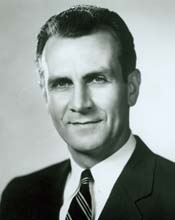
Historical · U.S. House · Texas · District 5
Bruce Alger
Former U.S. Representative · Texas District 5 · 1955–1965 · Republican
Bruce Alger represented Texas's District 5 in the United States House of Representatives (1955–1965) for the Republican party. The page below collects sourced biographical facts, term history, committee roles, and provenance for Alger.
Bioguide ID: A000106
Key facts
- Full name
- Bruce Alger
- State
- Texas
- District
- District 5
- Party
- Republican
- House service
- 1955–1965
- First House term
- 1955
- Status
- Left office
- Current term ends
- —
- Born
- 1918
- Bioguide ID
- A000106
- Committee assignments
- —
- Dataset version
- 1.20260605
Biographical narrative
1,033 words · sourced from the Wikipedia REST extract
Bruce Alger was an American politician and real estate agent who served as a Republican U.S. Representative for Texas's 5th congressional district from 1955 until 1965. He was notable for being the first Republican to represent a Dallas district since the Reconstruction era. Alger's tenure in Congress was marked by his strong conservative beliefs and his commitment to limited government, which often put him at odds with his colleagues in a predominantly Democratic Texas delegation.
Early life and career
Bruce Reynolds Alger was born on June 12, 1918, in Dallas, Texas. He was the son of David Bruce Alger, a bank representative, and Clare Freeman, who had aspirations of becoming a poet and writer. Alger spent his early years in Webster Groves, Missouri, a suburb of St. Louis, where he was raised. He later attended Princeton University on a scholarship, where he studied philosophy, art, and music. During his time at Princeton, he was also a center on the football team. Alger graduated in 1940 with an A.B. in philosophy, completing a senior thesis that focused on "Chinese Painting."
Following his graduation, Alger began working for the RCA Corporation as a field representative. However, with the onset of World War II, he joined the United States Army and was assigned to Squadron 5 at the Army Air Corps Advanced Flying School in San Antonio, Texas. He flew bombers during the war and achieved the rank of captain. Alger claimed to be among the first U.S. troops to arrive in Japan after the war concluded in August 1945, and he was awarded the Distinguished Flying Cross for his service.
After returning to civilian life, Alger faced challenges in re-entering the workforce, as RCA declined to rehire him, citing his absence from television production during the war. In 1945, he relocated to Dallas and established his own real estate and land development company. His involvement in local commerce led to his election as the first president of the White Rock Chamber of Commerce. In 1950, he announced plans for a 180-lot subdivision in Far East Dallas, which was named Alger Park in his honor. Alger continued to support this development even after his election to Congress, participating in various ceremonies related to the neighborhood.
In 1943, Alger married his first wife, Lucille "Lynn" Antoine. Later in life, he authored a self-published book in 2013 detailing his experiences during World War II, titled "The Crew Book - Miss America '62." The book recounts the journey of the B-29 bomber he piloted, named after his daughter, and covers the crew's experiences from training through combat and the eventual surrender of Japan.
House tenure
Alger entered politics in 1954 when he became the Republican candidate for the U.S. House of Representatives in Texas's 5th congressional district. His victory was considered unexpected due to Texas's historical Democratic leanings. In the election, he received a majority of the votes against Democrat Wallace H. Savage, marking the beginning of his five terms in Congress. For the first eight years of his tenure, he was the only Republican in the Texas delegation until Ed Foreman joined him in 1963.
During his time in Congress, Alger served amidst the influential political landscape shaped by prominent figures such as Lyndon B. Johnson and Sam Rayburn. As a staunch conservative, he often found himself in a minority position within the Texas delegation, which was predominantly Democratic. Alger identified as an individualist and a constitutionalist, holding firm to his principles, which some critics interpreted as stubbornness. He was known for his belief in limited government, advocating that many responsibilities, particularly social programs, should be managed at the local level rather than by the federal government.
Alger's views on civil rights were particularly contentious. He believed that local solutions were preferable to national intervention, which led him to oppose several significant pieces of legislation, including the Civil Rights Acts of 1957, 1960, and 1964, as well as the 24th Amendment to the U.S. Constitution. His opposition to the popular school lunch program further distinguished him from his colleagues, who largely supported such initiatives.
In 1960, Alger organized a protest against Lyndon Johnson at the Adolphus Hotel in Dallas, during which tensions escalated, resulting in an incident involving Lady Bird Johnson. This protest was viewed as a significant moment in the political climate of the time, with some attributing the fallout to the loss of Texas's electoral votes for Richard Nixon in the 1960 presidential election.
Despite his electoral successes in the 1956 and 1958 elections, where he defeated notable Democratic opponents, Alger's political fortunes changed in 1964 when he was defeated for reelection. His earlier victories included wins against Henry Wade, who later became known for his role in the Roe v. Wade case, and Barefoot Sanders, who would also gain prominence in Texas politics.
Legislative focus and committees
Throughout his congressional career, Bruce Alger maintained a focus on limited government and individual liberties, which shaped his legislative priorities. He was known for his opposition to federal involvement in various social issues, advocating instead for local governance and solutions. His stance often placed him at odds with the prevailing Democratic majority in Congress, particularly during the civil rights movement.
Alger's commitment to his principles was evident in his voting record, where he consistently opposed legislation that he believed expanded the federal government's role in social programs. His resistance to the Civil Rights Acts and other significant reforms reflected his belief that such matters should be handled at the state or local level. This perspective was not widely shared among his colleagues, leading to a reputation as a maverick within the Texas delegation.
During his tenure, Alger served on various committees, where he contributed to discussions and decisions that aligned with his conservative values. His approach to governance emphasized fiscal responsibility and a cautious stance on government spending, which he believed would lead to better outcomes for constituents.
Alger's time in Congress concluded on January 3, 1965, after which he returned to private life. His political career, characterized by his strong conservative beliefs and commitment to limited government, left a lasting impact on the political landscape of Texas during a transformative era in American history.
Notable legislation
Sponsored and co-sponsored legislation for Bruce Alger is pending operator curation. The biographical narrative above carries the same provenance trail until per-bill rows are written.
Sources
- [1]https://en.wikipedia.org/wiki/Bruce_AlgerWikipedia · retrieved 2026-06-05
Notable quotes
Sourced quotes for Bruce Alger are pending operator curation. Narrative-scope provenance remains attached below.
Sources
- [1]https://en.wikipedia.org/wiki/Bruce_AlgerWikipedia · retrieved 2026-06-05
Key positions
Curated policy positions for Bruce Alger are pending operator review. The biographical narrative above carries the same provenance trail until per-topic positions are written.
Sources
- [1]https://en.wikipedia.org/wiki/Bruce_AlgerWikipedia · retrieved 2026-06-05
Terms served
- 1955–1957U.S. House · Term 1 · Republican
- 1957–1959U.S. House · Term 2 · Republican
- 1959–1961U.S. House · Term 3 · Republican
- 1961–1963U.S. House · Term 4 · Republican
- 1963–1965U.S. House · Term 5 · Republican
Sources & provenance
Every attributable claim above carries a per-section [N] marker that resolves to the corresponding URL below. Each entry records the upstream provider, the canonical URL, and the timestamp at which the source was retrieved by the ingest pipeline.
Key facts
- https://bioguide.congress.gov/search/bio/A000106bioguide · retrieved 2026-06-05
- https://www.govtrack.us/congress/members/400764govtrack · retrieved 2026-06-05
Biographical narrative
- https://en.wikipedia.org/wiki/Bruce_Algerwikipedia · retrieved 2026-06-05
Find your representative
Every U.S. state elects representatives by district. Browse Texas’s delegation, the full former-representative roster, or explore the role and term length.
Related on The Candidate
- Preceded by Joseph WilsonEarlier holder of the Texas District 5 House seat · Democratic.Open
- Succeeded by Earle CabellLater holder of the Texas District 5 House seat · Democratic.Open
- Charles StewartFormer U.S. Representative · Texas District 1 · DemocraticOpen
- David KaufmanFormer U.S. Representative · Texas District 1 · DemocraticOpen
- Eugene BlackFormer U.S. Representative · Texas District 1 · DemocraticOpen
- George SmythFormer U.S. Representative · Texas District 1 · DemocraticOpen