
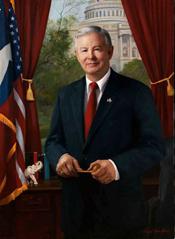
Historical · U.S. House · Texas · District 6
Joe Barton
Former U.S. Representative · Texas District 6 · 1985–2019 · Republican
Joe Barton represented Texas's District 6 in the United States House of Representatives (1985–2019) for the Republican party. The page below collects sourced biographical facts, term history, committee roles, and provenance for Barton.
Bioguide ID: B000213
Key facts
- Full name
- Joe Barton
- State
- Texas
- District
- District 6
- Party
- Republican
- House service
- 1985–2019
- First House term
- 1985
- Status
- Left office
- Current term ends
- —
- Born
- 1949
- Bioguide ID
- B000213
- Committee assignments
- —
- Dataset version
- 1.20260605
Biographical narrative
927 words · sourced from the Wikipedia REST extract
Joseph Linus Barton is a former American politician who served as a U.S. Representative for Texas's 6th congressional district from 1985 until 2019. A member of the Republican Party, Barton was known for his long tenure in Congress, which spanned 17 terms, making him one of the longest-serving members of the Texas congressional delegation. His district encompassed areas including Arlington, parts of Fort Worth, and several smaller towns and rural regions south of the Dallas-Fort Worth Metroplex. Throughout his career, Barton was recognized for his advocacy of conservative principles and his involvement in various legislative efforts, particularly in the energy sector.
Early life and career
Joe Barton was born on September 15, 1949, in Waco, Texas, to Bess Wynell and Larry Linus Barton. He completed his secondary education at Waco High School before pursuing higher education at Texas A&M University. There, he received a Bachelor of Science degree in industrial engineering in 1972, supported by a Gifford-Hill Opportunity Award scholarship. Following his undergraduate studies, Barton continued his education at Purdue University, where he earned a Master of Science degree in industrial administration in 1973.
After completing his education, Barton entered the private sector, where he worked until 1981. His career took a significant turn when he became a White House Fellow, serving under United States Secretary of Energy James B. Edwards. This experience provided him with insights into federal energy policy and governance. Following his fellowship, Barton worked as a consultant for Atlantic Richfield Oil and Gas Company before entering politics. He made his first bid for elected office in 1984, which ultimately led to his election to the U.S. House of Representatives.
House tenure
Barton began his congressional career in 1985 after winning the Republican primary for Texas's 6th congressional district. He succeeded three-term incumbent Phil Gramm, who vacated the seat to run for the U.S. Senate. In the primary, Barton emerged as the frontrunner, securing approximately 42% of the vote among five candidates. He then narrowly defeated Max Hoyt in the runoff election before going on to defeat Democratic nominee Dan Kubiak in the general election with a margin of 57% to 43%. This victory marked the beginning of a lengthy and influential career in Congress.
Throughout his tenure, Barton consistently won re-election, often with a significant majority of the vote. His re-election campaigns from 1988 to 2010 saw him secure at least 60% of the vote in each election, with his closest call occurring in 2006 when he defeated Democratic candidate David Harris with 60% to 37%. In 2008, he faced another Democratic challenger, Ludwig Otto, and won with a 26-point margin. During this period, Barton faced limited challenges within his party, with only two primary contests in 1992 and 1994, both of which he won decisively.
As controversies surrounding his political record began to surface, Barton faced increasingly contentious election battles. In 2011, a Super PAC was established by conservative groups in Texas to challenge him and other long-serving incumbents. His comments during town hall meetings and other public forums were utilized in national political advertisements against him, contributing to a growing perception of vulnerability. In 2012, Barton faced three primary challengers, including Joe Chow, the Mayor of Addison, who labeled him as "the most corrupt congressman in the State of Texas." Despite these challenges, Barton won re-nomination for his 16th term in the Republican primary in 2014, securing 72.7% of the votes.
In 2016, Barton successfully won his 17th consecutive term in the House, defeating Democratic opponent Ruby Faye Woolridge with 58.3% of the vote. This election marked a notable moment in his career, as Woolridge garnered the highest percentage of votes for a Democratic challenger against him throughout his three-decade tenure. However, by late 2017, Barton announced that he would not seek re-election in 2018, following a personal scandal that had garnered significant media attention.
Legislative focus and committees
During his time in the House, Barton was known for his strong advocacy of conservative values and policies. He was a member of the Tea Party Caucus and positioned himself as a defender of deregulation in the energy sector, particularly concerning the electricity and natural gas industries. His leadership roles included serving as vice-chairman of the House Energy and Commerce Committees, where he played a pivotal role in shaping energy policy.
Barton was a vocal proponent of fossil fuels and consistently opposed regulations aimed at reducing carbon emissions, asserting that human-induced emissions did not significantly contribute to global warming. His environmental record, characterized by a defense of industry interests against stricter pollution controls, earned him the nickname "Smokey Joe." Notably, he led efforts to repeal the oil export ban in the House in 2015, reflecting his commitment to promoting the fossil fuel industry.
In addition to his energy-related initiatives, Barton supported various conservative legislative measures, including the 2017 Republican plan to replace the Affordable Care Act and President Donald Trump's immigration policies, which included a ban on immigration from certain predominantly Muslim countries. He also advocated for the death penalty for individuals convicted of espionage.
Barton’s career was marked by significant legislative achievements and controversies, including a notable incident in which he told a constituent to "shut up" during a town hall meeting, which brought him national attention. His tenure concluded in January 2019, after he chose not to seek re-election amidst personal scandals that included the leak of explicit photos he had shared consensually. Barton's long career in Congress reflects a complex legacy shaped by both his legislative accomplishments and the challenges he faced as a public figure.
Notable legislation
Sponsored and co-sponsored legislation for Joe Barton is pending operator curation. The biographical narrative above carries the same provenance trail until per-bill rows are written.
Sources
- [1]https://en.wikipedia.org/wiki/Joe_BartonWikipedia · retrieved 2026-06-05
Notable quotes
Sourced quotes for Joe Barton are pending operator curation. Narrative-scope provenance remains attached below.
Sources
- [1]https://en.wikipedia.org/wiki/Joe_BartonWikipedia · retrieved 2026-06-05
Key positions
Curated policy positions for Joe Barton are pending operator review. The biographical narrative above carries the same provenance trail until per-topic positions are written.
Sources
- [1]https://en.wikipedia.org/wiki/Joe_BartonWikipedia · retrieved 2026-06-05
Terms served
- 1985–1987U.S. House · Term 1 · Republican
- 1987–1989U.S. House · Term 2 · Republican
- 1989–1991U.S. House · Term 3 · Republican
- 1991–1993U.S. House · Term 4 · Republican
- 1993–1995U.S. House · Term 5 · Republican
- 1995–1997U.S. House · Term 6 · Republican
- 1997–1999U.S. House · Term 7 · Republican
- 1999–2001U.S. House · Term 8 · Republican
- 2001–2003U.S. House · Term 9 · Republican
- 2003–2005U.S. House · Term 10 · Republican
- 2005–2007U.S. House · Term 11 · Republican
- 2007–2009U.S. House · Term 12 · Republican
- 2009–2011U.S. House · Term 13 · Republican
- 2011–2013U.S. House · Term 14 · Republican
- 2013–2015U.S. House · Term 15 · Republican
- 2015–2017U.S. House · Term 16 · Republican
- 2017–2019U.S. House · Term 17 · Republican
Sources & provenance
Every attributable claim above carries a per-section [N] marker that resolves to the corresponding URL below. Each entry records the upstream provider, the canonical URL, and the timestamp at which the source was retrieved by the ingest pipeline.
Key facts
- https://bioguide.congress.gov/search/bio/B000213bioguide · retrieved 2026-06-05
- https://joebarton.house.govhouse.gov · retrieved 2026-06-05
Biographical narrative
- https://en.wikipedia.org/wiki/Joe_Bartonwikipedia · retrieved 2026-06-05
Find your representative
Every U.S. state elects representatives by district. Browse Texas’s delegation, the full former-representative roster, or explore the role and term length.
Related on The Candidate
- Preceded by Olin TeagueEarlier holder of the Texas District 6 House seat · Democratic.Open
- Succeeded by Ron WrightLater holder of the Texas District 6 House seat · Republican.Open
- Charles StewartFormer U.S. Representative · Texas District 1 · DemocraticOpen
- David KaufmanFormer U.S. Representative · Texas District 1 · DemocraticOpen
- Eugene BlackFormer U.S. Representative · Texas District 1 · DemocraticOpen
- George SmythFormer U.S. Representative · Texas District 1 · DemocraticOpen