
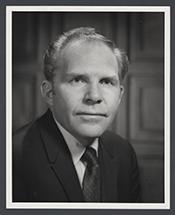
Historical · U.S. House · Utah · District 1
Koln McKay
Former U.S. Representative · Utah District 1 · 1971–1981 · Democratic
Koln McKay represented Utah's District 1 in the United States House of Representatives (1971–1981) for the Democratic party. The page below collects sourced biographical facts, term history, committee roles, and provenance for McKay.
Bioguide ID: M000490
Key facts
- Full name
- Koln McKay
- State
- Utah
- District
- District 1
- Party
- Democratic
- House service
- 1971–1981
- First House term
- 1971
- Status
- Left office
- Current term ends
- —
- Born
- 1925
- Bioguide ID
- M000490
- Committee assignments
- —
- Dataset version
- 1.20260605
Biographical narrative
974 words · sourced from the Wikipedia REST extract
K. Gunn McKay was an American politician who served as a U.S. Representative for Utah's 1st congressional district from January 3, 1971, until January 3, 1981. A member of the Democratic Party, McKay was known for his advocacy of government development in Utah and his efforts to protect the state's natural resources. His political career spanned five terms in the U.S. House of Representatives, during which he held significant committee positions and worked on various legislative initiatives.
Early life and career
K. Gunn McKay was born on February 23, 1925, in Ogden, Weber County, Utah. He was raised in a family that was active in the Church of Jesus Christ of Latter-day Saints (LDS Church). His familial connections included his brother Monroe G. McKay, who later became a judge on the U.S. Tenth Circuit Court of Appeals, and David O. McKay, who served as the president of the LDS Church from 1951 to 1970.
During World War II, McKay served in the U.S. Coast Guard, an experience that contributed to his sense of civic duty and public service. Following his military service, he became an LDS missionary in England, which further solidified his commitment to community and leadership. After returning from his mission, McKay pursued a career in education, working as a high school history teacher. He attended Weber County public schools and later studied at Weber State College in Ogden and Utah State University in Logan, where he graduated with a degree in education in 1962.
In 1950, McKay married Donna Biesinger, and together they had ten children. His family life and background in education likely influenced his later political career, as he sought to address educational and community needs during his time in office.
McKay's political career began in 1962 when he was elected to the Utah House of Representatives. He completed two terms in this role, during which he served on several important committees, including the legislative council, the Utah Long Range Goals and Planning Committee, and the Utah Government Reorganization Committee. His involvement in state politics led to an appointment as administrative assistant to Utah Governor Cal Rampton, a fellow Democrat, from 1967 until 1970. This position allowed him to gain valuable experience in governance and public policy, setting the stage for his later election to Congress.
House tenure
In 1970, K. Gunn McKay was elected as a Democrat to represent Utah's 1st congressional district in the U.S. House of Representatives. He began his first term in the Ninety-second Congress and continued to serve in four subsequent Congresses, completing a total of five terms in the House. His tenure was marked by a focus on issues pertinent to Utah and the broader western United States.
During his time in Congress, McKay was particularly active in advocating for military and defense-related initiatives. As chairman of the Military Construction Subcommittee, he played a crucial role in reopening Utah’s Minuteman Missile production line and securing the F-16 fighter mission for Hill Air Force Base. Additionally, he worked to appropriate funding for enhancing security at the nerve gas storage facility in Tooele, Utah. These efforts underscored his commitment to both national defense and local economic development.
In addition to military matters, McKay was a strong proponent of environmental protection and the development of Utah's natural resources. He successfully secured funding for the enhancement of several national parks in Utah, including Capitol Reef, Glen Canyon, Arches, and Zion National Parks. His legislative efforts also included drafting important legislation related to the Lone Peak Wilderness Area and contributing to the Clean Air Act. Through these initiatives, McKay aimed to balance economic growth with environmental stewardship, reflecting the interests of his constituents.
Despite his accomplishments, McKay faced challenges as the political landscape shifted in the late 1970s. The Republican Party made significant gains in western politics during the 1980 election cycle, culminating in McKay's defeat in his bid for a sixth term by Republican candidate James V. Hansen. Following his congressional career, McKay attempted to reclaim his seat in 1986 and 1988 but was unsuccessful in both attempts.
Legislative focus and committees
Throughout his time in the U.S. House of Representatives, K. Gunn McKay was involved in various legislative committees and initiatives that reflected his priorities and the needs of his constituents. His role as chairman of the Military Construction Subcommittee was particularly notable, as it allowed him to influence funding and policy related to military installations and defense infrastructure in Utah. This position enabled him to advocate for projects that not only supported national security but also provided economic benefits to the local community.
McKay's commitment to environmental issues was evident in his legislative focus on protecting Utah's natural resources. His efforts to secure funding for national parks demonstrated his dedication to preserving the state's unique landscapes and promoting tourism. By advocating for the development of these parks, he aimed to enhance both the ecological integrity of the region and the economic opportunities for residents.
In addition to his work on military and environmental issues, McKay's legislative agenda included a broader commitment to education and community development. His background as a teacher and his experience in state politics informed his approach to these issues, as he sought to address the educational needs of Utah's residents and promote policies that would benefit families and communities.
Overall, K. Gunn McKay's tenure in the U.S. House of Representatives was characterized by a focus on military readiness, environmental protection, and community development. His legislative efforts reflected a commitment to serving the interests of Utahns while navigating the complexities of national politics. After leaving Congress, McKay remained active in public service and continued to contribute to his community through various roles, including leadership positions within the LDS Church. He passed away on October 6, 2000, in Huntsville, Utah, leaving behind a legacy of public service and community engagement.
Notable legislation
Sponsored and co-sponsored legislation for Koln McKay is pending operator curation. The biographical narrative above carries the same provenance trail until per-bill rows are written.
Sources
- [1]https://en.wikipedia.org/wiki/K._Gunn_McKayWikipedia · retrieved 2026-06-05
Notable quotes
Sourced quotes for Koln McKay are pending operator curation. Narrative-scope provenance remains attached below.
Sources
- [1]https://en.wikipedia.org/wiki/K._Gunn_McKayWikipedia · retrieved 2026-06-05
Key positions
Curated policy positions for Koln McKay are pending operator review. The biographical narrative above carries the same provenance trail until per-topic positions are written.
Sources
- [1]https://en.wikipedia.org/wiki/K._Gunn_McKayWikipedia · retrieved 2026-06-05
Terms served
- 1971–1973U.S. House · Term 1 · Democratic
- 1973–1975U.S. House · Term 2 · Democratic
- 1975–1977U.S. House · Term 3 · Democratic
- 1977–1979U.S. House · Term 4 · Democratic
- 1979–1981U.S. House · Term 5 · Democratic
Sources & provenance
Every attributable claim above carries a per-section [N] marker that resolves to the corresponding URL below. Each entry records the upstream provider, the canonical URL, and the timestamp at which the source was retrieved by the ingest pipeline.
Key facts
- https://bioguide.congress.gov/search/bio/M000490bioguide · retrieved 2026-06-05
- https://www.govtrack.us/congress/members/407485govtrack · retrieved 2026-06-05
Biographical narrative
- https://en.wikipedia.org/wiki/K._Gunn_McKaywikipedia · retrieved 2026-06-05
Find your representative
Every U.S. state elects representatives by district. Browse Utah’s delegation, the full former-representative roster, or explore the role and term length.
Related on The Candidate
- Preceded by Laurence BurtonEarlier holder of the Utah District 1 House seat · Republican.Open
- Succeeded by James HansenLater holder of the Utah District 1 House seat · Republican.Open
- Clarence AllenFormer U.S. Representative · Utah District 1 · RepublicanOpen
- Don ColtonFormer U.S. Representative · Utah District 1 · RepublicanOpen
- Douglas StringfellowFormer U.S. Representative · Utah District 1 · RepublicanOpen
- Henry DixonFormer U.S. Representative · Utah District 1 · RepublicanOpen