
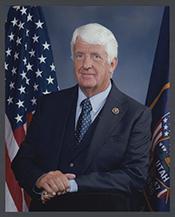
Historical · U.S. House · Utah · District 1
Rob Bishop
Former U.S. Representative · Utah District 1 · 2003–2021 · Republican
Rob Bishop represented Utah's District 1 in the United States House of Representatives (2003–2021) for the Republican party. The page below collects sourced biographical facts, term history, committee roles, and provenance for Bishop.
Bioguide ID: B001250
Key facts
- Full name
- Rob Bishop
- State
- Utah
- District
- District 1
- Party
- Republican
- House service
- 2003–2021
- First House term
- 2003
- Status
- Left office
- Current term ends
- —
- Born
- 1951
- Bioguide ID
- B001250
- Committee assignments
- —
- Dataset version
- 1.20260604
Biographical narrative
890 words · sourced from the Wikipedia REST extract
Robert William Bishop is an American politician who served as the U.S. Representative for Utah's 1st congressional district from 2003 until 2021. A member of the Republican Party, he became a prominent figure in Utah politics, eventually becoming the dean of the state's congressional delegation following the retirement of Orrin Hatch from the U.S. Senate in 2019. Bishop's political career is marked by his long tenure in both state and federal government, where he focused on various issues, particularly those related to land use and federalism.
Early life and career
Rob Bishop was born on July 13, 1951, in Kaysville, Utah. He completed his secondary education at Davis High School before embarking on a mission for the Church of Jesus Christ of Latter-day Saints in Germany from 1970 to 1972. After returning to the United States, he pursued higher education at the University of Utah, where he earned a bachelor's degree in political science in 1974.
Following his graduation, Bishop began a career in education, teaching civics at Box Elder High School in Brigham City from 1974 to 1980. He later taught German at Ben Lomond High School in Ogden, Utah, before returning to Box Elder High School to teach government and history. He remained in the teaching profession until his retirement in 2002. During his time as an educator, Bishop collaborated with the Close Up Foundation, which facilitated civic education programs for students in Washington, D.C.
Bishop's entry into politics began in 1978 when he was elected to the Utah House of Representatives, where he served until 1994. His political career in the state legislature included roles as House Majority Leader and Speaker of the House from 1992 to 1994. Following his tenure in the state legislature, he was elected chairman of the Utah Republican Party in 1997, a position he held for two terms. Additionally, he worked as a legislative lobbyist in Washington, D.C., further solidifying his involvement in political affairs.
House tenure
In 2002, Rob Bishop returned to politics by running for the Republican nomination in Utah's 1st congressional district, which had become vacant following the retirement of long-serving Congressman Jim Hansen. At the state Republican convention, Bishop emerged as the frontrunner among a field of seven candidates. He subsequently faced State Representative Kevin Garn in a primary election, where he secured victory with a significant majority of the votes. This success positioned him favorably for the general election, which he won with a substantial margin, receiving approximately 61% of the votes cast.
Bishop's re-election campaigns were characterized by consistent support from his constituents. He successfully won re-election in subsequent cycles, including the elections of 2004, 2006, 2008, 2010, and 2012, often with increasing margins. In 2014, he was re-elected with 64% of the vote. His tenure in the House of Representatives lasted for nine terms, concluding on January 3, 2021.
Throughout his time in Congress, Bishop garnered attention for the significant portion of his campaign contributions that came from outside Utah, particularly during the 2016 election cycle, where over 92% of his funding was sourced from out-of-state donors. This trend was notably high compared to his peers in the House, with much of the financial support stemming from the energy and agribusiness sectors.
Legislative focus and committees
During his time in the U.S. House of Representatives, Rob Bishop focused on a range of legislative issues, particularly those related to federalism, land use, and environmental policy. He was a proponent of a "repeal amendment" to the U.S. Constitution, which aimed to empower states to overturn federal legislation through a majority vote. This initiative reflected his belief in the importance of state sovereignty and local governance.
Bishop was also a vocal critic of the Endangered Species Act of 1973, arguing that it had been misused to restrict land use and hinder economic development. He expressed a desire to repeal or modify the law, claiming it had been "hijacked" for purposes beyond its original intent. His stance on land management extended to his opposition to the Antiquities Act, particularly regarding the designation of national monuments. He opposed the establishment of the Bears Ears National Monument and advocated for the transfer of federal public lands to state control.
In 2013, Bishop introduced the Ensuring Public Involvement in the Creation of National Monuments Act, which sought to amend the Antiquities Act to require public input in national monument designations. He argued that such decisions should involve community participation, whether made by Congress or the President.
Bishop's legislative agenda also included attempts to defund certain federal land management programs, although he faced backlash for some of these proposals. He introduced a budget amendment in 2011 aimed at eliminating funding for the National Landscape Conservation System, which oversees a significant amount of Bureau of Land Management land. After receiving criticism, he withdrew the amendment.
In addition to his legislative efforts, Bishop's political rhetoric often sparked controversy. He made headlines in 2019 for comments comparing the Green New Deal to genocide, a statement that drew significant media attention and public discussion.
Bishop's political career has been marked by a commitment to conservative principles, particularly in the realms of land use and federalism. His tenure in the U.S. House of Representatives reflects a long-standing engagement with issues that resonate with his constituents in Utah and align with the broader Republican Party platform.
Notable legislation
Sponsored and co-sponsored legislation for Rob Bishop is pending operator curation. The biographical narrative above carries the same provenance trail until per-bill rows are written.
Sources
- [1]https://en.wikipedia.org/wiki/Rob_BishopWikipedia · retrieved 2026-06-04
Notable quotes
Sourced quotes for Rob Bishop are pending operator curation. Narrative-scope provenance remains attached below.
Sources
- [1]https://en.wikipedia.org/wiki/Rob_BishopWikipedia · retrieved 2026-06-04
Key positions
Curated policy positions for Rob Bishop are pending operator review. The biographical narrative above carries the same provenance trail until per-topic positions are written.
Sources
- [1]https://en.wikipedia.org/wiki/Rob_BishopWikipedia · retrieved 2026-06-04
Terms served
- 2003–2005U.S. House · Term 1 · Republican
- 2005–2007U.S. House · Term 2 · Republican
- 2007–2009U.S. House · Term 3 · Republican
- 2009–2011U.S. House · Term 4 · Republican
- 2011–2013U.S. House · Term 5 · Republican
- 2013–2015U.S. House · Term 6 · Republican
- 2015–2017U.S. House · Term 7 · Republican
- 2017–2019U.S. House · Term 8 · Republican
- 2019–2021U.S. House · Term 9 · Republican
Sources & provenance
Every attributable claim above carries a per-section [N] marker that resolves to the corresponding URL below. Each entry records the upstream provider, the canonical URL, and the timestamp at which the source was retrieved by the ingest pipeline.
Key facts
- https://bioguide.congress.gov/search/bio/B001250bioguide · retrieved 2026-06-04
- https://robbishop.house.govhouse.gov · retrieved 2026-06-04
Biographical narrative
- https://en.wikipedia.org/wiki/Rob_Bishopwikipedia · retrieved 2026-06-04
Find your representative
Every U.S. state elects representatives by district. Browse Utah’s delegation, the full former-representative roster, or explore the role and term length.
Related on The Candidate
- Preceded by James HansenEarlier holder of the Utah District 1 House seat · Republican.Open
- Clarence AllenFormer U.S. Representative · Utah District 1 · RepublicanOpen
- Don ColtonFormer U.S. Representative · Utah District 1 · RepublicanOpen
- Douglas StringfellowFormer U.S. Representative · Utah District 1 · RepublicanOpen
- Henry DixonFormer U.S. Representative · Utah District 1 · RepublicanOpen
- Republican PartyFederal candidates and office holders on the Republican line.Open