
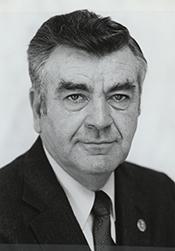
Historical · U.S. House · Virginia · District 1
Herbert Bateman
Former U.S. Representative · Virginia District 1 · 1983–2000 · Republican
Herbert Bateman represented Virginia's District 1 in the United States House of Representatives (1983–2000) for the Republican party. The page below collects sourced biographical facts, term history, committee roles, and provenance for Bateman.
Bioguide ID: B000229
Key facts
- Full name
- Herbert Bateman
- State
- Virginia
- District
- District 1
- Party
- Republican
- House service
- 1983–2000
- First House term
- 1983
- Status
- Left office
- Current term ends
- —
- Born
- 1928
- Bioguide ID
- B000229
- Committee assignments
- —
- Dataset version
- 1.20260605
Biographical narrative
868 words · sourced from the Wikipedia REST extract
Herbert H. Bateman was an American politician who served as a Republican member of the United States House of Representatives for Virginia's 1st congressional district from 1983 until his death in 2000. A notable figure in Virginia politics, Bateman was known for his moderate voting record, particularly on defense issues, and his strong support for military spending, reflecting the interests of his constituents in a region with significant military presence.
Early life and career
Herbert Harvell Bateman was born on August 7, 1928, in Elizabeth City, North Carolina. However, he spent the majority of his life in Newport News, Virginia. Bateman completed his secondary education at Newport News High School, graduating in 1945. He then attended the College of William and Mary, where he earned a Bachelor’s degree. Following his graduation, Bateman briefly entered the field of education, teaching at Hampton High School from 1949 to 1951.
In 1951, Bateman's career took a significant turn when he was commissioned as a first lieutenant in the United States Air Force during the Korean War. He served as a special agent in the Air Force Office of Special Investigations until his discharge in 1953. After his military service, Bateman pursued a legal education at Georgetown University Law Center, obtaining his law degree in 1956. His early legal career included a brief period as a clerk for the United States Court of Appeals in Washington, D.C., before he began practicing law privately in Newport News from 1968 until 1983.
During his time as a practicing attorney, Bateman became actively involved in community service and local politics, which helped him establish a political base. He was notably engaged with the Virginia Jaycees, serving as president and later as national legal counsel for the United States Junior Chamber of Commerce. His involvement in these organizations laid the groundwork for his future political career.
House tenure
Bateman's political career in elected office began when he was elected to the Virginia State Senate, where he served for 14 years, representing parts of Newport News. Initially a member of the Democratic Party, he switched to the Republican Party in 1976. In 1982, he successfully ran for the United States House of Representatives, winning the seat previously held by Paul S. Trible, Jr. Bateman's first election to Congress was marked by a significant victory, as he secured 55 percent of the vote against his Democratic opponent.
Throughout his time in Congress, Bateman was re-elected multiple times, demonstrating a strong electoral base. His re-election campaigns varied in competitiveness, with his closest contest occurring in 1990 when he received 51 percent of the vote against Democrat Andrew Fox. Following the 1990 Census, redistricting altered the demographics of his constituency, allowing him to consolidate his support and win subsequent elections with larger margins, including a notable 74 percent of the vote in 1994 and being unopposed in 1996.
Bateman's tenure in the House of Representatives lasted until his death on September 11, 2000. Over the course of his nine terms, he became a well-known figure in Virginia politics, particularly in relation to military and defense issues, which were of great importance to his constituents.
Legislative focus and committees
During his time in the House, Bateman's legislative focus was characterized by a moderate approach, particularly in comparison to some of his Southern Republican colleagues. He maintained a lifetime rating of 79 from the American Conservative Union, indicating a centrist position on various issues. Notably, Bateman diverged from many in his party by supporting certain gun control measures, reflecting a nuanced stance on public safety and regulation.
Bateman was particularly active in matters related to defense and military spending, which aligned with the interests of his constituents in a region that was home to significant military operations. He served on the Armed Services Committee and the Transportation and Infrastructure Committee for nearly his entire congressional career. His leadership roles included chairing the House Armed Services Subcommittee on Military Readiness and the House Merchant Marine Panel, where he was influential in shaping policies related to military readiness and maritime issues.
In addition to his committee work, Bateman was involved in various local organizations, including the Virginia Jaycees, Peninsula United Way, and the Red Cross Blood Donor Program. His community engagement extended beyond his legislative duties, as he sought to address local concerns and support initiatives that benefited the residents of his district.
Bateman's health began to decline in the 1990s, as he faced several serious medical challenges, including diagnoses of lung and prostate cancer, as well as a heart attack. Despite these health issues, he continued to serve in Congress until his passing in 2000. His contributions to Virginia politics and his commitment to his constituents are remembered through the legacy of his public service.
Bateman is interred at Peninsula Memorial Park in Newport News, Virginia. He is survived by his wife, Laura, and their two children, who have continued to be involved in public service and community affairs. His papers from his time in the Virginia Senate and the U.S. House of Representatives are preserved at the Special Collections Research Center at the College of William & Mary, providing insight into his political career and contributions to American governance.
Notable legislation
Sponsored and co-sponsored legislation for Herbert Bateman is pending operator curation. The biographical narrative above carries the same provenance trail until per-bill rows are written.
Sources
- [1]https://en.wikipedia.org/wiki/Herb_BatemanWikipedia · retrieved 2026-06-05
Notable quotes
Sourced quotes for Herbert Bateman are pending operator curation. Narrative-scope provenance remains attached below.
Sources
- [1]https://en.wikipedia.org/wiki/Herb_BatemanWikipedia · retrieved 2026-06-05
Key positions
Curated policy positions for Herbert Bateman are pending operator review. The biographical narrative above carries the same provenance trail until per-topic positions are written.
Sources
- [1]https://en.wikipedia.org/wiki/Herb_BatemanWikipedia · retrieved 2026-06-05
Terms served
- 1983–1985U.S. House · Term 1 · Republican
- 1985–1987U.S. House · Term 2 · Republican
- 1987–1989U.S. House · Term 3 · Republican
- 1989–1991U.S. House · Term 4 · Republican
- 1991–1993U.S. House · Term 5 · Republican
- 1993–1995U.S. House · Term 6 · Republican
- 1995–1997U.S. House · Term 7 · Republican
- 1997–1999U.S. House · Term 8 · Republican
- 1999–2000U.S. House · Term 9 · Republican
Sources & provenance
Every attributable claim above carries a per-section [N] marker that resolves to the corresponding URL below. Each entry records the upstream provider, the canonical URL, and the timestamp at which the source was retrieved by the ingest pipeline.
Key facts
- https://bioguide.congress.gov/search/bio/B000229bioguide · retrieved 2026-06-05
- https://www.govtrack.us/congress/members/400569govtrack · retrieved 2026-06-05
Biographical narrative
- https://en.wikipedia.org/wiki/Herb_Batemanwikipedia · retrieved 2026-06-05
Find your representative
Every U.S. state elects representatives by district. Browse Virginia’s delegation, the full former-representative roster, or explore the role and term length.
Related on The Candidate
- Preceded by Thomas DowningEarlier holder of the Virginia District 1 House seat · Democratic.Open
- Succeeded by Jo Ann DavisLater holder of the Virginia District 1 House seat · Republican.Open
- Alexander WhiteFormer U.S. Representative · Virginia District 1Open
- Archibald AtkinsonFormer U.S. Representative · Virginia District 1 · DemocraticOpen
- Beverly DouglasFormer U.S. Representative · Virginia District 1 · DemocraticOpen
- Daniel MorganFormer U.S. Representative · Virginia District 1 · FederalistOpen