
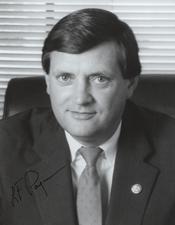
Historical · U.S. House · Virginia · District 5
Lewis Payne Jr.
Former U.S. Representative · Virginia District 5 · 1988–1997 · Democratic
Lewis Payne Jr. represented Virginia's District 5 in the United States House of Representatives (1988–1997) for the Democratic party. The page below collects sourced biographical facts, term history, committee roles, and provenance for Jr..
Bioguide ID: P000152
Key facts
- Full name
- Lewis Payne Jr.
- State
- Virginia
- District
- District 5
- Party
- Democratic
- House service
- 1988–1997
- First House term
- 1988
- Status
- Left office
- Current term ends
- —
- Born
- 1945
- Bioguide ID
- P000152
- Committee assignments
- —
- Dataset version
- 1.20260605
Biographical narrative
985 words · sourced from the Wikipedia REST extract
Lewis F. Payne Jr. is a former American politician and businessman who served as a member of the United States House of Representatives from Virginia's 5th congressional district. A member of the Democratic Party, Payne's congressional career spanned nearly a decade, during which he was elected to five consecutive terms. His tenure in the House of Representatives was marked by a commitment to his constituents in Southside Virginia, as well as a focus on conservative Democratic principles. After leaving Congress in 1997, he transitioned into a career in government relations and lobbying.
Early life and career
Lewis Franklin Payne Jr. was born on July 9, 1945, in Amherst, Virginia. He grew up in a region known for its rich history and natural beauty, which likely influenced his later pursuits in both business and politics. Payne's educational background includes a degree from the Virginia Military Institute, where he received a rigorous education that prepared him for future leadership roles. Following his graduation, he served as an officer in the United States Army, gaining valuable experience in leadership and public service.
After completing his military service, Payne pursued further education by earning a Master of Business Administration (M.B.A.) from the University of Virginia. This advanced degree equipped him with the skills necessary for a successful career in business. Prior to entering politics, he founded and served as president of Wintergreen Resort, a prominent recreational facility in Virginia. His experience in the private sector, particularly in managing a resort, provided him with insights into the economic and social needs of his community.
Payne's background in business and military service laid the groundwork for his political career. His understanding of both the private and public sectors would later inform his legislative priorities and approach to governance. His decision to enter politics was likely influenced by his desire to serve his community and address the challenges faced by the residents of Southside Virginia.
House tenure
Lewis F. Payne Jr. was elected to the United States House of Representatives in a special election held in 1988, filling the vacancy left by the passing of Representative Dan Daniel. This election marked the beginning of Payne's congressional career, during which he served five terms from June 14, 1988, to January 3, 1997. As a member of the Democratic Party, he was part of a broader coalition of lawmakers advocating for various issues relevant to their constituents.
Throughout his time in Congress, Payne was known for his conservative Democratic stance, which distinguished him from some of his more liberal colleagues. His approach to legislation often focused on pragmatic solutions that aimed to balance the needs of his constituents with the broader goals of the Democratic Party. This positioning allowed him to appeal to a diverse electorate in his district, which included a mix of urban and rural communities.
Payne's electoral history reflects his ability to connect with voters and maintain their support over multiple election cycles. In his initial special election, he secured a significant portion of the vote, demonstrating strong grassroots support. He continued to build on this foundation in subsequent elections, often winning re-election with a comfortable margin. His electoral success can be attributed to his engagement with the community and his responsiveness to the concerns of his constituents.
However, Payne's political fortunes shifted in the 1994 election, when his share of the vote declined significantly. This change in voter sentiment was indicative of the broader political landscape at the time, as many incumbents faced challenges from a wave of new candidates and shifting party dynamics. Despite this setback, Payne remained committed to serving his constituents until he retired from Congress in 1997.
After his departure from the House, Payne sought to continue his public service by running for the office of lieutenant governor of Virginia in the same year. Although he lost the general election to Republican John H. Hager, the experience further solidified his involvement in Virginia politics and demonstrated his ongoing commitment to public service.
Legislative focus and committees
During his tenure in the House of Representatives, Lewis F. Payne Jr. was involved in various legislative initiatives and served on several committees that aligned with his interests and the needs of his constituents. His legislative focus encompassed a range of issues, including economic development, education, and veterans' affairs. Given his background as a businessman and military veteran, these areas were particularly relevant to his work in Congress.
Payne's committee assignments allowed him to influence policy in ways that directly impacted the lives of those he represented. By serving on committees that addressed economic issues, he was able to advocate for policies that supported job creation and economic growth in Southside Virginia. His experience in the private sector informed his understanding of the challenges faced by businesses and entrepreneurs in his district.
Additionally, Payne's commitment to education was evident in his legislative efforts. He recognized the importance of education in fostering economic opportunity and improving the quality of life for residents in his district. His focus on education policy included advocating for funding and resources that would benefit local schools and educational institutions.
As a veteran, Payne also prioritized issues related to veterans' affairs, working to ensure that those who served in the military received the support and resources they needed. His firsthand experience in the Army provided him with a unique perspective on the challenges faced by veterans, and he sought to address these issues through his legislative work.
Overall, Lewis F. Payne Jr.'s tenure in the U.S. House of Representatives was characterized by a dedication to his constituents and a commitment to addressing the pressing issues facing Southside Virginia. His background in business and military service informed his approach to governance, and his legislative focus reflected the diverse needs of the communities he represented. After leaving Congress, he transitioned into a career in lobbying and government relations, continuing his engagement in public policy and advocacy.
Notable legislation
Sponsored and co-sponsored legislation for Lewis Payne Jr. is pending operator curation. The biographical narrative above carries the same provenance trail until per-bill rows are written.
Sources
- [1]https://en.wikipedia.org/wiki/Lewis_F._Payne_Jr.Wikipedia · retrieved 2026-06-05
Notable quotes
Sourced quotes for Lewis Payne Jr. are pending operator curation. Narrative-scope provenance remains attached below.
Sources
- [1]https://en.wikipedia.org/wiki/Lewis_F._Payne_Jr.Wikipedia · retrieved 2026-06-05
Key positions
Curated policy positions for Lewis Payne Jr. are pending operator review. The biographical narrative above carries the same provenance trail until per-topic positions are written.
Sources
- [1]https://en.wikipedia.org/wiki/Lewis_F._Payne_Jr.Wikipedia · retrieved 2026-06-05
Terms served
- 1988–1989U.S. House · Term 1 · Democratic
- 1989–1991U.S. House · Term 2 · Democratic
- 1991–1993U.S. House · Term 3 · Democratic
- 1993–1995U.S. House · Term 4 · Democratic
- 1995–1997U.S. House · Term 5 · Democratic
Sources & provenance
Every attributable claim above carries a per-section [N] marker that resolves to the corresponding URL below. Each entry records the upstream provider, the canonical URL, and the timestamp at which the source was retrieved by the ingest pipeline.
Key facts
- https://bioguide.congress.gov/search/bio/P000152bioguide · retrieved 2026-06-05
- https://www.govtrack.us/congress/members/408556govtrack · retrieved 2026-06-05
Biographical narrative
- https://en.wikipedia.org/wiki/Lewis_F._Payne_Jr.wikipedia · retrieved 2026-06-05
Find your representative
Every U.S. state elects representatives by district. Browse Virginia’s delegation, the full former-representative roster, or explore the role and term length.
Related on The Candidate
- Preceded by Dan DanielEarlier holder of the Virginia District 5 House seat · Democratic.Open
- Succeeded by Virgil Goode Jr.Later holder of the Virginia District 5 House seat · Republican.Open
- Alexander WhiteFormer U.S. Representative · Virginia District 1Open
- Archibald AtkinsonFormer U.S. Representative · Virginia District 1 · DemocraticOpen
- Beverly DouglasFormer U.S. Representative · Virginia District 1 · DemocraticOpen
- Daniel MorganFormer U.S. Representative · Virginia District 1 · FederalistOpen