
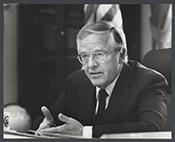
Historical · U.S. House · Virginia · District 8
Stanford Parris
Former U.S. Representative · Virginia District 8 · 1973–1991 · Republican
Stanford Parris represented Virginia's District 8 in the United States House of Representatives (1973–1991) for the Republican party. The page below collects sourced biographical facts, term history, committee roles, and provenance for Parris.
Bioguide ID: P000080
Key facts
- Full name
- Stanford Parris
- State
- Virginia
- District
- District 8
- Party
- Republican
- House service
- 1973–1991
- First House term
- 1973
- Status
- Left office
- Current term ends
- —
- Born
- 1929
- Bioguide ID
- P000080
- Committee assignments
- —
- Dataset version
- 1.20260605
Biographical narrative
1,010 words · sourced from the Wikipedia REST extract
Stanford E. (Stan) Parris was an American lawyer and politician who served as a Republican U.S. Representative for Virginia's 8th congressional district from 1973 until 1991. His political career spanned several decades and included roles at various levels of government, including the Fairfax County Board of Supervisors and the Virginia House of Delegates. Parris was also a veteran of the Korean War, where he served as a pilot in the United States Air Force. Throughout his career, he was known for his involvement in local and national issues, as well as his contentious political campaigns.
Early life and career
Stanford Elmer Parris was born on September 9, 1929, in Champaign, Illinois. He received his early education in the public school system of Champaign before pursuing higher education. Parris earned a Bachelor of Science degree from the University of Illinois in 1950. Following his undergraduate studies, he attended George Washington University, where he obtained a Bachelor of Laws (LL.B.) degree in 1958. While attending law school, he worked as a doorkeeper in the United States Senate, gaining exposure to the legislative process.
Parris's military service began when he joined the United States Air Force during the Korean War. He served as a pilot of the F-84 Thunderjet fighter aircraft and was involved in combat operations. During his service, he was shot down and subsequently rescued. His military achievements earned him several commendations, including the Distinguished Flying Cross with cluster, the Air Medal with clusters, and the Purple Heart. After his discharge from the military, Parris briefly worked as an airline pilot before transitioning to a legal career. He was admitted to the Virginia bar in 1958 and established a private law practice in Alexandria, Virginia.
In addition to his legal career, Parris was involved in various business ventures, including serving as president of a Chrysler dealership in Woodbridge, Virginia, and managing the Flying Circus Aerodrome, an air show venue. His early political career began with his election to the Fairfax County Board of Supervisors, where he served one term from 1964 to 1967. He later won a seat in the Virginia House of Delegates, serving from April 1969 until November 1972. During his time in the Virginia legislature, Parris made headlines for a controversial remark about the 14th Street Bridge, which he jokingly referred to as the "longest in the world."
House tenure
Parris's congressional career began when he was elected to the United States House of Representatives in 1972, representing Virginia's 8th congressional district. His first term commenced in 1973, and he served a total of six terms in the House. Parris faced a challenging political landscape during his early years in Congress, losing his bid for re-election in 1974 to Democrat Herb Harris amid the fallout from the Watergate scandal. However, he made a political comeback in 1980, defeating Harris by a narrow margin in a closely contested race.
Throughout his tenure in the House, Parris was known for his active engagement in various committees and legislative initiatives. He was a member of the House Committee on Science and Technology during the 93rd Congress, participating in subcommittees focused on aeronautics, space technology, and energy. Parris's legislative efforts included introducing a bill aimed at preventing the National Football League from imposing television blackouts on non-sold-out games, reflecting his interest in sports and media issues.
Parris's political career was marked by several electoral challenges and controversies. He considered running for the United States Senate in 1982 but ultimately chose to seek re-election to the House. He successfully defeated State Senator Dick Saslaw in the 1984 election and continued to win re-election in subsequent years, although he faced increasingly competitive races. In 1990, Parris lost his seat to Alexandria mayor Jim Moran in what was considered an upset. Factors contributing to his defeat included economic challenges and a well-funded campaign by Moran, who focused on Parris's positions on various issues, including abortion.
After leaving Congress in January 1991, Parris was appointed by President George H. W. Bush to serve a seven-year term as President of the Saint Lawrence Seaway Development Corporation. He held this position until 1995, when he resigned to pursue a seat in the Virginia Senate. Following his departure from federal office, Parris maintained residences in both Melbourne, Florida, and Mathews County, Virginia.
Legislative focus and committees
During his time in the House of Representatives, Stanford Parris was involved in a range of legislative issues and served on several important committees. His membership on the House Committee on Science and Technology allowed him to engage with matters related to scientific research, technology development, and energy policy. Parris's work on subcommittees, particularly those focused on aeronautics and space technology, reflected his background as a military pilot and his interest in aviation and space exploration.
Parris's legislative initiatives included efforts to address issues affecting his constituents in Virginia, as well as broader national concerns. His introduction of a bill to prevent NFL television blackouts highlighted his engagement with sports and media policy, while his position on the House District Committee often placed him in opposition to the local government of the District of Columbia. This dynamic led to notable conflicts with D.C. officials, including the mayor at the time, Marion Barry.
Throughout his congressional career, Parris was known for his strong Republican stance on various issues, including fiscal policy and social issues. His opposition to abortion was a significant aspect of his political platform, and it became a focal point in his campaigns, particularly during the contentious 1990 election against Jim Moran. Despite his electoral setbacks, Parris remained an influential figure in Virginia politics and continued to engage in public service after his congressional tenure.
Stanford Parris passed away on March 27, 2010, due to heart disease at his home in Mathews County, Virginia. His contributions to public service and his involvement in various community initiatives were recognized by peers and constituents alike. He was laid to rest at Arlington National Cemetery, marking the end of a career that spanned military service, legal practice, and decades of political engagement.
Notable legislation
Sponsored and co-sponsored legislation for Stanford Parris is pending operator curation. The biographical narrative above carries the same provenance trail until per-bill rows are written.
Sources
- [1]https://en.wikipedia.org/wiki/Stanford_ParrisWikipedia · retrieved 2026-06-05
Notable quotes
Sourced quotes for Stanford Parris are pending operator curation. Narrative-scope provenance remains attached below.
Sources
- [1]https://en.wikipedia.org/wiki/Stanford_ParrisWikipedia · retrieved 2026-06-05
Key positions
Curated policy positions for Stanford Parris are pending operator review. The biographical narrative above carries the same provenance trail until per-topic positions are written.
Sources
- [1]https://en.wikipedia.org/wiki/Stanford_ParrisWikipedia · retrieved 2026-06-05
Terms served
- 1973–1975U.S. House · Term 1 · Republican
- 1981–1983U.S. House · Term 2 · Republican
- 1983–1985U.S. House · Term 3 · Republican
- 1985–1987U.S. House · Term 4 · Republican
- 1987–1989U.S. House · Term 5 · Republican
- 1989–1991U.S. House · Term 6 · Republican
Sources & provenance
Every attributable claim above carries a per-section [N] marker that resolves to the corresponding URL below. Each entry records the upstream provider, the canonical URL, and the timestamp at which the source was retrieved by the ingest pipeline.
Key facts
- https://bioguide.congress.gov/search/bio/P000080bioguide · retrieved 2026-06-05
- https://www.govtrack.us/congress/members/408490govtrack · retrieved 2026-06-05
Biographical narrative
- https://en.wikipedia.org/wiki/Stanford_Parriswikipedia · retrieved 2026-06-05
Find your representative
Every U.S. state elects representatives by district. Browse Virginia’s delegation, the full former-representative roster, or explore the role and term length.
Related on The Candidate
- Preceded by Howard SmithEarlier holder of the Virginia District 8 House seat · Democratic.Open
- Succeeded by Jim Moran Jr.Later holder of the Virginia District 8 House seat · Democratic.Open
- Alexander WhiteFormer U.S. Representative · Virginia District 1Open
- Archibald AtkinsonFormer U.S. Representative · Virginia District 1 · DemocraticOpen
- Beverly DouglasFormer U.S. Representative · Virginia District 1 · DemocraticOpen
- Daniel MorganFormer U.S. Representative · Virginia District 1 · FederalistOpen