
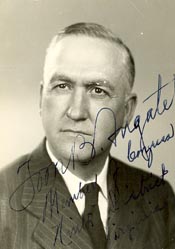
Historical · U.S. House · Virginia · District 9
Thomas Fugate
Former U.S. Representative · Virginia District 9 · 1949–1953 · Democratic
Thomas Fugate represented Virginia's District 9 in the United States House of Representatives (1949–1953) for the Democratic party. The page below collects sourced biographical facts, term history, committee roles, and provenance for Fugate.
Bioguide ID: F000399
Key facts
- Full name
- Thomas Fugate
- State
- Virginia
- District
- District 9
- Party
- Democratic
- House service
- 1949–1953
- First House term
- 1949
- Status
- Left office
- Current term ends
- —
- Born
- 1899
- Bioguide ID
- F000399
- Committee assignments
- —
- Dataset version
- 1.20260605
Biographical narrative
944 words · sourced from the Wikipedia REST extract
Thomas Fugate was a prominent American businessman and politician who served as a U.S. Representative for Virginia's 9th congressional district. A member of the Democratic Party, he held office during the Eighty-first and Eighty-second Congresses from 1949 until 1953. Born in 1899 in Tennessee, Fugate's career spanned various sectors, including banking, farming, and public service, reflecting a deep commitment to his community and state.
Early life and career
Thomas Fugate was born on April 10, 1899, on a farm located near Tazewell in Claiborne County, Tennessee. His early education took place in public schools, where he laid the foundation for his future endeavors. He furthered his education at the University of Tennessee and Lincoln Memorial University, institutions that provided him with the knowledge and skills that would later aid him in his business and political careers.
In 1918, Fugate married Lillian Rowlett, and together they had five children. Following their marriage, the Fugate family relocated to Ewing, Virginia, where Thomas pursued various business interests. His professional life was heavily influenced by his family's background; like his father, he engaged in banking, trade, and farming. This diverse experience in business would later inform his political career and legislative priorities.
Fugate's entry into politics began unexpectedly when he was nominated as a Democratic candidate for the Virginia House of Delegates. He successfully won election to the House, serving one term from 1928 to 1930. After his tenure in the House of Delegates, he continued to build a diverse career in business. He held significant positions, including president of the Peoples Bank of Ewing, director of the Virginia-Tennessee Farm Bureau, and president of the Ewing Live Stock Company. These roles not only solidified his standing in the community but also enhanced his understanding of economic and agricultural issues, which would later play a role in his legislative work.
Fugate's political aspirations remained strong throughout his career. In 1945, he was appointed as a member of the Virginia Constitutional Convention, where he contributed to discussions on state governance. His political acumen was further demonstrated when he served as a campaign manager for local Congressman John Flanagan. When Flanagan announced his retirement in 1948, Fugate was chosen as the Democratic nominee to succeed him, marking the beginning of his congressional career.
House tenure
Fugate was elected to the U.S. House of Representatives, where he served from 1949 until 1953. During his time in Congress, he represented Virginia's 9th congressional district, which encompassed a significant portion of the southwestern part of the state. His election to the Eighty-first and Eighty-second Congresses marked a notable chapter in his life, as he transitioned from local and state politics to the national stage.
Throughout his congressional tenure, Fugate was involved in various legislative efforts. One of his notable achievements was his sponsorship of legislation related to the operations of the Panama Canal. This work garnered him commendations from both the military and the President of the United States, highlighting the significance of his contributions to national infrastructure and international trade.
In addition to his work on the Panama Canal, Fugate's background in banking led to his appointment to the Banking and Currency Committee. In this capacity, he played a role in overseeing loans made by the Export-Import Bank, an institution vital for facilitating international trade and supporting American businesses abroad. His experience in finance and commerce allowed him to navigate complex economic issues effectively, making him a valuable member of the committee.
Despite his contributions, Fugate's political career was not without controversy. He faced accusations of being affiliated with the Byrd political machine, a powerful faction within Virginia politics. This association raised questions about his independence and the influence of established political networks on his legislative actions.
After serving two terms in Congress, Fugate chose not to seek a third term. He returned to Ewing, Virginia, where he resumed his business and farming interests. His decision to step away from national politics did not diminish his commitment to public service; he continued to engage in various community and educational initiatives.
Legislative focus and committees
During his time in the House of Representatives, Thomas Fugate's legislative focus was shaped by his background in business and agriculture. His work on the Banking and Currency Committee was particularly significant, as it allowed him to influence policies related to financial institutions and economic development. This experience was crucial in understanding the complexities of federal financial regulations and their impact on local economies.
Fugate's involvement in legislation concerning the Panama Canal underscored his interest in infrastructure and international trade. The canal has historically been a critical conduit for maritime commerce, and Fugate's efforts in this area reflected a broader understanding of how such infrastructure projects could benefit the United States economically and strategically.
In addition to his legislative work, Fugate remained active in various civic and educational organizations after leaving Congress. He served on the board of trustees for Lincoln Memorial University for over twenty years, demonstrating his commitment to education and community development. Furthermore, he was a member of the Virginia Agricultural Stabilization and Conservation Committee, where he contributed to discussions on agricultural policy and conservation efforts.
Fugate's career illustrates the interplay between business, agriculture, and politics in mid-20th century America. His experiences in these fields informed his legislative priorities and shaped his contributions to the U.S. Congress. After his death on September 22, 1980, Fugate left behind a legacy of public service that encompassed both his time in office and his ongoing involvement in community affairs. His life reflects the complexities and challenges faced by politicians of his era, as well as the enduring impact of their work on local and national levels.
Notable legislation
Sponsored and co-sponsored legislation for Thomas Fugate is pending operator curation. The biographical narrative above carries the same provenance trail until per-bill rows are written.
Sources
- [1]https://en.wikipedia.org/wiki/Thomas_B._FugateWikipedia · retrieved 2026-06-05
Notable quotes
Sourced quotes for Thomas Fugate are pending operator curation. Narrative-scope provenance remains attached below.
Sources
- [1]https://en.wikipedia.org/wiki/Thomas_B._FugateWikipedia · retrieved 2026-06-05
Key positions
Curated policy positions for Thomas Fugate are pending operator review. The biographical narrative above carries the same provenance trail until per-topic positions are written.
Sources
- [1]https://en.wikipedia.org/wiki/Thomas_B._FugateWikipedia · retrieved 2026-06-05
Terms served
- 1949–1951U.S. House · Term 1 · Democratic
- 1951–1953U.S. House · Term 2 · Democratic
Sources & provenance
Every attributable claim above carries a per-section [N] marker that resolves to the corresponding URL below. Each entry records the upstream provider, the canonical URL, and the timestamp at which the source was retrieved by the ingest pipeline.
Key facts
- https://bioguide.congress.gov/search/bio/F000399bioguide · retrieved 2026-06-05
- https://www.govtrack.us/congress/members/404341govtrack · retrieved 2026-06-05
Biographical narrative
- https://en.wikipedia.org/wiki/Thomas_B._Fugatewikipedia · retrieved 2026-06-05
Find your representative
Every U.S. state elects representatives by district. Browse Virginia’s delegation, the full former-representative roster, or explore the role and term length.
Related on The Candidate
- Preceded by John Flannagan Jr.Earlier holder of the Virginia District 9 House seat · Democratic.Open
- Succeeded by William WamplerLater holder of the Virginia District 9 House seat · Republican.Open
- Alexander WhiteFormer U.S. Representative · Virginia District 1Open
- Archibald AtkinsonFormer U.S. Representative · Virginia District 1 · DemocraticOpen
- Beverly DouglasFormer U.S. Representative · Virginia District 1 · DemocraticOpen
- Daniel MorganFormer U.S. Representative · Virginia District 1 · FederalistOpen