
Historical · U.S. House · Virginia · District 9
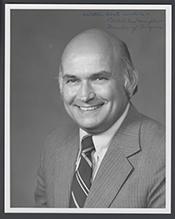
William Wampler
Former U.S. Representative · Virginia District 9 · 1953–1983 · Republican
William Wampler represented Virginia's District 9 in the United States House of Representatives (1953–1983) for the Republican party. The page below collects sourced biographical facts, term history, committee roles, and provenance for Wampler.
Bioguide ID: W000121
Key facts
- Full name
- William Wampler
- State
- Virginia
- District
- District 9
- Party
- Republican
- House service
- 1953–1983
- First House term
- 1953
- Status
- Left office
- Current term ends
- —
- Born
- 1926
- Bioguide ID
- W000121
- Committee assignments
- —
- Dataset version
- 1.20260605
Biographical narrative
881 words · sourced from the Wikipedia REST extract
William C. Wampler was a prominent American politician and businessman who served as a U.S. Representative for Virginia's 9th congressional district. A member of the Republican Party, Wampler's congressional career spanned nearly three decades, during which he was known for his advocacy on behalf of Appalachian coal miners and his involvement in various legislative committees. His tenure in the House of Representatives began in 1953 and concluded in 1983, marking him as one of the longest-serving members from his state during that period.
Early life and career
William Creed Wampler was born on April 21, 1926, in Pennington Gap, Virginia, situated in Lee County. He was the son of John Sevier Wampler, a hardware store owner, and Lilian May Wolfe, a schoolteacher. Growing up in a family with two older brothers, Wampler experienced the challenges of the Great Depression, which influenced his early life. He attended public schools in Bristol, Virginia, where he developed an interest in politics and community service.
At the age of 17, Wampler enlisted in the United States Navy on May 21, 1943, during World War II. He served for approximately 28 months, contributing to the war effort until his discharge on September 29, 1945. Following his military service, he took advantage of the GI Bill to further his education. Wampler graduated from Virginia Polytechnic Institute in 1948 with a degree in political science. He briefly attended the University of Virginia to study law from 1948 to 1950 but left before completing his degree.
Wampler's professional career began in journalism. He worked as a reporter for The Tennessean in Nashville, Tennessee, in 1950 and 1951. He then returned to Virginia, where he held positions as a reporter and editorial writer for the Big Stone Gap Post and later for the Bristol Herald Courier. His early involvement in politics included serving as the Republican assistant campaign manager for the 9th congressional district elections in 1948 and as president of the Young Republican Federation of Virginia in 1950. His political engagement also included serving as the keynote speaker and permanent chairman of the 9th district Republican Convention that same year.
In 1953, Wampler was elected to the U.S. House of Representatives as a Republican, marking the beginning of his congressional career. He was notably the youngest member of the House at that time. However, his initial term ended in 1955 after he lost his re-election bid. Following this setback, he worked for the U.S. Atomic Energy Commission under President Dwight D. Eisenhower from early 1955 until March 1956. He then returned to Virginia to manage his family's furniture and carpeting businesses while remaining active in Republican politics.
Wampler's persistence in seeking public office paid off when he won election to the 90th Congress in 1966, defeating his previous opponent, William Pat Jennings. This victory marked the start of a lengthy tenure in the House, during which Wampler was re-elected multiple times.
House tenure
Wampler's congressional career was characterized by a series of electoral victories that solidified his position as a significant political figure in Virginia. After winning his seat in the 90th Congress, he was re-elected to seven successive terms, serving from January 3, 1967, until January 3, 1983. His electoral success included notable victories in the 1968, 1970, and 1972 elections, where he received a substantial majority of the votes. However, he faced challenges during the Watergate scandal in 1974, narrowly winning re-election with a slim margin. He rebounded in 1976, increasing his vote share significantly in that election.
Wampler's political career came to an end in 1982 when he lost his re-election bid to Democrat Frederick C. Boucher by a narrow margin. This defeat marked the conclusion of his 16-year tenure in the House, during which he had established himself as a key advocate for issues affecting his constituents, particularly those related to the coal industry in Appalachia.
Legislative focus and committees
Throughout his time in Congress, Wampler was known for his commitment to representing the interests of his district, particularly in relation to the Appalachian coal mining community. He actively advocated for policies that supported coal miners and their families, recognizing the importance of the coal industry to the region's economy and culture. His legislative efforts were often aligned with the broader goals of the Republican Party during his tenure.
In addition to his advocacy for coal miners, Wampler served on the Agriculture Committee, where he contributed to discussions and legislation concerning agricultural policies and rural development. His involvement in this committee reflected his understanding of the diverse needs of his constituents, which included both urban and rural populations.
After leaving Congress, Wampler remained engaged in political activities, although he did not seek public office again. His son, William C. Wampler, Jr., continued the family legacy in politics by winning election to the Virginia Senate in 1988. Wampler's influence extended to his grandson, William C. Wampler III, who was elected to the Virginia House of Delegates in 2019.
William C. Wampler passed away on May 23, 2012, in Bristol, Virginia. In recognition of his contributions to the state and his community, a section of Interstate 81 was renamed in his honor. His legacy continues through his family's ongoing involvement in Virginia politics, reflecting the impact he had on the region during his lifetime.
Notable legislation
Sponsored and co-sponsored legislation for William Wampler is pending operator curation. The biographical narrative above carries the same provenance trail until per-bill rows are written.
Sources
- [1]https://en.wikipedia.org/wiki/William_C._WamplerWikipedia · retrieved 2026-06-05
Notable quotes
Sourced quotes for William Wampler are pending operator curation. Narrative-scope provenance remains attached below.
Sources
- [1]https://en.wikipedia.org/wiki/William_C._WamplerWikipedia · retrieved 2026-06-05
Key positions
Curated policy positions for William Wampler are pending operator review. The biographical narrative above carries the same provenance trail until per-topic positions are written.
Sources
- [1]https://en.wikipedia.org/wiki/William_C._WamplerWikipedia · retrieved 2026-06-05
Terms served
- 1953–1955U.S. House · Term 1 · Republican
- 1967–1969U.S. House · Term 2 · Republican
- 1969–1971U.S. House · Term 3 · Republican
- 1971–1973U.S. House · Term 4 · Republican
- 1973–1975U.S. House · Term 5 · Republican
- 1975–1977U.S. House · Term 6 · Republican
- 1977–1979U.S. House · Term 7 · Republican
- 1979–1981U.S. House · Term 8 · Republican
- 1981–1983U.S. House · Term 9 · Republican
Sources & provenance
Every attributable claim above carries a per-section [N] marker that resolves to the corresponding URL below. Each entry records the upstream provider, the canonical URL, and the timestamp at which the source was retrieved by the ingest pipeline.
Key facts
- https://bioguide.congress.gov/search/bio/W000121bioguide · retrieved 2026-06-05
- https://www.govtrack.us/congress/members/411296govtrack · retrieved 2026-06-05
Biographical narrative
- https://en.wikipedia.org/wiki/William_C._Wamplerwikipedia · retrieved 2026-06-05
Find your representative
Every U.S. state elects representatives by district. Browse Virginia’s delegation, the full former-representative roster, or explore the role and term length.
Related on The Candidate
- Preceded by Thomas FugateEarlier holder of the Virginia District 9 House seat · Democratic.Open
- Succeeded by Rick BoucherLater holder of the Virginia District 9 House seat · Democratic.Open
- Alexander WhiteFormer U.S. Representative · Virginia District 1Open
- Archibald AtkinsonFormer U.S. Representative · Virginia District 1 · DemocraticOpen
- Beverly DouglasFormer U.S. Representative · Virginia District 1 · DemocraticOpen
- Daniel MorganFormer U.S. Representative · Virginia District 1 · FederalistOpen