
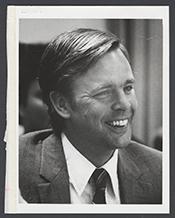
Historical · U.S. House · Vermont · At-Large
Peter Smith
Former U.S. Representative · Vermont At-Large · 1989–1991 · Republican
Peter Smith represented Vermont's At-Large in the United States House of Representatives (1989–1991) for the Republican party. The page below collects sourced biographical facts, term history, committee roles, and provenance for Smith.
Bioguide ID: S000601
Key facts
- Full name
- Peter Smith
- State
- Vermont
- District
- At-Large
- Party
- Republican
- House service
- 1989–1991
- First House term
- 1989
- Status
- Left office
- Current term ends
- —
- Born
- 1945
- Bioguide ID
- S000601
- Committee assignments
- —
- Dataset version
- 1.20260605
Biographical narrative
881 words · sourced from the Wikipedia REST extract
Peter Plympton Smith is a former American politician and educator who served as a U.S. Representative for Vermont's at-large congressional district. A member of the Republican Party, Smith's congressional career began in 1989 and concluded in 1991. In addition to his tenure in the House of Representatives, he has held various significant roles in education, including serving as the founding president of the Community College of Vermont and California State University, Monterey Bay. Smith has also worked internationally as an assistant director general for education at UNESCO. His contributions to education and politics are complemented by his authorship of several books focusing on higher education and personal learning.
Early life and career
Peter Smith was born on October 31, 1945, in Boston, Massachusetts, and spent his formative years in Burlington, Vermont. He is the son of Frederick Plympton Smith, a banker and Vermont State Senator, which likely influenced his early interest in public service and education. Smith graduated from Phillips Academy in 1964 before pursuing higher education at Princeton University, where he earned an A.B. in history in 1968. His senior thesis examined the economic development and social changes in Burlington from 1791 to 1848, reflecting his early engagement with historical and community studies.
Following his undergraduate education, Smith continued his academic pursuits at Harvard University, where he obtained a Master of Arts in Teaching (M.A.T.) in 1970. He further advanced his education by earning an Ed.D. in administration, planning, and social policy from Harvard in 1983. His academic background laid a strong foundation for his future roles in education and public service.
Smith's professional career began in education, where he served as an assistant to the Vermont Commissioner of Education for one year. In 1970, he became the founding president of the Community College of Vermont, a position that allowed him to shape the educational landscape of the state. His foray into politics began in 1978 when he ran for the office of Lieutenant Governor of Vermont. Although he won the Republican primary, he was ultimately defeated in the general election by Democrat Madeleine M. Kunin.
Following his initial political efforts, Smith served as a Vermont State Senator from 1981 to 1983, representing the Washington County district. After Kunin opted not to seek re-election in 1982, Smith successfully ran for the position, serving two consecutive terms. His political ambitions continued when he ran for Governor of Vermont in 1986 but was again defeated by Kunin.
House tenure
In 1988, after serving as Vice President of Development at Norwich University, Smith was elected to the United States House of Representatives, representing Vermont's at-large congressional district. His first term in Congress began in 1989. During his time in the House, Smith focused on various issues pertinent to Vermont and the nation, although specific details regarding his legislative initiatives and activities during this period are not extensively documented.
Smith's tenure in Congress was relatively brief, as he served only one term. In 1990, he sought re-election but was defeated by Independent candidate Bernie Sanders. This loss marked the end of his congressional career, but it did not conclude his involvement in education and public service.
Legislative focus and committees
While specific details about Smith's legislative focus during his time in the House of Representatives are limited, his background in education likely influenced his priorities. His experience as an educator and administrator may have shaped his perspectives on educational policy and funding, although the exact nature of his legislative contributions remains less defined.
Throughout his career, Smith has been involved in various committees and initiatives related to education. His commitment to improving educational opportunities is evident in his later roles, including serving as dean of the Graduate School of Education and Human Development at George Washington University from 1991 to 1994. Following this position, he became the founding president of California State University, Monterey Bay, where he served until 2005.
In addition to his administrative roles in higher education, Smith has authored several books that address issues within the educational system. His works include "Your Hidden Credentials: The Value of Personal Learning Outside College," which advocates for recognizing life experiences in academic credit, and "The Quiet Crisis: How Higher Education Is Failing America," which critiques the state of higher education in the United States. His later publications, such as "Harnessing America's Wasted Talent: New Dimensions for Higher Education" and "Free-range Learning in the Digital Age: The Emerging Revolution in College, Career, and Education," further reflect his ongoing engagement with educational reform and innovation.
Smith's international experience includes his role as assistant director general for education at UNESCO from 2005 to 2007, where he contributed to global educational initiatives. His later appointment as the Orkand Endowed Chair and Professor of Innovative Practices in Higher Education at the University of Maryland University College in 2016 underscores his continued influence in the field of education until his retirement in 2022.
In summary, Peter Smith's career spans significant roles in both education and politics. His tenure in the U.S. House of Representatives, although brief, was part of a broader commitment to enhancing educational opportunities and addressing the challenges within the educational system. His contributions as an author and educator reflect a sustained interest in improving learning outcomes and advocating for innovative practices in higher education.
Notable legislation
Sponsored and co-sponsored legislation for Peter Smith is pending operator curation. The biographical narrative above carries the same provenance trail until per-bill rows are written.
Sources
- [1]https://en.wikipedia.org/wiki/Peter_Plympton_SmithWikipedia · retrieved 2026-06-05
Notable quotes
Sourced quotes for Peter Smith are pending operator curation. Narrative-scope provenance remains attached below.
Sources
- [1]https://en.wikipedia.org/wiki/Peter_Plympton_SmithWikipedia · retrieved 2026-06-05
Key positions
Curated policy positions for Peter Smith are pending operator review. The biographical narrative above carries the same provenance trail until per-topic positions are written.
Sources
- [1]https://en.wikipedia.org/wiki/Peter_Plympton_SmithWikipedia · retrieved 2026-06-05
Terms served
- 1989–1991U.S. House · Term 1 · Republican
Sources & provenance
Every attributable claim above carries a per-section [N] marker that resolves to the corresponding URL below. Each entry records the upstream provider, the canonical URL, and the timestamp at which the source was retrieved by the ingest pipeline.
Key facts
- https://bioguide.congress.gov/search/bio/S000601bioguide · retrieved 2026-06-05
- https://www.govtrack.us/congress/members/410079govtrack · retrieved 2026-06-05
Biographical narrative
- https://en.wikipedia.org/wiki/Peter_Plympton_Smithwikipedia · retrieved 2026-06-05
Find your representative
Every U.S. state elects representatives by district. Browse Vermont’s delegation, the full former-representative roster, or explore the role and term length.
Related on The Candidate
- Preceded by Richard MallaryEarlier holder of the Vermont At-Large House seat · Republican.Open
- Ahiman MinerFormer U.S. Representative · Vermont District 1 · WhigOpen
- Charles JoyceFormer U.S. Representative · Vermont District 1 · RepublicanOpen
- Charles WillardFormer U.S. Representative · Vermont District 1 · RepublicanOpen
- David FosterFormer U.S. Representative · Vermont District 1 · RepublicanOpen
- Republican PartyFederal candidates and office holders on the Republican line.Open