
Historical · U.S. House · Washington · District 8
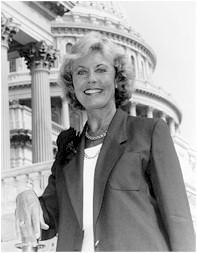
Jennifer Dunn
Former U.S. Representative · Washington District 8 · 1993–2005 · Republican
Jennifer Dunn represented Washington's District 8 in the United States House of Representatives (1993–2005) for the Republican party. The page below collects sourced biographical facts, term history, committee roles, and provenance for Dunn.
Bioguide ID: D000549
Key facts
- Full name
- Jennifer Dunn
- State
- Washington
- District
- District 8
- Party
- Republican
- House service
- 1993–2005
- First House term
- 1993
- Status
- Left office
- Current term ends
- —
- Born
- 1941
- Bioguide ID
- D000549
- Committee assignments
- —
- Dataset version
- 1.20260605
Biographical narrative
854 words · sourced from the Wikipedia REST extract
Jennifer Dunn was an American politician and engineer who served as a Republican member of the United States House of Representatives for Washington's 8th congressional district from 1993 until 2005. Over the course of her six terms in office, Dunn became known for her leadership roles within the House and her involvement in various legislative committees. Her career in politics was preceded by a background in engineering and a significant role in the Washington State Republican Party.
Early life and career
Jennifer Jill Dunn was born on July 29, 1941, in Seattle, Washington. She spent her formative years in Bellevue, Washington, where she graduated from Bellevue High School in 1959. Following high school, Dunn pursued higher education at the University of Washington, where she became a member of the Gamma Phi Beta sorority. She later transferred to Stanford University, where she earned a Bachelor of Arts degree. After completing her education, Dunn embarked on a career as a systems engineer, a profession that underscored her analytical skills and technical expertise.
Dunn's political involvement began in earnest when she took on leadership roles within the Washington State Republican Party. She served as the party's chair from 1981 to 1992, during which time she worked to strengthen the party's presence and influence in the state. Her dedication to women's issues was evident through her participation as a delegate to the United Nations Commission on the Status of Women in both 1984 and 1990. These experiences laid the groundwork for her subsequent political ambitions.
In 1992, Dunn decided to run for an open seat in the U.S. House of Representatives. Her campaign was successful, as she secured approximately 60 percent of the vote, marking the beginning of her tenure in Congress. Upon her election, she became Washington's only Republican representative until the Republican Revolution of 1994, when the party made significant gains in the House.
House tenure
Dunn's congressional career spanned six terms, beginning in 1993 and concluding in 2005. During her time in office, she was recognized for her leadership and was involved in various significant legislative efforts. Notably, in 1998, she made history by becoming the first woman to run for the position of House Majority Leader, a testament to her rising prominence within the Republican Party and the House of Representatives.
Throughout her tenure, Dunn served on several important committees that shaped national policy. She was the vice-chair of the Select Committee on Homeland Security, where she contributed to discussions and decisions regarding national safety and security. Additionally, she was a member of the House Ways and Means Committee, which is responsible for taxation and other revenue-related matters, and the Joint Economic Committee, where she engaged in economic policy analysis and recommendations.
Dunn's voting record included significant decisions on critical issues. For instance, she voted in favor of authorizing military action in Iraq in 2002, a decision that reflected her alignment with the party's stance on national security at that time. Her involvement in the House also extended to the presidential election of 2000, during which she participated in an exploratory committee for then-Texas Governor George W. Bush, indicating her active engagement in national politics beyond her congressional duties.
Legislative focus and committees
Throughout her time in Congress, Dunn's legislative focus encompassed a range of issues, particularly those related to economic policy, national security, and women's rights. As a member of the House Ways and Means Committee, she played a role in shaping tax policy and addressing economic challenges faced by her constituents and the nation at large. Her work on the Joint Economic Committee allowed her to engage in discussions about economic growth, job creation, and fiscal responsibility.
Dunn's commitment to women's issues was a consistent theme in her political career. Her earlier involvement with the United Nations Commission on the Status of Women informed her advocacy for policies that supported women's rights and empowerment. This focus was particularly significant during her time as a Republican leader, as she sought to elevate the role of women within the party and in public service.
After announcing her decision not to seek re-election in 2004, Dunn concluded her congressional career on January 3, 2005. Her seat was subsequently filled by King County Sheriff Dave Reichert. Following her departure from Congress, Dunn continued to be active in public service and political advocacy. She co-chaired the Information Technology and Innovation Foundation alongside former Representative Calvin Dooley, contributing her expertise in technology and innovation.
In addition to her work with the foundation, Dunn served as co-chair of the campaign organization "Women for Mitt," supporting presidential candidate Mitt Romney until her passing in 2007. Her contributions to the political landscape, particularly in advocating for women's involvement in politics, left a lasting impact.
Jennifer Dunn passed away on September 5, 2007, due to a pulmonary embolism in her Alexandria, Virginia, apartment. Her memorial service was held at St. James Cathedral in Seattle, reflecting her deep ties to the community she represented. Dunn's legacy includes her role as a pioneering woman in politics, her contributions to economic policy, and her advocacy for women's rights within the Republican Party.
Notable legislation
Sponsored and co-sponsored legislation for Jennifer Dunn is pending operator curation. The biographical narrative above carries the same provenance trail until per-bill rows are written.
Sources
- [1]https://en.wikipedia.org/wiki/Jennifer_DunnWikipedia · retrieved 2026-06-05
Notable quotes
Sourced quotes for Jennifer Dunn are pending operator curation. Narrative-scope provenance remains attached below.
Sources
- [1]https://en.wikipedia.org/wiki/Jennifer_DunnWikipedia · retrieved 2026-06-05
Key positions
Curated policy positions for Jennifer Dunn are pending operator review. The biographical narrative above carries the same provenance trail until per-topic positions are written.
Sources
- [1]https://en.wikipedia.org/wiki/Jennifer_DunnWikipedia · retrieved 2026-06-05
Terms served
- 1993–1995U.S. House · Term 1 · Republican
- 1995–1997U.S. House · Term 2 · Republican
- 1997–1999U.S. House · Term 3 · Republican
- 1999–2001U.S. House · Term 4 · Republican
- 2001–2003U.S. House · Term 5 · Republican
- 2003–2005U.S. House · Term 6 · Republican
Sources & provenance
Every attributable claim above carries a per-section [N] marker that resolves to the corresponding URL below. Each entry records the upstream provider, the canonical URL, and the timestamp at which the source was retrieved by the ingest pipeline.
Key facts
- https://bioguide.congress.gov/search/bio/D000549bioguide · retrieved 2026-06-05
- http://www.house.gov/dunnhouse.gov · retrieved 2026-06-05
Biographical narrative
- https://en.wikipedia.org/wiki/Jennifer_Dunnwikipedia · retrieved 2026-06-05
Find your representative
Every U.S. state elects representatives by district. Browse Washington’s delegation, the full former-representative roster, or explore the role and term length.
Related on The Candidate
- Preceded by Rodney ChandlerEarlier holder of the Washington District 8 House seat · Republican.Open
- Succeeded by David ReichertLater holder of the Washington District 8 House seat · Republican.Open
- Emerson De LacyFormer U.S. Representative · Washington District 1 · DemocraticOpen
- Homer JonesFormer U.S. Representative · Washington District 1 · RepublicanOpen
- Jay InsleeFormer U.S. Representative · Washington District 1 · DemocraticOpen
- Joel PritchardFormer U.S. Representative · Washington District 1 · RepublicanOpen