
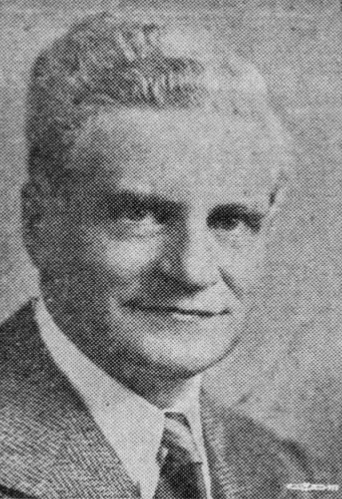
Historical · U.S. House · Wisconsin · District 3
William Stevenson
Former U.S. Representative · Wisconsin District 3 · 1941–1949 · Republican
William Stevenson represented Wisconsin's District 3 in the United States House of Representatives (1941–1949) for the Republican party. The page below collects sourced biographical facts, term history, committee roles, and provenance for Stevenson.
Bioguide ID: S000896
Key facts
- Full name
- William Stevenson
- State
- Wisconsin
- District
- District 3
- Party
- Republican
- House service
- 1941–1949
- First House term
- 1941
- Status
- Left office
- Current term ends
- —
- Born
- 1891
- Bioguide ID
- S000896
- Committee assignments
- —
- Dataset version
- 1.20260605
Biographical narrative
1,086 words · sourced from the Wikipedia REST extract
William Stevenson was a prominent American lawyer and politician who served as a U.S. Representative for Wisconsin's 3rd congressional district from 1941 to 1949. A member of the Republican Party, he was known for his legal background and his involvement in local politics prior to his congressional career. Stevenson's tenure in the House of Representatives spanned four terms, during which he engaged in significant legislative activities and addressed various issues pertinent to his constituents and the nation.
Early life and career
William Stevenson was born on September 23, 1891, in Kenosha, Wisconsin. His family later relocated to La Crosse, Wisconsin, where he spent his formative years. Stevenson completed his secondary education at La Crosse Central High School before pursuing higher education at La Crosse Normal School, which is now known as the University of Wisconsin–La Crosse. He graduated in 1912 and began his career in education by helping to organize the Union Free High School in Holmen, Wisconsin. Following this, he served as a teacher at the school for two years and subsequently became the principal of a high school in Neillsville, Wisconsin, from 1914 to 1916.
In 1916, Stevenson decided to further his education by enrolling in the University of Wisconsin Law School. While studying law, he also taught at Madison Central High School. He earned his LL.B. degree in 1919 and became a member of the Phi Alpha Delta legal fraternity. After being admitted to the bar, he returned to La Crosse and briefly partnered with J. E. Higbee. In 1920, he moved to Richland Center, Wisconsin, where he established a partnership with Levi H. Bancroft, taking over Bancroft's private practice while Bancroft served as a circuit court judge. During this period, Stevenson also held the position of court commissioner for the circuit court in Richland County.
Stevenson's political career began in earnest in 1924 when he was elected district attorney of Richland County, Wisconsin. After completing his two-year term, he formed a new law partnership with A. H. Schubert, a former high school teacher. Initially, Stevenson divided his time between offices in Richland Center and La Crosse, but he eventually moved his practice entirely to La Crosse. His political aspirations continued to grow, and in 1932, he sought the Republican nomination for district attorney of La Crosse County. Although he narrowly lost the primary election, he remained active in local politics.
In 1934, Stevenson successfully ran for district attorney of La Crosse County, defeating the incumbent in a competitive three-way race that included candidates from the Democratic and Progressive parties. He was re-elected in 1936 and 1938, solidifying his reputation as a capable and dedicated public servant.
House tenure
Stevenson's congressional career began following the death of U.S. Representative Harry W. Griswold on July 4, 1939, which created a vacancy in Wisconsin's 3rd congressional district. Although Griswold had only been in office for six months of his two-year term, no special election was called to fill the seat for the remainder of the 76th Congress. In July 1940, Stevenson announced his candidacy for the Republican nomination to succeed Griswold in the upcoming 77th Congress. His campaign was marked by his opposition to the United States joining World War II and his advocacy for a national highway system aimed at providing employment and enhancing national defense.
In the Republican primary, Stevenson faced three other candidates, including state senator Edward J. Roethe and businessman Raymond C. Bice. He won the primary by a narrow margin, securing his place on the ballot for the general election. His main opponent in the general election was Gardner R. Withrow, the Progressive Party nominee, along with Democratic candidate George T. Doherty. Stevenson campaigned against the New Deal policies of the Roosevelt administration and expressed concerns about Roosevelt's decision to seek a third presidential term. He also advocated for new tariffs to support Wisconsin's dairy farmers. Ultimately, Stevenson won the general election, marking the beginning of his four terms in the House.
During his first year in Congress, Stevenson maintained his opposition to new trade agreements that aimed to reduce tariff barriers. He also opposed the Lend-Lease Act, although he supported other forms of domestic military spending. One of his notable achievements during this period was securing the establishment of the Badger Army Ammunition Plant within his district as part of the broader defense buildup in response to World War II. Following the attack on Pearl Harbor, Stevenson's stance shifted, aligning more closely with his fellow Republicans in Wisconsin, as he abandoned his previous isolationist views.
In 1942, Stevenson faced a primary challenge from Joseph F. Walsh, who criticized him for his earlier isolationist positions and presented himself as a more supportive ally of President Roosevelt. Stevenson successfully defended his seat in this primary election, continuing his congressional career.
Legislative focus and committees
Throughout his tenure in the House of Representatives, Stevenson focused on various legislative issues that were significant to his constituents and the broader national context. His early opposition to trade agreements reflected his commitment to protecting local industries, particularly agriculture, which was vital to Wisconsin's economy. He advocated for tariffs that would benefit dairy farmers and other agricultural producers in his district.
As a member of Congress during a tumultuous time in American history, Stevenson also engaged in discussions surrounding national defense and military preparedness. His support for domestic military spending and the establishment of defense-related facilities underscored his commitment to ensuring the safety and security of the nation during World War II.
Stevenson's legislative activities were also influenced by the political dynamics of the time, including the shifting landscape of the Republican Party and the impact of the New Deal. His critiques of Roosevelt's policies and his emphasis on local economic interests positioned him as a representative who sought to balance national priorities with the needs of his constituents.
In addition to his legislative work, Stevenson served on various committees during his time in the House, contributing to discussions and decisions that shaped policy in areas such as defense, agriculture, and trade. His experience as a lawyer and district attorney informed his approach to legislative matters, allowing him to navigate complex legal and political issues effectively.
Stevenson's congressional career concluded on January 3, 1949, after serving four full terms. His time in office was marked by significant historical events and challenges, reflecting the complexities of American politics during the mid-20th century. Following his departure from Congress, Stevenson continued to be involved in legal and civic activities until his passing on March 19, 1978.
Notable legislation
Sponsored and co-sponsored legislation for William Stevenson is pending operator curation. The biographical narrative above carries the same provenance trail until per-bill rows are written.
Sources
- [1]https://en.wikipedia.org/wiki/William_H._StevensonWikipedia · retrieved 2026-06-05
Notable quotes
Sourced quotes for William Stevenson are pending operator curation. Narrative-scope provenance remains attached below.
Sources
- [1]https://en.wikipedia.org/wiki/William_H._StevensonWikipedia · retrieved 2026-06-05
Key positions
Curated policy positions for William Stevenson are pending operator review. The biographical narrative above carries the same provenance trail until per-topic positions are written.
Sources
- [1]https://en.wikipedia.org/wiki/William_H._StevensonWikipedia · retrieved 2026-06-05
Terms served
- 1941–1943U.S. House · Term 1 · Republican
- 1943–1945U.S. House · Term 2 · Republican
- 1945–1947U.S. House · Term 3 · Republican
- 1947–1949U.S. House · Term 4 · Republican
Sources & provenance
Every attributable claim above carries a per-section [N] marker that resolves to the corresponding URL below. Each entry records the upstream provider, the canonical URL, and the timestamp at which the source was retrieved by the ingest pipeline.
Key facts
- https://bioguide.congress.gov/search/bio/S000896bioguide · retrieved 2026-06-05
- https://www.govtrack.us/congress/members/410357govtrack · retrieved 2026-06-05
Biographical narrative
- https://en.wikipedia.org/wiki/William_H._Stevensonwikipedia · retrieved 2026-06-05
Find your representative
Every U.S. state elects representatives by district. Browse Wisconsin’s delegation, the full former-representative roster, or explore the role and term length.
Related on The Candidate
- Preceded by Harry GriswoldEarlier holder of the Wisconsin District 3 House seat · Republican.Open
- Succeeded by Vernon ThomsonLater holder of the Wisconsin District 3 House seat · Republican.Open
- Charles WilliamsFormer U.S. Representative · Wisconsin District 1 · RepublicanOpen
- Clifford RandallFormer U.S. Representative · Wisconsin District 1 · RepublicanOpen
- Clinton BabbittFormer U.S. Representative · Wisconsin District 1 · DemocraticOpen
- Daniel Wells Jr.Former U.S. Representative · Wisconsin District 1 · DemocraticOpen