
Historical · U.S. House · Wisconsin · District 6
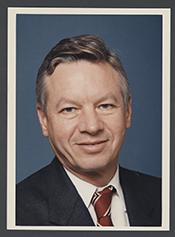
Tom Petri
Former U.S. Representative · Wisconsin District 6 · 1979–2015 · Republican
Tom Petri represented Wisconsin's District 6 in the United States House of Representatives (1979–2015) for the Republican party. The page below collects sourced biographical facts, term history, committee roles, and provenance for Petri.
Bioguide ID: P000265
Key facts
- Full name
- Tom Petri
- State
- Wisconsin
- District
- District 6
- Party
- Republican
- House service
- 1979–2015
- First House term
- 1979
- Status
- Left office
- Current term ends
- —
- Born
- 1940
- Bioguide ID
- P000265
- Committee assignments
- —
- Dataset version
- 1.20260605
Biographical narrative
965 words · sourced from the Wikipedia REST extract
Thomas E. Petri is a former U.S. Representative who served Wisconsin's 6th congressional district from 1979 until 2015. A member of the Republican Party, Petri's lengthy political career spanned 18 terms in the U.S. House of Representatives. He is recognized for his involvement in various legislative initiatives and his participation in several political organizations, reflecting a moderate stance within his party.
Early life and career
Born on May 28, 1940, in Marinette, Wisconsin, Thomas E. Petri experienced a significant personal loss in his early childhood when his father, a Navy flyer during World War II, went missing during a mission over the Atlantic Ocean. Following this tragedy, Petri, along with his infant brother and their widowed mother, relocated to Fond du Lac, Wisconsin. There, his mother worked as a teacher in the local public school system, which likely influenced Petri's own educational pursuits.
Petri attended Goodrich High School in Fond du Lac, where he demonstrated early leadership potential by participating as a delegate in the Badger Boys State program in 1957, a youth government and leadership initiative. After graduating from high school, he pursued higher education at Harvard University, where he earned both a Bachelor of Arts and a Bachelor of Laws degree. Following his graduation from law school, Petri served as a law clerk for federal district judge James Doyle, gaining valuable legal experience.
In addition to his academic achievements, Petri was actively involved in public service. He volunteered with the Peace Corps in Somalia from 1966 to 1967, an experience that contributed to his understanding of international issues and humanitarian efforts. After his time in the Peace Corps, he returned to the United States and worked as a White House aide during the Nixon administration from 1969 to 1970. His early political career began in the Wisconsin State Senate, where he served from 1973 until 1979, laying the groundwork for his future congressional ambitions.
House tenure
Petri's congressional career began in 1979 when he won a special election to fill the vacancy left by the death of Congressman William A. Steiger. His victory was narrow, defeating fellow state senator Gary Goyke by a margin of approximately 1,200 votes. Petri successfully retained his seat in the subsequent 1980 election, securing 57 percent of the vote in a rematch against Goyke. Over the course of his 18 terms in office, Petri was reelected 16 times, showcasing his electoral strength and the support he garnered from his constituents.
Throughout his tenure, Petri faced varying levels of electoral competition. His most competitive race occurred in 1992 when he defeated State Representative Peg Lautenschlager with 53 percent of the vote, marking the only instance in which he received less than 65 percent of the vote in a reelection contest. In several election cycles, including 1990, 1994, 2002, and 2006, he ran unopposed, reflecting his strong position within his district. Petri announced in April 2014 that he would not seek reelection in November 2014, concluding a lengthy and impactful career in the U.S. House.
Legislative focus and committees
During his time in Congress, Petri was known for his involvement in various legislative initiatives and his participation in multiple committees. He was a member of the Republican Main Street Partnership, which included moderate Republicans, and he was part of the Tuesday Group, a caucus of centrist Republicans. His legislative priorities included support for stem-cell research, although he maintained a generally anti-abortion stance. Petri also advocated for a moratorium on the death penalty while opposing certain restrictions related to it.
Petri's legislative contributions included the authorship and sponsorship of three significant surface transportation laws. He played a role in the repeal of the 55-miles-per-hour national speed limit and the dissolution of the Interstate Commerce Commission, reflecting his focus on transportation and infrastructure issues. His approach to labor issues was notable, as he received substantial contributions from labor unions during his 2012 campaign and supported Project Labor Agreements (PLAs) in government contracts.
In 1994, Petri introduced the Multicare Act, which aimed to establish federally funded government-run health insurance programs. He continued to advocate for this initiative until 2004, demonstrating his commitment to healthcare reform. Other legislative efforts included the introduction of the Direct Loan Reward Act in 2005 and the Student Aid Reward (STAR) Act in 2006, both aimed at improving student loan programs.
Petri's voting record included a mix of positions on key issues. He voted against the Online Freedom of Speech Act in 2005 and supported the Budget Control Act of 2011, which raised the nation's debt limit. He also endorsed candidates in presidential elections, supporting Mitt Romney in the 2008 GOP primary and later endorsing John McCain in the general election.
Throughout his congressional career, Petri was involved in various initiatives that reflected his commitment to both local and national interests. He led the Congressional British-American Parliamentary Exchange Group, fostering relationships between U.S. Congress members and their counterparts in the United Kingdom. In the 112th and 113th Congresses, he introduced the ExCEL Act, which aimed to create a universal income-contingent student loan repayment system, garnering bipartisan support.
In 2012, Petri introduced the Fox-Wisconsin Heritage Parkway National Heritage Area Act, which sought to designate a significant area in Wisconsin under federal control for preservation and heritage purposes. His legislative efforts and committee work illustrate a career dedicated to addressing a wide range of issues, from transportation and education to healthcare and international relations.
Thomas E. Petri's lengthy tenure in the U.S. House of Representatives reflects a commitment to public service and a focus on legislative initiatives that aimed to address the needs of his constituents and the broader American public. His career, marked by significant electoral success and involvement in various political organizations, underscores his role as a prominent figure in Wisconsin politics and the Republican Party.
Notable legislation
Sponsored and co-sponsored legislation for Tom Petri is pending operator curation. The biographical narrative above carries the same provenance trail until per-bill rows are written.
Sources
- [1]https://en.wikipedia.org/wiki/Tom_PetriWikipedia · retrieved 2026-06-05
Notable quotes
Sourced quotes for Tom Petri are pending operator curation. Narrative-scope provenance remains attached below.
Sources
- [1]https://en.wikipedia.org/wiki/Tom_PetriWikipedia · retrieved 2026-06-05
Key positions
Curated policy positions for Tom Petri are pending operator review. The biographical narrative above carries the same provenance trail until per-topic positions are written.
Sources
- [1]https://en.wikipedia.org/wiki/Tom_PetriWikipedia · retrieved 2026-06-05
Terms served
- 1979–1981U.S. House · Term 1 · Republican
- 1981–1983U.S. House · Term 2 · Republican
- 1983–1985U.S. House · Term 3 · Republican
- 1985–1987U.S. House · Term 4 · Republican
- 1987–1989U.S. House · Term 5 · Republican
- 1989–1991U.S. House · Term 6 · Republican
- 1991–1993U.S. House · Term 7 · Republican
- 1993–1995U.S. House · Term 8 · Republican
- 1995–1997U.S. House · Term 9 · Republican
- 1997–1999U.S. House · Term 10 · Republican
- 1999–2001U.S. House · Term 11 · Republican
- 2001–2003U.S. House · Term 12 · Republican
- 2003–2005U.S. House · Term 13 · Republican
- 2005–2007U.S. House · Term 14 · Republican
- 2007–2009U.S. House · Term 15 · Republican
- 2009–2011U.S. House · Term 16 · Republican
- 2011–2013U.S. House · Term 17 · Republican
- 2013–2015U.S. House · Term 18 · Republican
Sources & provenance
Every attributable claim above carries a per-section [N] marker that resolves to the corresponding URL below. Each entry records the upstream provider, the canonical URL, and the timestamp at which the source was retrieved by the ingest pipeline.
Key facts
- https://bioguide.congress.gov/search/bio/P000265bioguide · retrieved 2026-06-05
- http://petri.house.govhouse.gov · retrieved 2026-06-05
Biographical narrative
- https://en.wikipedia.org/wiki/Tom_Petriwikipedia · retrieved 2026-06-05
Find your representative
Every U.S. state elects representatives by district. Browse Wisconsin’s delegation, the full former-representative roster, or explore the role and term length.
Related on The Candidate
- Preceded by William SteigerEarlier holder of the Wisconsin District 6 House seat · Republican.Open
- Charles WilliamsFormer U.S. Representative · Wisconsin District 1 · RepublicanOpen
- Clifford RandallFormer U.S. Representative · Wisconsin District 1 · RepublicanOpen
- Clinton BabbittFormer U.S. Representative · Wisconsin District 1 · DemocraticOpen
- Daniel Wells Jr.Former U.S. Representative · Wisconsin District 1 · DemocraticOpen
- Republican PartyFederal candidates and office holders on the Republican line.Open