
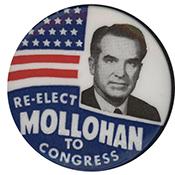
Historical · U.S. House · West Virginia · District 1
Robert Mollohan
Former U.S. Representative · West Virginia District 1 · 1953–1983 · Democratic
Robert Mollohan represented West Virginia's District 1 in the United States House of Representatives (1953–1983) for the Democratic party. The page below collects sourced biographical facts, term history, committee roles, and provenance for Mollohan.
Bioguide ID: M000845
Key facts
- Full name
- Robert Mollohan
- State
- West Virginia
- District
- District 1
- Party
- Democratic
- House service
- 1953–1983
- First House term
- 1953
- Status
- Left office
- Current term ends
- —
- Born
- 1909
- Bioguide ID
- M000845
- Committee assignments
- —
- Dataset version
- 1.20260605
Biographical narrative
1,075 words · sourced from the Wikipedia REST extract
Robert H. Mollohan was an American politician who served as a member of the United States House of Representatives, representing West Virginia's 1st congressional district. A member of the Democratic Party, Mollohan's congressional career spanned from 1953 to 1957 and then from 1969 until his retirement in 1983. He was known for his ability to secure funding for local projects and was succeeded in Congress by his son, Alan Mollohan.
Early life and career
Robert Homer Mollohan was born on September 18, 1909, in Grantsville, West Virginia. He pursued higher education at Glenville State College, where he earned a Bachelor of Science degree in accounting. Following his graduation, Mollohan began his professional career in public service. He took a position as a tax collector for the city of Parkersburg, West Virginia. His work in local government led to a promotion in 1935, when he became the chief of the miscellaneous tax division.
In 1939, Mollohan's responsibilities shifted as he was appointed the local director of the Works Progress Administration (WPA), a New Deal agency that provided jobs and income to the unemployed during the Great Depression. His career continued to evolve in 1940 when he briefly worked for the United States Census Bureau, gaining experience in federal operations.
From 1941 to 1949, Mollohan served as the director of the West Virginia Industrial School for Boys located in Pruntytown. This role involved overseeing the institution's operations and programs aimed at rehabilitating young offenders. After leaving the school, he transitioned to a position as a clerk for the United States Senate, which further solidified his understanding of legislative processes and government functions.
Mollohan's political career took a significant turn when he was elected to the U.S. House of Representatives in 1953. He represented West Virginia's 1st congressional district and served two terms until 1957. During this initial period in Congress, he did not endorse the Southern Manifesto, a document that opposed racial integration in public places.
In 1956, Mollohan sought to advance his political career by running for governor of West Virginia. However, he lost the general election to Cecil Underwood, the state house minority leader. His gubernatorial campaign faced challenges, particularly when allegations surfaced regarding financial contributions he received from a coal operator while he was superintendent of the Industrial School for Boys. This controversy impacted his candidacy and contributed to his electoral defeat.
Following his loss in the gubernatorial race, Mollohan temporarily withdrew from politics and established an insurance agency. However, he remained engaged in public service and returned to the political arena in 1968 when he sought to reclaim his former congressional seat. At that time, the seat was held by Republican Arch A. Moore Jr., who had decided to run for governor. Despite his absence from Congress, Mollohan was successful in his bid, marking the beginning of a second tenure in the House.
House tenure
Mollohan's second tenure in the House of Representatives began in 1969 and lasted until his retirement in 1983. During this period, he was elected to seven consecutive terms, demonstrating a significant level of support from his constituents in West Virginia. His experience and familiarity with the legislative process allowed him to navigate the complexities of Congress effectively.
Throughout his time in the House, Mollohan served on the Armed Services Committee, where he contributed to discussions and decisions regarding national defense and military appropriations. His role on this committee was particularly relevant given the geopolitical context of the time, including the Cold War and various military engagements.
Mollohan became known for his ability to secure funding for local projects, often referred to as "pork barrel" spending. This practice involved directing federal funds to specific projects within his district, which helped address local needs and foster economic development. His efforts in this area contributed to his reputation as a dedicated representative who prioritized the interests of his constituents.
In addition to his work on the Armed Services Committee, Mollohan's legislative activities included a focus on various issues pertinent to West Virginia and its residents. He was involved in initiatives related to infrastructure, education, and health care, reflecting the diverse needs of his district. His ability to advocate for these issues was supported by his extensive experience in public service and local government.
Mollohan's congressional career concluded on January 3, 1983, when he retired from the House. His departure marked the end of a significant chapter in West Virginia's political history, as he had been a prominent figure in the state's representation at the federal level. Following his retirement, he was succeeded by his son, Alan Mollohan, who continued the family's political legacy by holding the same congressional seat until 2011.
Legislative focus and committees
During his time in the U.S. House of Representatives, Robert H. Mollohan's legislative focus encompassed a range of issues that were critical to his constituents and the broader interests of West Virginia. His work on the Armed Services Committee allowed him to engage with matters related to national security and military funding, which were particularly relevant during the tumultuous decades of the 1960s, 1970s, and early 1980s.
Mollohan's reputation for securing federal funding for local projects was a hallmark of his legislative approach. He was adept at navigating the appropriations process to direct resources toward initiatives that benefitted his district. This included funding for infrastructure improvements, educational programs, and health care services, all of which were vital to the well-being of his constituents. His efforts in this area were often characterized by a commitment to enhancing the quality of life for residents of West Virginia.
In addition to his work on the Armed Services Committee, Mollohan participated in various other legislative initiatives that reflected the needs and priorities of his district. He was involved in discussions about economic development, job creation, and support for local industries, particularly in the context of West Virginia's economic landscape. His ability to advocate for these issues was informed by his background in local government and his understanding of the challenges faced by his constituents.
Mollohan's tenure in Congress was marked by a dedication to public service and a commitment to representing the interests of West Virginians. His legislative focus and committee work contributed to his effectiveness as a representative, allowing him to leave a lasting impact on both his district and the broader legislative landscape. After retiring from Congress, Mollohan's legacy continued through his son, who succeeded him and maintained the family's political involvement in West Virginia.
Notable legislation
Sponsored and co-sponsored legislation for Robert Mollohan is pending operator curation. The biographical narrative above carries the same provenance trail until per-bill rows are written.
Sources
- [1]https://en.wikipedia.org/wiki/Bob_MollohanWikipedia · retrieved 2026-06-05
Notable quotes
Sourced quotes for Robert Mollohan are pending operator curation. Narrative-scope provenance remains attached below.
Sources
- [1]https://en.wikipedia.org/wiki/Bob_MollohanWikipedia · retrieved 2026-06-05
Key positions
Curated policy positions for Robert Mollohan are pending operator review. The biographical narrative above carries the same provenance trail until per-topic positions are written.
Sources
- [1]https://en.wikipedia.org/wiki/Bob_MollohanWikipedia · retrieved 2026-06-05
Terms served
- 1953–1955U.S. House · Term 1 · Democratic
- 1955–1957U.S. House · Term 2 · Democratic
- 1969–1971U.S. House · Term 3 · Democratic
- 1971–1973U.S. House · Term 4 · Democratic
- 1973–1975U.S. House · Term 5 · Democratic
- 1975–1977U.S. House · Term 6 · Democratic
- 1977–1979U.S. House · Term 7 · Democratic
- 1979–1981U.S. House · Term 8 · Democratic
- 1981–1983U.S. House · Term 9 · Democratic
Sources & provenance
Every attributable claim above carries a per-section [N] marker that resolves to the corresponding URL below. Each entry records the upstream provider, the canonical URL, and the timestamp at which the source was retrieved by the ingest pipeline.
Key facts
- https://bioguide.congress.gov/search/bio/M000845bioguide · retrieved 2026-06-05
- https://www.govtrack.us/congress/members/407818govtrack · retrieved 2026-06-05
Biographical narrative
- https://en.wikipedia.org/wiki/Bob_Mollohanwikipedia · retrieved 2026-06-05
Find your representative
Every U.S. state elects representatives by district. Browse West Virginia’s delegation, the full former-representative roster, or explore the role and term length.
Related on The Candidate
- Preceded by Robert RamsayEarlier holder of the West Virginia District 1 House seat · Democratic.Open
- Succeeded by Alan MollohanLater holder of the West Virginia District 1 House seat · Democratic.Open
- Andrew SchifflerFormer U.S. Representative · West Virginia District 1 · RepublicanOpen
- Arch Moore Jr.Former U.S. Representative · West Virginia District 1 · RepublicanOpen
- Benjamin RosenbloomFormer U.S. Representative · West Virginia District 1 · RepublicanOpen
- Democratic PartyFederal candidates and office holders on the Democratic line.Open