
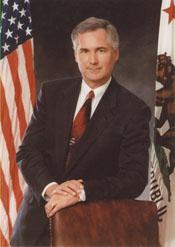
Serving · U.S. House · California · District 5
Tom McClintock
U.S. Representative · California District 5 · 2009–present · Republican
Tom McClintock represents California's District 5 in the United States House of Representatives (2009–present) for the Republican party. The page below collects sourced biographical facts, term history, committee roles, and provenance for McClintock.
Bioguide ID: M001177
Key facts
- Full name
- Tom McClintock
- State
- California
- District
- District 5
- Party
- Republican
- House service
- 2009–present
- First House term
- 2009
- Status
- Currently serving
- Current term ends
- 2027
- Born
- 1956
- Bioguide ID
- M001177
- Committee assignments
- 3
- Dataset version
- 1.20260604
Biographical narrative
858 words · sourced from the Wikipedia REST extract
Thomas Miller McClintock II, commonly known as Tom McClintock, is an American politician currently serving as the U.S. Representative for California's 5th congressional district, a position he has held since 2009. A member of the Republican Party, McClintock's congressional district encompasses areas from the Sacramento suburbs to the outskirts of Fresno, including significant natural landmarks such as Yosemite National Park. His political career spans several decades, during which he has held various roles at both the state and federal levels, including service in the California State Assembly and State Senate prior to his election to the U.S. House of Representatives.
Early life and career
Tom McClintock was born on July 10, 1956, in Westchester County, New York. In 1965, his family relocated to Thousand Oaks, California, where he spent his formative years. McClintock pursued higher education at the University of California, Los Angeles (UCLA), earning a degree in political science in 1978. His early involvement in politics began shortly after graduation when, at the age of 23, he was elected as the chair of the Ventura County Republican Party, a position he held until 1981. This early engagement in local politics laid the groundwork for his subsequent political career.
Following his tenure as party chair, McClintock served as the chief of staff to State Senator Ed Davis from 1980 to 1982. This role provided him with valuable insights into the legislative process and the workings of state government. After leaving this position, he took on the role of director at the Center for the California Taxpayer from 1992 to 1994, where he focused on issues related to taxation and fiscal policy. He later became the director of the Claremont Institute's Golden State Center for Policy Studies from 1995 to 1996, further solidifying his expertise in public policy.
House tenure
McClintock's political career at the state level began in earnest when he was elected to the California State Assembly in 1982, representing the 36th district. His initial victory came against Democrat Harriet Kosmo Henson, and he quickly established a reputation for his conservative positions. Over the course of his time in the Assembly, he was reelected multiple times, defeating various opponents with significant margins. His legislative focus included advocating for spending cuts, opposing tax increases, and supporting measures related to the death penalty.
In 2000, McClintock transitioned to the California State Senate, where he continued to serve until 2008. During his time in the Senate, he was known for his opposition to various legislative measures that he believed would increase taxes or government spending. He was particularly vocal against Proposition 2, which aimed to improve the living conditions of farm animals, arguing that such regulations would lead to higher grocery prices.
Despite his extensive experience in state politics, McClintock's aspirations extended beyond the California legislature. He ran for various statewide offices, including a bid for California State Controller in 1994 and again in 2002, as well as a campaign for Lieutenant Governor in 2006. Although he was unsuccessful in these races, these attempts further raised his profile within the Republican Party.
In 2008, McClintock announced his candidacy for the U.S. House of Representatives, specifically targeting California's 4th congressional district. This district, located approximately 300 miles north of his previous Senate district, was represented by a nine-term incumbent. McClintock's campaign was successful, and he was elected to the House, officially beginning his congressional tenure in January 2009.
Since taking office, McClintock has been reelected multiple times, demonstrating a consistent level of support from his constituents. His current term is set to conclude on January 3, 2027, marking a significant period of service in the U.S. House.
Legislative focus and committees
Throughout his time in Congress, McClintock has maintained a focus on several key issues that align with his conservative values. His legislative priorities often include fiscal responsibility, limited government, and individual liberties. He has been a vocal advocate for reducing federal spending and has consistently opposed tax increases, reflecting his long-standing commitment to fiscal conservatism.
In addition to his focus on fiscal issues, McClintock has been involved in various committees that align with his interests and expertise. His committee assignments have allowed him to influence legislation on a range of topics, including natural resources, agriculture, and budgetary matters. His representation of a district that includes Yosemite National Park has also made him an advocate for conservation and responsible land management, balancing environmental concerns with economic interests.
McClintock's legislative record includes efforts to promote accountability in government spending and to streamline bureaucratic processes. He has often emphasized the importance of performance-based budgeting and has supported measures aimed at reducing government waste. His approach to governance reflects a belief in the principles of limited government and personal responsibility.
In summary, Tom McClintock's career has been characterized by a commitment to conservative principles and a focus on fiscal responsibility. From his early days in local politics to his current role in the U.S. House of Representatives, he has consistently advocated for policies that align with his beliefs. His tenure in Congress continues to reflect his dedication to serving the constituents of California's 5th congressional district while addressing broader national issues.
Committees & roles
- House Committee on Natural ResourcesMember · since 2025
- House Committee on the BudgetMember · since 2025
- House Committee on the JudiciaryMember · since 2025
Notable legislation
Sponsored and co-sponsored legislation for Tom McClintock is pending operator curation. The biographical narrative above carries the same provenance trail until per-bill rows are written.
Sources
- [1]https://en.wikipedia.org/wiki/Tom_McClintockWikipedia · retrieved 2026-06-04
Notable quotes
Sourced quotes for Tom McClintock are pending operator curation. Narrative-scope provenance remains attached below.
Sources
- [1]https://en.wikipedia.org/wiki/Tom_McClintockWikipedia · retrieved 2026-06-04
Key positions
Curated policy positions for Tom McClintock are pending operator review. The biographical narrative above carries the same provenance trail until per-topic positions are written.
Sources
- [1]https://en.wikipedia.org/wiki/Tom_McClintockWikipedia · retrieved 2026-06-04
Terms served
- 2009–2011U.S. House · Term 1 · Republican
- 2011–2013U.S. House · Term 2 · Republican
- 2013–2015U.S. House · Term 3 · Republican
- 2015–2017U.S. House · Term 4 · Republican
- 2017–2019U.S. House · Term 5 · Republican
- 2019–2021U.S. House · Term 6 · Republican
- 2021–2023U.S. House · Term 7 · Republican
- 2023–2025U.S. House · Term 8 · Republican
- 2025–2027U.S. House · Term 9 · Republican
Sources & provenance
Every attributable claim above carries a per-section [N] marker that resolves to the corresponding URL below. Each entry records the upstream provider, the canonical URL, and the timestamp at which the source was retrieved by the ingest pipeline.
Key facts
- https://bioguide.congress.gov/search/bio/M001177bioguide · retrieved 2026-06-04
- https://mcclintock.house.gov/house.gov · retrieved 2026-06-04
Biographical narrative
- https://en.wikipedia.org/wiki/Tom_McClintockwikipedia · retrieved 2026-06-04
Find your representative
Every U.S. state elects representatives by district. Browse California’s delegation, the full currently-serving-representative roster, or explore the role and term length.
Related on The Candidate
- James GallagherServing U.S. Representative · California District 1 · RepublicanOpen
- Mark DeSaulnierServing U.S. Representative · California District 10 · DemocraticOpen
- Nancy PelosiServing U.S. Representative · California District 11 · DemocraticOpen
- Lateefah SimonServing U.S. Representative · California District 12 · DemocraticOpen
- Republican PartyFederal candidates and office holders on the Republican line.Open
- Representatives from CaliforniaEvery currently-serving U.S. Representative who has represented California.Open