
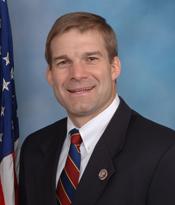
Serving · U.S. House · Ohio · District 4
Jim Jordan
U.S. Representative · Ohio District 4 · 2007–present · Republican
Jim Jordan represents Ohio's District 4 in the United States House of Representatives (2007–present) for the Republican party. The page below collects sourced biographical facts, term history, committee roles, and provenance for Jordan.
Bioguide ID: J000289
Key facts
- Full name
- Jim Jordan
- State
- Ohio
- District
- District 4
- Party
- Republican
- House service
- 2007–present
- First House term
- 2007
- Status
- Currently serving
- Current term ends
- 2027
- Born
- 1964
- Bioguide ID
- J000289
- Committee assignments
- 2
- Dataset version
- 1.20260604
Biographical narrative
1,084 words · sourced from the Wikipedia REST extract
James Daniel Jordan is an American politician currently serving as the U.S. Representative for Ohio's 4th congressional district, a position he has held since 2007. A member of the Republican Party, Jordan is in his tenth term in the House of Representatives. He is known for his involvement in various congressional committees and for his role in the formation of the House Freedom Caucus, a group that has been influential in shaping the Republican agenda in Congress.
Early life and career
Jim Jordan was born on February 17, 1964, in Troy, Ohio, to parents Shirley and John Jordan. He grew up in Champaign County, Ohio, where he attended Graham High School. During his high school years, he excelled in wrestling, winning state championships throughout his four years and finishing with an impressive record of 156 wins and only 1 loss. His success on the mat laid the foundation for his future in wrestling and education.
Following high school, Jordan pursued higher education at the University of Wisconsin–Madison. There, he continued to excel in wrestling, becoming a two-time NCAA Division I wrestling champion in the 134-pound weight class, winning titles in 1985 and 1986. His wrestling career included a notable match against future Olympic champion John Smith. Although he competed in the 1988 U.S. Olympic wrestling trials, he did not qualify for the Olympic team.
Jordan graduated from the University of Wisconsin in 1986 with a bachelor's degree in economics. He later earned a master's degree in education from Ohio State University and a Juris Doctor degree from Capital University Law School in 2001. Despite his legal education, he did not take the bar examination.
Jordan's early career included a significant tenure as an assistant wrestling coach at Ohio State University from 1987 to 1995. This period was marked by controversy due to the later revelations of sexual misconduct by the team's physician, Richard Strauss. An independent investigation by Ohio State University concluded that Strauss had abused numerous student-athletes during his time with the program. While some have alleged that Jordan was aware of the misconduct, he has denied any knowledge of it and has characterized the accusations against him as politically motivated.
In addition to his coaching career, Jordan entered politics, winning a seat in the Ohio House of Representatives in 1994, where he served three terms. He was subsequently elected to the Ohio Senate in 2000, securing a significant victory over an independent candidate. He was re-elected in 2004, further solidifying his political presence in Ohio.
House tenure
Jim Jordan's congressional career began when he was elected to the U.S. House of Representatives in 2006. He won the Republican primary for Ohio's 4th congressional district after the retirement of long-serving incumbent Mike Oxley. In the general election, Jordan defeated Democratic nominee Rick Siferd with a substantial majority of the vote. Since then, he has been re-elected multiple times, consistently winning a significant percentage of the vote in each election cycle.
Jordan's tenure in the House has been characterized by his active involvement in various Republican initiatives and his leadership roles within the party. He served as the chair of the Republican Study Committee during the 112th Congress, a group that plays a critical role in shaping conservative policy within the House. His leadership during the 2013 government shutdown positioned him as a prominent figure in the Republican strategy to leverage budgetary issues for political gain.
In 2015, Jordan was instrumental in the formation of the House Freedom Caucus, a group of conservative Republican members of Congress advocating for a more aggressive conservative agenda. He served as its first chair from 2015 to 2017 and has remained a key figure in the caucus since then. His leadership within the caucus has often placed him at the forefront of significant political battles, including those involving the leadership of the House.
Jordan's relationship with party leadership has evolved over time. Initially, he was a vocal critic of then-Speaker John Boehner, contributing to Boehner's resignation under pressure from the Freedom Caucus. However, he later aligned himself closely with Speaker Kevin McCarthy, supporting him during the contentious Speaker of the House election in January 2023. Following McCarthy's removal from the speakership, Jordan sought to replace him but was unable to secure the position after multiple rounds of voting.
Legislative focus and committees
Throughout his time in Congress, Jim Jordan has focused on a range of legislative issues, often aligning with the more conservative elements of the Republican Party. He has been a vocal advocate for limited government, fiscal conservatism, and a strong national defense. His positions have often placed him at odds with Democrats and more moderate Republicans, particularly on issues related to government spending and regulation.
Jordan has served on several important committees during his congressional career. He was the ranking member of the House Oversight Committee from 2019 to 2020, where he played a significant role in investigating various issues, including allegations of misconduct related to the previous administration. In 2020, he transitioned to become the ranking member of the House Judiciary Committee, a position that allowed him to influence key legislative matters, particularly those related to justice and law enforcement.
In 2023, Jordan was appointed chair of the House Judiciary Committee, a role that further elevated his profile within Congress and allowed him to shape the legislative agenda on critical issues such as immigration, crime, and civil liberties. His leadership in this capacity has been marked by a focus on addressing what he and his colleagues perceive as overreach by federal agencies and a commitment to upholding conservative principles in lawmaking.
Jordan's alignment with former President Donald Trump has also been a defining aspect of his congressional career. He has been a staunch defender of Trump's policies and has actively worked to challenge investigations into the Trump administration. His actions during the Trump presidency, including efforts to discredit investigations into Russian interference in the 2016 election and his refusal to cooperate with the House Select Committee investigating the January 6 attack, have drawn significant media attention and criticism.
In summary, Jim Jordan's career in the U.S. House of Representatives reflects a commitment to conservative principles and a willingness to engage in contentious political battles. His leadership roles within the Republican Party and his legislative focus on key issues have made him a prominent figure in contemporary American politics. As he continues to serve in Congress, his influence on the Republican agenda and his role in shaping legislative outcomes will likely remain significant.
Committees & roles
- House Committee on the JudiciaryChair · since 2025
- House Committee on Oversight and Government ReformMember · since 2025
Notable legislation
Sponsored and co-sponsored legislation for Jim Jordan is pending operator curation. The biographical narrative above carries the same provenance trail until per-bill rows are written.
Sources
- [1]https://en.wikipedia.org/wiki/Jim_JordanWikipedia · retrieved 2026-06-04
Notable quotes
Sourced quotes for Jim Jordan are pending operator curation. Narrative-scope provenance remains attached below.
Sources
- [1]https://en.wikipedia.org/wiki/Jim_JordanWikipedia · retrieved 2026-06-04
Key positions
Curated policy positions for Jim Jordan are pending operator review. The biographical narrative above carries the same provenance trail until per-topic positions are written.
Sources
- [1]https://en.wikipedia.org/wiki/Jim_JordanWikipedia · retrieved 2026-06-04
Terms served
- 2007–2009U.S. House · Term 1 · Republican
- 2009–2011U.S. House · Term 2 · Republican
- 2011–2013U.S. House · Term 3 · Republican
- 2013–2015U.S. House · Term 4 · Republican
- 2015–2017U.S. House · Term 5 · Republican
- 2017–2019U.S. House · Term 6 · Republican
- 2019–2021U.S. House · Term 7 · Republican
- 2021–2023U.S. House · Term 8 · Republican
- 2023–2025U.S. House · Term 9 · Republican
- 2025–2027U.S. House · Term 10 · Republican
Sources & provenance
Every attributable claim above carries a per-section [N] marker that resolves to the corresponding URL below. Each entry records the upstream provider, the canonical URL, and the timestamp at which the source was retrieved by the ingest pipeline.
Key facts
- https://bioguide.congress.gov/search/bio/J000289bioguide · retrieved 2026-06-04
- https://jordan.house.gov/house.gov · retrieved 2026-06-04
Biographical narrative
- https://en.wikipedia.org/wiki/Jim_Jordanwikipedia · retrieved 2026-06-04
Find your representative
Every U.S. state elects representatives by district. Browse Ohio’s delegation, the full currently-serving-representative roster, or explore the role and term length.
Related on The Candidate
- Greg LandsmanServing U.S. Representative · Ohio District 1 · DemocraticOpen
- Michael TurnerServing U.S. Representative · Ohio District 10 · RepublicanOpen
- Shontel BrownServing U.S. Representative · Ohio District 11 · DemocraticOpen
- Troy BaldersonServing U.S. Representative · Ohio District 12 · RepublicanOpen
- Republican PartyFederal candidates and office holders on the Republican line.Open
- Representatives from OhioEvery currently-serving U.S. Representative who has represented Ohio.Open