
Historical · U.S. Senate · Alabama
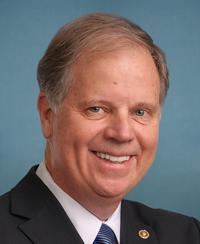
Doug Jones
Former U.S. Senator from Alabama · 2018–2021 · Democratic · Class 2
Doug Jones represented Alabama in the United States Senate (2018–2021) for the Democratic party. The page below collects sourced biographical facts, term history, committee roles, and provenance for Jones.
Bioguide ID: J000300
Key facts
- Full name
- Doug Jones
- State
- Alabama
- Party
- Democratic
- Senate class
- Class II
- Senate service
- 2018–2021
- First Senate term
- 2018
- Status
- Left office
- Current term ends
- —
- Born
- 1954
- Bioguide ID
- J000300
- Committee assignments
- —
- Dataset version
- 1.20260601-3
Biographical narrative
920 words · sourced from the Wikipedia REST extract
Gordon Douglas Jones is an American politician and attorney who served as a United States senator from Alabama from 2018 to 2021. A member of the Democratic Party, Jones is notable for being the last Democrat to have won or held statewide office in Alabama as of 2026. Prior to his Senate career, he held the position of U.S. Attorney for the Northern District of Alabama from 1997 to 2001, where he gained recognition for prosecuting significant civil rights cases, including the 1963 Birmingham church bombing.
Early life and career
Doug Jones was born on May 4, 1954, in Fairfield, Alabama, to Gordon and Gloria (Wesson) Jones. His father was employed at U.S. Steel, while his mother dedicated her time to homemaking. Jones attended Fairfield High School, where he began to develop an interest in politics and public service. He pursued higher education at the University of Alabama, earning a Bachelor of Science degree in political science in 1976. Following his undergraduate studies, he attended Cumberland School of Law at Samford University, where he obtained his Juris Doctor in 1979.
Jones's professional journey commenced as a staff counsel for the U.S. Senate Judiciary Committee, working under Alabama Senator Howell Heflin. This role provided him with foundational experience in legislative processes and legal matters. He transitioned to the position of Assistant U.S. Attorney, serving from 1980 until 1984. After this tenure, he left the federal government to join a private law firm in Birmingham, Alabama, where he practiced law until 1997.
In 1994, Jones sought to enter the political arena by running in the Democratic primary for the Alabama House of Representatives, specifically for District 6. However, he did not advance to the runoff in that election. His political aspirations would later gain traction with his appointment as U.S. Attorney for the Northern District of Alabama.
In 1997, President Bill Clinton nominated Jones to serve as U.S. Attorney for the Northern District of Alabama, a position he held until 2001. His tenure was marked by high-profile cases, particularly his prosecution of two Ku Klux Klan members involved in the 1963 Birmingham church bombing, which resulted in the deaths of four African-American girls. This case became a defining moment in his career and highlighted his commitment to civil rights and justice.
Senate tenure
Jones's political career took a significant turn when he announced his candidacy for the United States Senate in 2017, following the resignation of Republican incumbent Jeff Sessions, who left to become U.S. Attorney General. Jones participated in a special election to fill the vacancy, which was scheduled for December 2017. He won the Democratic primary in August of that year, positioning himself against former Alabama Supreme Court Justice Roy Moore in the general election.
Despite being in a predominantly Republican state, Jones's campaign gained momentum, particularly after allegations surfaced against Moore, accusing him of sexual misconduct with several women, including minors. This development shifted the political landscape and contributed to Jones's eventual victory in the special election, where he won by a narrow margin.
Jones's victory was historic, as he became the first Democrat to win a U.S. Senate seat in Alabama in over two decades. His term began in January 2018, and he served as a member of the Senate until January 2021. During his time in office, Jones focused on various issues, including healthcare, education, and civil rights, reflecting his background as a civil rights attorney.
In 2020, Jones sought re-election for a full term but faced Republican nominee Tommy Tuberville. The election resulted in a significant defeat for Jones, marking one of the largest margins of loss for an incumbent senator since 2010. Following his departure from the Senate, Jones transitioned into various roles, including serving as a political commentator for CNN and engaging in academic fellowships at institutions such as Georgetown University and the University of Chicago.
Legislative focus and committees
During his tenure in the Senate, Doug Jones was involved in several legislative initiatives and served on various committees. His background as a civil rights attorney informed his legislative priorities, which included advocating for social justice, healthcare reform, and education. Jones was known for his bipartisan approach, often seeking to collaborate with colleagues across the aisle to advance key issues.
Jones's work on civil rights was particularly notable, as he continued to emphasize the importance of addressing systemic inequalities and promoting justice for marginalized communities. His experiences as U.S. Attorney provided him with a unique perspective on the challenges faced by these communities, and he utilized his platform to advocate for meaningful reforms.
In addition to his focus on civil rights, Jones was active in discussions surrounding healthcare, particularly in the context of the Affordable Care Act and efforts to expand access to healthcare services for Alabamians. He also prioritized education, advocating for policies that would improve funding for public schools and support for higher education.
After leaving the Senate, Jones continued to engage in public service and political discourse. He was appointed as a nomination advisor for legislative affairs by the Biden administration, where he provided counsel on Supreme Court nominations. As of 2026, he is the Democratic nominee for the gubernatorial election in Alabama, indicating his ongoing commitment to public service and political engagement.
Throughout his career, Doug Jones has navigated various roles in public service, law, and politics, reflecting a dedication to justice and civil rights. His legacy includes significant contributions to the legal landscape in Alabama and a commitment to advocating for the rights of all citizens.
Notable legislation
Sponsored and co-sponsored legislation for Doug Jones is pending operator curation. The biographical narrative above carries the same provenance trail until per-bill rows are written.
Sources
- [1]https://en.wikipedia.org/wiki/Doug_Jones_(politician)Wikipedia · retrieved 2026-06-01
Notable quotes
Sourced quotes for Doug Jones are pending operator curation. Narrative-scope provenance remains attached below.
Sources
- [1]https://en.wikipedia.org/wiki/Doug_Jones_(politician)Wikipedia · retrieved 2026-06-01
Key positions
Curated policy positions for Doug Jones are pending operator review. The biographical narrative above carries the same provenance trail until per-topic positions are written.
Sources
- [1]https://en.wikipedia.org/wiki/Doug_Jones_(politician)Wikipedia · retrieved 2026-06-01
Terms served
- 2018–2021U.S. Senate · Term 1 · Democratic · Class II
Sources & provenance
Every attributable claim above carries a per-section [N] marker that resolves to the corresponding URL below. Each entry records the upstream provider, the canonical URL, and the timestamp at which the source was retrieved by the ingest pipeline.
Key facts
- https://bioguide.congress.gov/search/bio/J000300bioguide · retrieved 2026-06-01
- https://www.jones.senate.govsenate.gov · retrieved 2026-06-01
Biographical narrative
- https://en.wikipedia.org/wiki/Doug_Jones_(politician)wikipedia · retrieved 2026-06-01
Find your senator
Every U.S. state elects two senators. Browse Alabama’s delegation, the full former-senator roster, or explore the role and term length.
Related on The Candidate
- Preceded by Luther StrangeEarlier holder of the Alabama Class II Senate seat · Republican.Open
- Arthur BagbyFormer U.S. Senator from Alabama · DemocraticOpen
- Benjamin FitzpatrickFormer U.S. Senator from Alabama · DemocraticOpen
- Braxton ComerFormer U.S. Senator from Alabama · DemocraticOpen
- Clement ClayFormer U.S. Senator from Alabama · DemocraticOpen
- Democratic PartyFederal candidates and office holders on the Democratic line.Open