
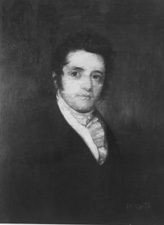
Historical · U.S. Senate · Alabama
Gabriel Moore
Former U.S. Senator from Alabama · 1831–1837 · Jackson · Class 3
Gabriel Moore represented Alabama in the United States Senate (1831–1837) for the Jackson party. The page below collects sourced biographical facts, term history, committee roles, and provenance for Moore.
Bioguide ID: M000898
Key facts
- Full name
- Gabriel Moore
- State
- Alabama
- Party
- Jackson
- Senate class
- Class III
- Senate service
- 1831–1837
- First Senate term
- 1831
- Status
- Left office
- Current term ends
- —
- Born
- —
- Bioguide ID
- M000898
- Committee assignments
- —
- Dataset version
- 1.20260602
Biographical narrative
903 words · sourced from the Wikipedia REST extract
Gabriel Moore was a prominent American politician who served as a U.S. Senator from Alabama. His political career spanned several decades, during which he held various significant positions, including the fifth governor of Alabama. Moore's tenure in the Senate was marked by his alignment with the Jacksonian movement and his involvement in legislative matters, particularly as chairman of the House Committee on Revolutionary Claims.
Early life and career
Gabriel Moore was born in 1785 in Stokes County, North Carolina, to a family of English and some French descent. His early life in North Carolina laid the foundation for his future pursuits in public service and politics. In 1810, Moore relocated to Huntsville, Alabama, a move that would significantly influence his political trajectory. As Alabama was still a relatively new state, Moore quickly became involved in local governance and legislative affairs.
Moore's political career began in the territorial legislatures of Alabama, where he gained experience and recognition. His first significant electoral success came in 1821 when he was elected to the United States Congress as a representative of Alabama's at-large congressional district. This marked the beginning of his congressional career, during which he was re-elected in 1827. Moore was notable for being the second representative from Alabama and the first representative from the state's First Congressional District.
During his time in Congress, Moore demonstrated considerable electoral strength. In his initial election for the at-large district, he secured a commanding victory, receiving over 67% of the votes. His subsequent election to represent Alabama's First District in 1823 was even more remarkable, as he was the only candidate on the ballot and received all 3,304 votes cast. In 1825, he faced competition from Clement Comer Clay but still won decisively with over 71% of the vote.
In 1829, Moore was elected unopposed as the governor of Alabama, a position he held until 1831. His governorship was characterized by his affiliation with the Jacksonian movement, which sought to promote the interests of the common man and limit the power of established elites. However, his time as governor was cut short when he resigned to pursue a seat in the U.S. Senate. Following his resignation, he was succeeded by Samuel B. Moore, the President of the Alabama Senate, who was not related to him.
Senate tenure
Gabriel Moore's Senate career began in 1831 when he successfully won a Class 3 Senate seat. He served alongside fellow senator William R. King and became an active participant in the legislative process. Moore's term in the Senate lasted for six years, during which he was involved in various discussions and decisions that shaped the direction of the state and the nation.
One notable aspect of Moore's Senate tenure was his role as chairman of the House Committee on Revolutionary Claims. In this capacity, he oversaw matters related to claims made by individuals seeking compensation for losses incurred during the Revolutionary War. This position allowed him to influence discussions on historical grievances and the financial responsibilities of the federal government.
Moore's political alignment during his Senate years was primarily with the Jacksonian faction, although he was also recognized as one of the few Anti-Jacksonian senators who opposed the censure of President Andrew Jackson in 1834. This vote highlighted the divisions within the Senate at the time and underscored Moore's willingness to take a stand on contentious issues.
Despite his contributions and involvement in the Senate, Moore's political career faced challenges. In 1837, he lost his bid for re-election to John McKinley, who had previously held the Senate seat. This defeat marked the end of Moore's time in the Senate, concluding his only term in that body.
Legislative focus and committees
Throughout his Senate tenure, Gabriel Moore focused on various legislative issues, particularly those related to claims and compensation for historical grievances. His role as chairman of the House Committee on Revolutionary Claims positioned him at the intersection of historical accountability and contemporary legislative action. This committee was responsible for evaluating claims made by individuals and entities seeking restitution for losses incurred during the Revolutionary War, a task that required a careful balance of historical context and fiscal responsibility.
Moore's alignment with the Jacksonian movement influenced his legislative priorities and decisions. The Jacksonians were known for their advocacy of the common man and their opposition to what they perceived as the elitism of established political figures. Moore's voting record and public statements reflected these principles, as he sought to represent the interests of his constituents and uphold the values of his political faction.
While specific details of the legislation he supported or opposed during his Senate term are not extensively documented, his participation in key votes and committee work contributed to the broader legislative landscape of the time. His opposition to the censure of President Andrew Jackson is particularly noteworthy, as it illustrated his commitment to the Jacksonian cause and his willingness to stand against prevailing sentiments within the Senate.
After leaving the Senate, Moore's political career did not continue in the same capacity. He relocated near Caddo Lake in Texas in 1843, where he spent the remaining years of his life. Gabriel Moore passed away on August 6, 1844, and was laid to rest on the plantation of Peter Swanson. His political legacy, marked by his service as a governor and senator, reflects the evolving political landscape of early 19th-century America and the complexities of governance during that period.
Notable legislation
Sponsored and co-sponsored legislation for Gabriel Moore is pending operator curation. The biographical narrative above carries the same provenance trail until per-bill rows are written.
Sources
- [1]https://en.wikipedia.org/wiki/Gabriel_MooreWikipedia · retrieved 2026-06-02
Notable quotes
Sourced quotes for Gabriel Moore are pending operator curation. Narrative-scope provenance remains attached below.
Sources
- [1]https://en.wikipedia.org/wiki/Gabriel_MooreWikipedia · retrieved 2026-06-02
Key positions
Curated policy positions for Gabriel Moore are pending operator review. The biographical narrative above carries the same provenance trail until per-topic positions are written.
Sources
- [1]https://en.wikipedia.org/wiki/Gabriel_MooreWikipedia · retrieved 2026-06-02
Terms served
- 1821–1823U.S. House · District 1 · Term 1 · Republican
- 1823–1825U.S. House · District 1 · Term 2
- 1825–1827U.S. House · District 1 · Term 3 · Jackson
- 1827–1829U.S. House · District 1 · Term 4 · Jackson
- 1831–1837U.S. Senate · Term 5 · Jackson · Class III
Sources & provenance
Every attributable claim above carries a per-section [N] marker that resolves to the corresponding URL below. Each entry records the upstream provider, the canonical URL, and the timestamp at which the source was retrieved by the ingest pipeline.
Key facts
- https://bioguide.congress.gov/search/bio/M000898bioguide · retrieved 2026-06-02
- https://www.govtrack.us/congress/members/407870govtrack · retrieved 2026-06-02
Biographical narrative
- https://en.wikipedia.org/wiki/Gabriel_Moorewikipedia · retrieved 2026-06-02
Find your senator
Every U.S. state elects two senators. Browse Alabama’s delegation, the full former-senator roster, or explore the role and term length.
Related on The Candidate
- Preceded by Henry ChambersEarlier holder of the Alabama Class III Senate seat · Jackson.Open
- Succeeded by Clement ClayLater holder of the Alabama Class III Senate seat · Democratic.Open
- Arthur BagbyFormer U.S. Senator from Alabama · DemocraticOpen
- Benjamin FitzpatrickFormer U.S. Senator from Alabama · DemocraticOpen
- Braxton ComerFormer U.S. Senator from Alabama · DemocraticOpen
- Senators from AlabamaEvery former U.S. Senator who has represented Alabama.Open