
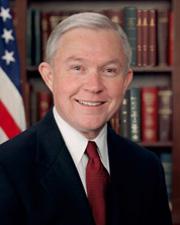
Historical · U.S. Senate · Alabama
Jeff Sessions
Former U.S. Senator from Alabama · 1997–2017 · Republican · Class 2
Jeff Sessions represented Alabama in the United States Senate (1997–2017) for the Republican party. The page below collects sourced biographical facts, term history, committee roles, and provenance for Sessions.
Bioguide ID: S001141
Key facts
- Full name
- Jeff Sessions
- State
- Alabama
- Party
- Republican
- Senate class
- Class II
- Senate service
- 1997–2017
- First Senate term
- 1997
- Status
- Left office
- Current term ends
- —
- Born
- 1946
- Bioguide ID
- S001141
- Committee assignments
- —
- Dataset version
- 1.20260601-3
Biographical narrative
968 words · sourced from the Wikipedia REST extract
Jeff Sessions is a former United States Senator from Alabama and a member of the Republican Party. He served in the Senate from 1997 until 2017, when he resigned to become the 84th Attorney General of the United States under President Donald Trump. Sessions is known for his conservative stance on various issues, including immigration and criminal justice reform. His tenure in the Senate was marked by his alignment with the Republican Party's right wing and his opposition to several significant legislative measures.
Early life and career
Jefferson Beauregard Sessions III was born on December 24, 1946, in Selma, Alabama. He is the son of Jefferson Beauregard Sessions Jr. and Abbie Powe. His family heritage includes namesakes of notable Confederate figures, including Jefferson Davis and P. G. T. Beauregard. Sessions's father operated a general store and later a farm equipment dealership in Hybart, Alabama. Growing up, Sessions demonstrated leadership and commitment to community service, becoming an Eagle Scout in 1964 and later receiving the Distinguished Eagle Scout Award.
Sessions attended Wilcox County High School in Camden, Alabama, where he was actively involved in various extracurricular activities. He pursued higher education at Huntingdon College in Montgomery, graduating with a Bachelor of Arts degree in 1969. During his time at college, he was engaged in the Young Republicans, participated in the marching band, and served as student body president. Following his undergraduate studies, Sessions attended the University of Alabama School of Law, earning his Juris Doctor in 1973.
After completing his legal education, Sessions began his career in private law practice in Russellville and later in Mobile, Alabama. In addition to his legal career, he served in the Army Reserve during the 1970s, achieving the rank of captain. His early legal career included a role as an assistant United States attorney in the Office of the U.S. Attorney for the Southern District of Alabama, a position he held starting in 1975.
In 1981, Sessions was nominated by President Ronald Reagan to serve as the U.S. Attorney for the Southern District of Alabama. His nomination was confirmed by the Senate, and he held this position for twelve years until 1993, when he resigned following the election of President Bill Clinton. During his tenure as U.S. Attorney, Sessions's office was involved in several notable cases, including civil rights charges related to the murder of Michael Donald by members of the Ku Klux Klan. Although his office did not prosecute the case, it played a role in the arrests and convictions of the perpetrators.
Sessions's tenure also included a controversial prosecution of three African American community organizers for alleged voter fraud in the Black Belt region of Alabama. The case, which became known as the Marion Three, was criticized for perceived selective prosecution, and the defendants were ultimately acquitted by a jury. These early experiences in law and public service laid the groundwork for Sessions's later political career.
Senate tenure
Jeff Sessions entered the political arena in 1996 when he was elected to the U.S. Senate, representing Alabama. He was re-elected three times, serving from 1997 until his resignation in February 2017. Throughout his Senate career, Sessions was recognized as one of the most conservative members of the Senate. His voting record reflected a consistent opposition to various bipartisan initiatives, including comprehensive immigration reform, the bank bailout in 2008, the American Recovery and Reinvestment Act of 2009, the Affordable Care Act, and certain criminal justice reforms.
Sessions's alignment with conservative principles was evident in his approach to immigration policy. He was a vocal opponent of illegal immigration and advocated for strict enforcement of immigration laws. His positions often placed him at odds with more moderate members of his party and with Democrats, particularly regarding issues related to sanctuary cities and federal funding.
In 2016, Sessions emerged as an early supporter of Donald Trump's presidential campaign, aligning himself with Trump's hardline stance on immigration and law enforcement. His support for Trump ultimately led to his nomination for the position of U.S. Attorney General following Trump's victory in the presidential election.
Legislative focus and committees
During his time in the Senate, Jeff Sessions served on several key committees, including the Senate Judiciary Committee, where he played a significant role in shaping legislation related to criminal justice and immigration. His committee work often reflected his conservative ideology, as he advocated for policies that aligned with his views on law and order, national security, and immigration enforcement.
Sessions's legislative focus included a strong opposition to what he viewed as overly lenient immigration policies and criminal justice reforms that he believed would undermine public safety. He was particularly critical of efforts to reform sentencing laws and reduce mandatory minimum sentences for certain drug offenses. His tenure as a senator was characterized by a commitment to traditional conservative values, which resonated with his constituents in Alabama.
In addition to his legislative work, Sessions's role as a senator included participation in various discussions and debates surrounding national security issues, particularly in the context of terrorism and immigration. His positions often emphasized the need for robust border security and strict enforcement of immigration laws, which he argued were essential for protecting American citizens.
Sessions's Senate career concluded in early 2017 when he resigned to assume the role of U.S. Attorney General. His tenure as Attorney General was marked by significant controversies, particularly regarding his recusal from investigations into Russian interference in the 2016 presidential election, which ultimately led to his dismissal by President Trump in late 2018.
After leaving office, Sessions sought to reclaim his Senate seat in the 2020 election but was unsuccessful in the Republican primary. His political career has been defined by his staunch conservative positions and his influence on immigration and law enforcement policies during his time in the Senate and as Attorney General.
Notable legislation
Sponsored and co-sponsored legislation for Jeff Sessions is pending operator curation. The biographical narrative above carries the same provenance trail until per-bill rows are written.
Sources
- [1]https://en.wikipedia.org/wiki/Jeff_SessionsWikipedia · retrieved 2026-06-01
Notable quotes
Sourced quotes for Jeff Sessions are pending operator curation. Narrative-scope provenance remains attached below.
Sources
- [1]https://en.wikipedia.org/wiki/Jeff_SessionsWikipedia · retrieved 2026-06-01
Key positions
Curated policy positions for Jeff Sessions are pending operator review. The biographical narrative above carries the same provenance trail until per-topic positions are written.
Sources
- [1]https://en.wikipedia.org/wiki/Jeff_SessionsWikipedia · retrieved 2026-06-01
Terms served
- 1997–2003U.S. Senate · Term 1 · Republican · Class II
- 2003–2009U.S. Senate · Term 2 · Republican · Class II
- 2009–2015U.S. Senate · Term 3 · Republican · Class II
- 2015–2017U.S. Senate · Term 4 · Republican · Class II
Sources & provenance
Every attributable claim above carries a per-section [N] marker that resolves to the corresponding URL below. Each entry records the upstream provider, the canonical URL, and the timestamp at which the source was retrieved by the ingest pipeline.
Key facts
- https://bioguide.congress.gov/search/bio/S001141bioguide · retrieved 2026-06-01
- http://www.sessions.senate.gov/publicsenate.gov · retrieved 2026-06-01
Biographical narrative
- https://en.wikipedia.org/wiki/Jeff_Sessionswikipedia · retrieved 2026-06-01
Find your senator
Every U.S. state elects two senators. Browse Alabama’s delegation, the full former-senator roster, or explore the role and term length.
Related on The Candidate
- Preceded by Howell HeflinEarlier holder of the Alabama Class II Senate seat · Democratic.Open
- Succeeded by Luther StrangeLater holder of the Alabama Class II Senate seat · Republican.Open
- Arthur BagbyFormer U.S. Senator from Alabama · DemocraticOpen
- Benjamin FitzpatrickFormer U.S. Senator from Alabama · DemocraticOpen
- Braxton ComerFormer U.S. Senator from Alabama · DemocraticOpen
- Clement ClayFormer U.S. Senator from Alabama · DemocraticOpen